
Methoden
Die wichtigsten Konzepte
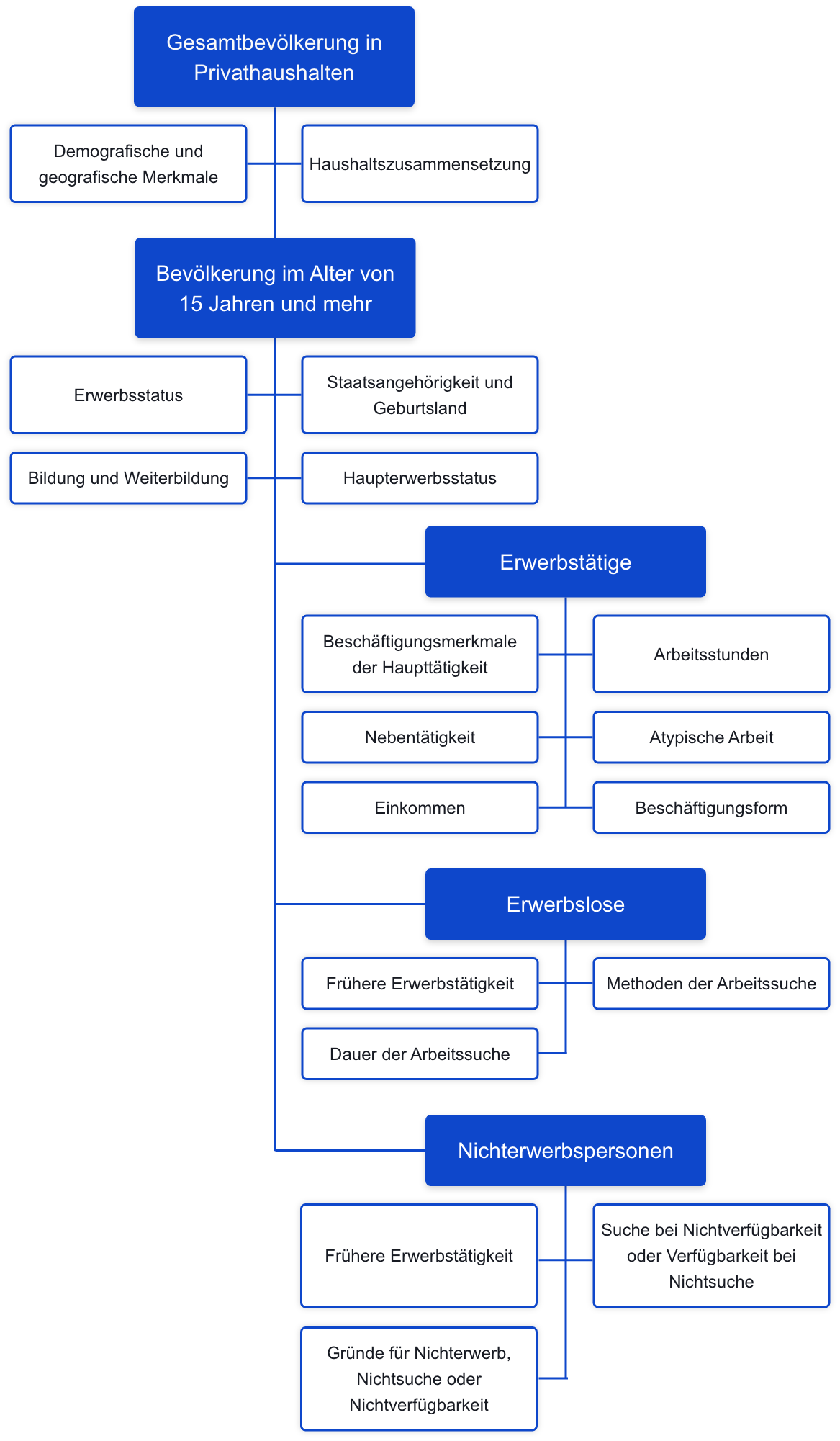
Das wichtigste statistische Ziel der EU-Arbeitskräfteerhebung (EU-AKE) besteht darin, beschreibende und erklärende Daten zu jeder der drei Gruppen beschäftigt, arbeitslos und außerhalb der Erwerbsbevölkerung bereitzustellen.
Die demografischen Daten werden für alle Altersgruppen der Bevölkerung erhoben, die Fragen zum Arbeitsmarktstatus beschränken sich aber auf Personen der Altersgruppe 15 Jahre und älter.
Je nach Erwerbsstatus einer Person, d. h. ob sie erwerbstätig, arbeitslos oder außerhalb der Erwerbsbevölkerung ist, werden unterschiedliche Daten erhoben.
Typologie zur Klassifikation der statistischen Information (Variablen) in der EU-AKE
Die wichtigsten Definitionen
Erwerbstätige: Personen im Alter von 15 bis 89 Jahren (in vollendeten Jahren am Ende der Bezugswoche), die in der Bezugswoche unter eine der folgenden Kategorien fielen:
- Personen, die in der Bezugswoche mindestens 1 Stunde gegen Entgelt oder zur Erzielung eines Gewinns arbeiteten, einschließlich mithelfender Familienangehöriger (6);
- Personen mit einer Stelle oder einem Unternehmen, die während der Bezugswoche vorübergehend nicht gearbeitet haben, jedoch eine Bindung an den Arbeitsplatz hatten; dabei wird bei folgenden Gruppen von einer Bindung an den Arbeitsplatz ausgegangen:
- Personen, die aufgrund von Urlaub, Arbeitszeitgestaltung, Krankheitsurlaub, Mutterschafts- oder Vaterschaftsurlaub nicht gearbeitet haben;
- Personen, die eine berufsbezogene Fortbildung absolvieren;
- Personen in Elternurlaub, die entweder arbeitsplatzbezogene Einnahmen oder Leistungen beziehen und/oder einen Anspruch darauf haben oder deren Elternurlaub voraussichtlich 3 Monate oder weniger beträgt;
- Saisonarbeitnehmer in der Nebensaison, soweit sie weiterhin regelmäßig Aufgaben und Pflichten für die Stelle beziehungsweise das Unternehmen, ausgenommen rechtliche oder administrative Verpflichtungen, erfüllen;
- Personen, die aus anderen Gründen vorübergehend nicht arbeiten, wenn die voraussichtliche Dauer der Abwesenheit 3 Monate oder weniger beträgt;
- Personen, die landwirtschaftliche Erzeugnisse herstellen, deren Hauptanteil zum Verkauf oder zum Tausch bestimmt ist.
Arbeitslose: Personen im Alter von 15 bis 74 Jahren (in vollendeten Jahren am Ende der Bezugswoche), die
- in der Bezugswoche im Sinne der Begriffsbestimmung wie oben beschrieben keine Arbeitnehmer waren und
- aktuell für eine Arbeit verfügbar waren, d. h. vor Ablauf von 2 Wochen im Anschluss an die Bezugswoche für eine abhängige Beschäftigung oder selbstständige Erwerbstätigkeit verfügbar waren, und
- aktiv nach Arbeit suchten, d. h. entweder in dem mit der Bezugswoche endenden vierwöchigen Zeitraum auf der Suche nach einer abhängigen Beschäftigung oder einer selbstständigen Erwerbstätigkeit waren oder eine Tätigkeit gefunden haben, die innerhalb eines Zeitraums von höchstens 3 Monaten nach Ablauf der Bezugswoche aufgenommen wird.
Die Erwerbsbevölkerung setzt sich aus den erwerbstätigen und den arbeitslosen Personen zusammen.
Personen außerhalb der Erwerbsbevölkerung, d. h. Menschen die weder erwerbstätig noch arbeitslos sind.
Weiterführende Informationen
Überblick über die Konzepte und andere methodische Fragen:
Ausführliche Informationen über die Klassifizierungen, den Zugang zu den Erläuterungen, die Benutzeranleitung und die nationalen Fragebögen, die für die Datenerhebung verwendet werden, finden Sie in dem Artikel EU labour force survey – documentation.
Die wichtigsten Entwicklungen der EU-AKE werden in dem Artikel EU labour force survey – development and history beschrieben.
Direkter Zugang zu den Erläuterungen mit detaillierten Informationen über die Definition der einzelnen Variablen: