
Energy in Europe – 2026 edition
Lighting, heating, moving, producing: energy is vital for our day-to-day life.
Without energy, people and businesses cannot function. Turning on our computers or starting our cars are actions that we take for granted, yet they represent the final stage of a complex process.
This publication helps to make the complex topic of energy more understandable. It is aimed at the needs of those who are not familiar with the energy sector as well as more experienced users.
Energy sources
This section focuses on the different energy sources available in the EU – the energy produced in the EU as well as the energy imported.

48% of energy produced in the EU in 2024 came from renewables.
Energy mix
The energy available in the European Union (EU) comes from energy produced in the EU and from energy imported from non-EU countries. Therefore, to get a good overview of the total energy available in the EU, energy production should always be put into context alongside imports.
In 2024, the EU produced 43% of its own energy, while 57% was imported.
Petroleum products have the largest share in the EU energy mix
In 2024, the energy mix in the EU, meaning the range of energy sources available, mainly consisted of 5 different sources:
- crude oil and (38%)
- natural gas (21%)
- (20%)
- (12%)
- (10%)
In 2024, the shares of different energy sources in the varied considerably among EU countries:
- petroleum products in available energy was highest in Cyprus (86%), Malta (85%) and Luxembourg (60%)
- natural gas was a significant energy source in Italy (36%), the Netherlands (31%), Hungary and Ireland (both 29%)
- renewables was highest in Sweden (48%), Latvia (46%) and Denmark (43%)
- nuclear energy accounted for 40% of energy available in France, Slovakia (30%) and Sweden (26%)
- solid fuels was highest in Estonia (50%), Poland (34%) and Czechia (26%)
For more information
Energy production
The in the EU is spread across a range of different energy sources: , natural gas, crude oil, , and (such as hydro, wind and solar energy).
Renewable energies account for the highest share in energy production
Renewable energy (48% of total EU energy production) was the largest contributing source to energy production in the EU in 2024. Nuclear energy (28%) was the second largest source, followed by solid fuels (15%), natural gas (5%) and crude oil (3%).
However, in 2024, the production of energy is very different among EU countries:
- Renewable energy was the exclusive source of energy production in Malta (100%). High shares were also recorded in Latvia (99%), Portugal (98%) and Cyprus (96%). In 17 other EU countries, renewable energy made up at least half of their energy production
- Production of nuclear energy was quite significant in France (71%) of total national energy production followed by Slovakia (67%) and Belgium (56%)
- Solid fuels were the main source of energy produced in Poland (65%), Estonia (51%) and Czechia (39%)
- Natural gas had the largest share in Romania and the Netherlands (both 36%), Ireland (30%) and Croatia (15%)
- Crude oil had the largest share in Denmark (29%), followed by Croatia (15%), Romania and Italy (both 13%)
Energy imports and imports dependency
In 2024, the main imported energy product category was oil and petroleum products (including crude oil, which is the main component), accounting for 67% of energy imports into the EU, followed by natural gas (24%), (4%), electricity (3%), and renewable energy (2%).
Different patterns among EU countries
In 2024, EU countries' energy imports had the highest shares of:
- oil and petroleum products in Cyprus (96%), Malta (86%), Sweden (85%) and Greece (84%)
- natural gas in Italy (37%), Denmark (33%), Germany and France (both 29%)
- solid fossil fuels in Slovakia (15%), Czechia and Austria (both 11%) and Germany (9%)
- electricity in Estonia (21%), Luxembourg (16%) and Slovenia (13%)
- renewable energy in Denmark (10%), Latvia (7%) and Luxembourg (5%)
Click on the link below to discover your country's main trading partners and the different trade flows.

EU main suppliers in 2024: The United States for oil and petroleum products, Norway for natural gas, Australia for solid fossil fuels
For its own consumption, the EU also needs energy that is imported from non-EU countries. In 2024, the largest shares of EU's imports for different products were:
- oil and petroleum products from the United States (16%), Norway (12%), Kazakhstan (9%), Saudi Arabia (8%), the United Kingdom and Libya (both 6%). These countries accounted for 57% of the extra-EU imports of oil and petroleum products
- natural gas from Norway (30%), the United States (17%), Algeria and Russia (both 14%). These countries accounted for 75% of the extra-EU imports of natural gas
- solid fossil fuel imports (mostly coal) originated from Australia (31%), followed by the United States (28%), Colombia (15%), Kazakhstan (8%) and South Africa (6%). These countries accounted for 88% of the extra-EU imports of solid fossil fuel
EU energy imports dependency rate: 57% in 2024
The shows the extent to which an economy relies upon imports to meet its energy needs. It is measured by the share of net imports (imports minus exports) in gross inland energy consumption (meaning the sum of energy produced and net imports).
In the EU in 2024, the energy imports dependency rate was 57%, which means that nearly 60% of the EU’s energy needs were met by net imports. However, the dependency rate varied across the EU countries, ranging from 98% in Malta, 91% in Luxembourg and 88% in Cyprus to 5% in Estonia.
Energy consumption
This section presents the different types of energy consumed, electricity and energy prices, and outlines the energy flows from production to final consumption.

31% of energy in the EU in 2024 were consumed by the transport activities.
Types of energy consumed
In 2024, out of the in the EU, 66% was (final energy consumption), for example EU households, industry, and transport. The remaining 34% was mainly lost during electricity generation and distribution, used to support energy production processes, or consumed in non-energy uses (like asphalt or bitumen).
Petroleum products are the most consumed
In the EU in 2024, (such as heating oil, petrol, diesel fuel) represented 37% of final energy consumption, followed by electricity (23%), natural and manufactured gas (20%), direct use of (not transformed into electricity, for example wood, solar thermal, geothermal or biogas for space heating or hot water production; 12%), (such as district heating; 5%) and (mostly coal; 2%).
The real consumption of renewable energy (25%) was higher than the direct use (12%) because other renewable sources, such as hydropower, wind power and solar photovoltaic, are included in electricity use.
Within the EU countries, the final energy consumption pattern varied considerably in 2024. Petroleum products made up more than 50% of final energy consumption in Cyprus, Greece, Luxembourg, Malta and Ireland. Electricity accounted the highest share of 41% in Malta. For gas, the largest share was 33% in the Netherlands. The direct use of renewable energies represented 28% of final energy consumption in both Latvia and Finland. The derived heat recorded the largest share in Denmark 21%.
Transport activities: 31% of EU's final energy consumption
In in the EU, the different had the following shares in final energy consumption:
- 31% of energy consumption was attributed to transport (rail, road, domestic aviation, and inland shipping), with road transport (mostly cars and vans) representing nearly the entire share
- 27% was used by private households in citizens' homes, with space heating accounting for two-thirds of this consumption
- 25% went to industry, with the chemical and petrochemical sectors being the largest sub-sector, accounting for one-fifth of the energy in this group
- 13% was consumed by commercial and public services, with wholesale and retail trade being the largest sub-sector, also accounting for one-fifth of the energy used in this sector
- 3% agriculture, forestry and fishing
From production to final consumption
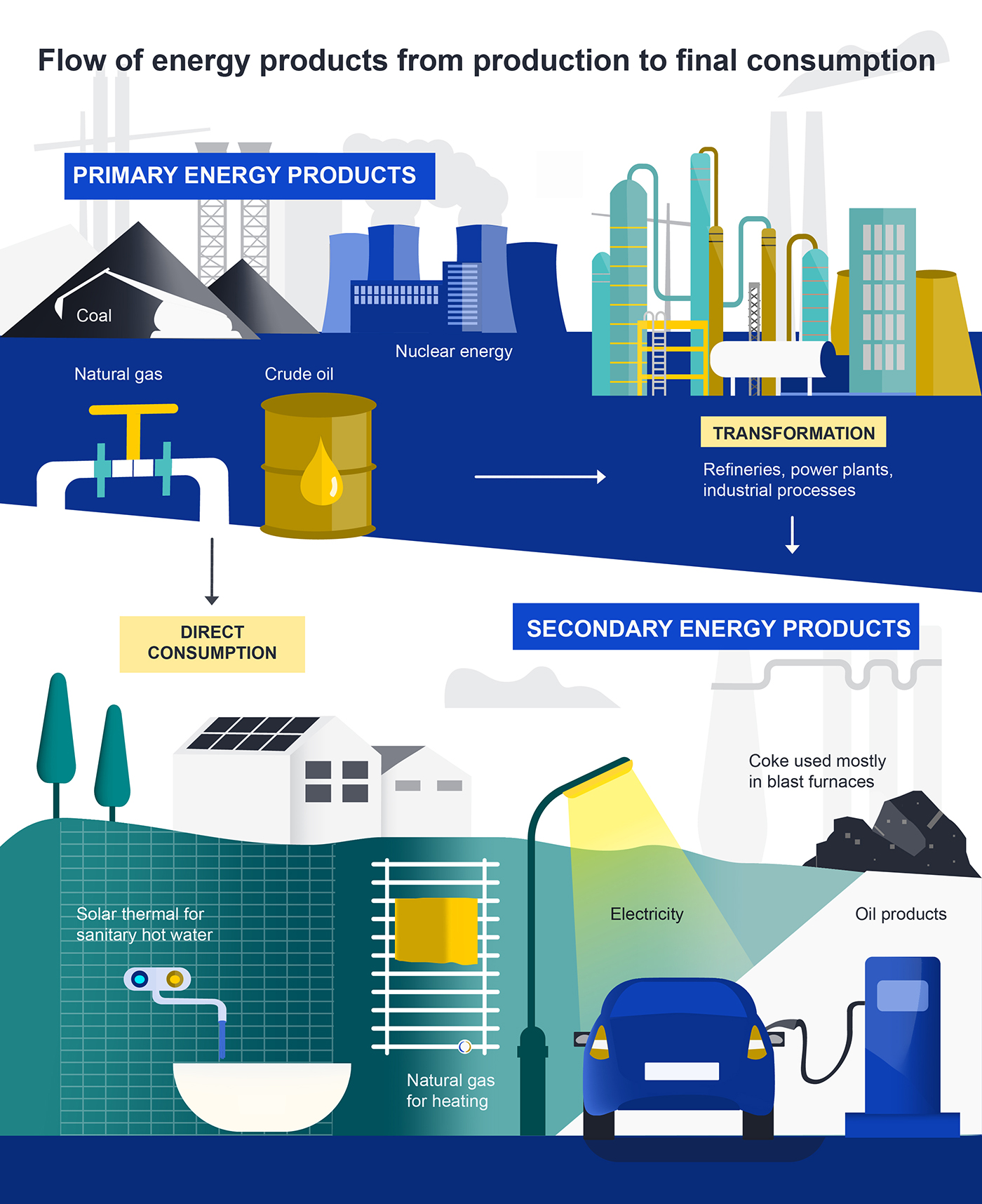
To properly interpret energy statistics, it is necessary to distinguish between primary and secondary energy products. A primary energy product is extracted or captured directly from natural resources, such as crude oil, firewood, natural gas or coal. This process is called primary production.
Secondary energy products (such as electricity or motor gasoline) are produced as a result of a transformation process, either from a primary or from a different secondary energy product. Final consumers can use primary (for example natural gas for heating) or secondary energy products (such as motor gasoline to fill up their car tank).
Electricity production
From source to switch
Renewables and fossil fuels come top in electricity production in the EU
In 2024 in the EU, 23% of the was which came from various sources. (48%) and (28%) were the leading sources in electricity production ahead of nuclear power plants (23%).
Among renewable sources, the highest share of electricity came from wind turbines (17%), hydropower plants (13%), solar power (11%) and biofuels (nearly 6%).
The sources of electricity production vary among the EU countries. In 2024, the highest share of fossil fuels in electricity production was recorded in Malta (85%), while nearly 67% came from nuclear power plants in France. In Denmark, 58% of electricity production came from wind energy, while 58% in Austria came from hydro power plants. The highest share of solar power was recorded in Hungary and Luxembourg (both 24%), while for biofuels it was in Luxembourg 29%.
Electricity and gas prices
In order to compare prices of electricity and gas among the EU countries, national prices have been converted into euro. Exchange rate fluctuations can influence prices expressed in euro for non-euro area countries.
Highest electricity prices, for households, in Germany, Belgium and Denmark
In the first half of 2025, household electricity prices, including taxes and levies, were highest in Germany (€38 per 100 kWh), Belgium (€36 per 100kWh) and Denmark (€35), while the lowest prices were recorded in Hungary (€10), Malta (€12) and Bulgaria (€13).
The share of taxes and levies in the electricity price was largest in Denmark (48%) followed by Poland (42%) and Sweden (35%), while it was lowest in the Netherlands (−14%), Ireland (−7%) and Luxembourg (−6%), where the values were negative due to subsidies and allowances given to household consumers.
For non-household consumers, electricity prices (excluding VAT and other recoverable taxes and levies) ranged from €27 per 100 kWh in Ireland to €8 per 100 kWh in Finland.
Gas prices for household consumers highest in Sweden, the Netherlands and Denmark
In the first half of 2025, natural gas prices for household consumers, including taxes and levies, were highest in Sweden (€21 per 100 kWh), the Netherlands (€16) and Denmark (€13), and lowest in Hungary (€3), Croatia (€5) and Romania (€6).
The share of taxes and levies in gas price was highest in the Netherlands (54%) and Denmark (48%), while it was lowest in Croatia (5%) and Greece (8%).
Natural gas prices for non-household consumers (excluding VAT and other recoverable taxes and levies) were the highest in at €11 per 100 kWh. The lowest prices of €5 per 100 kWh were recorded in Bulgaria, Greece, Belgium, Spain, Croatia, Lithuania and Portugal.
For more information
Energy flows
An energy balance presents energy products (solid fossil fuels, oil and petroleum products, gas, renewable energies, nuclear heat, electricity, etc.) of a country and their production, transformation, and consumption by different types of economic actors (industry, transport, etc.). It allows users to see the total amount of energy extracted from the environment, traded, transformed, and used by end-users.
Energy balances can be graphically represented through flow diagrams (also called Sankey diagrams), which allow users to visualise the interrelation of energy commodities in a more illustrative and intuitive way. These flows can be combined, split and traced through a series of events or processing stages.
Click on the link below to open the tool and build your own diagram!

For more information
Energy and environment
This section presents data on greenhouse gas emissions, energy efficiency and renewable energy.

25% of energy consumed in the EU in 2023 came from renewables.
Net greenhouse gas emissions
Climate change is a threat to sustainable development. Man-made emissions are primarily a by-product of burning of fuels in power plants, cars or homes. Farming and waste decay in landfills are also sources of GHG emissions. The EU has set itself ambitious goals to bring down energy costs for households and business, reduce emissions, and invest in clean energy.
GHG emissions in the EU fell by 36% between 1990 and 2023. The EU has set a legally binding target to achieve climate neutrality by 2050 and reduce net GHG emissions by at least 55% in 2030 and 90% 2040, compared to 1990. For 2040 the Commission has proposed a 90% reduction as an intermediate target.
Net GHG emissions were below 1990 levels in 23 EU countries. The largest decreases were recorded in Romania (−70%), Lithuania (−68%) and Estonia (−64%), while the biggest increases were in Cyprus (58%), Sweden (37%) and Austria (13%).
Land use, land use change and forestry set off 7% of GHG emissions in the EU in 2023
In 2023 in the EU, fuel combustion in transport had the highest share in total GHG emissions (30%), ahead of fuel combustion by energy users (excluding transport) (26%) and the energy producing industries sector (24%). In 1990, the shares were 15%, 30% and 33%, respectively.
Contrary to the other sectors, the sector ‘land use, land use change, and forestry’ (LULUCF) can act as a net sink setting off other sectors' GHG emissions. This happens if plants remove more CO2 from the atmosphere than greenhouse gases are emitted from other components within the LULUCF sector, such as converting land into settlements.
In the EU, LULUCF compensated for 6% of the emissions of the other sectors, with the highest share recorded in Sweden (70%), followed by Romania (45%), Lithuania and Croatia (both 29%). At the opposite end of the scale, in Latvia, LULUCF contributed 46% to the GHG emissions.
The CO2 reduction plans for future include permanent carbon storage through industrial technologies, such as bioenergy with carbon capture and storage, and direct air capture with capture and storage.
Energy efficiency
One of the priorities of the energy union strategy is to increase energy efficiency, mainly by cutting the EU’s overall energy use and managing energy in a more cost-effective way. Improving energy efficiency helps to achieve energy savings, protect the environment, mitigate climate change and reduce the EU's reliance on external suppliers of oil and gas.
To use less energy, we need to cut down on 2 things:
- : This is the total energy a country needs, including the energy used to produce and deliver energy to us.
- : This is the energy we actually use in our homes, cars, and businesses, not including what the energy sector uses or loses along the way.
Improving energy efficiency means reducing both the overall energy demand and what each of us uses directly.
Energy consumption down in 2024
In 2024 in the EU, primary energy consumption reached 1 209 (Mtoe). This is 9% lower than in 2014 and 22% away from the 2030 target (992.5 Mtoe).
When comparing 2024 with 2014, primary energy consumption decreased in 18 EU countries, most notably in Estonia (−26%), Germany (−23%) and France (−15%). On the other side, in Cyprus it increased by 18%, followed by Croatia (15%) and Lithuania (14%).
Final energy consumption of the EU in 2024 was 901 Mtoe. This is 2% lower than in 2014 and 18% away from the 2030 target (763 Mtoe).
When comparing 2024 with 2014, primary energy consumption decreased in 11 EU countries. The highest decrease recorded in Luxembourg (−12%), followed by Germany (−10%) and the Netherlands (−9%). On the other side, in Malta increased by 35%, followed by Croatia and Cyprus (both 19%) as well as Poland and Lithuania (both 15%).
For more information
Renewable energy
From wind to watts
Share of renewable energy almost tripled between 2004 and 2024
In 2024, the share of in the EU's gross final energy consumption was 25%, up from 17% in 2014 and 10% in 2004. The current EU target is to reach a minimum of 42.5% renewables by 2030.
Sweden had by far the highest share of renewables in energy consumption (63%) in 2024, primarily relying on solid biomass, hydro and wind. It was followed by Finland (52%) and Denmark (47%). The lowest proportions of renewables were recorded in Belgium (14%), Luxembourg (15%), and Malta (16%). Differences are partly due to variations in economic conditions and the availability of natural resources, including abundant wind, solar energy (sunlight), flowing water to build hydropower plants and biomass.
Glossary
Bunkers include all dutiable petroleum products loaded aboard a vessel for consumption by that vessel. International maritime bunkers describe the quantities of fuel oil delivered to ships of all flags that are engaged in international navigation. It is the fuel used to power these ships. International navigation may take place at sea, on inland lakes and waterways, and in coastal waters. International maritime bunkers do not include fuel oil consumption by:
- ships engaged in domestic navigation (whether a vessel is engaged in domestic or international navigation is determined only by the ship's port of departure and port of arrival — not by the flag or nationality of the ship)
- fishing vessels
- military forces.
Combined heat and power describes the simultaneous production of both useful heat (that can be used, for example, in industrial processes or city heating schemes) and electricity in a single process or unit.
Derived heat is used for warming spaces and for industrial processes and is obtained by burning combustible fuels like coal, natural gas, oil, renewables (biofuels) and wastes, or also by transforming electricity to heat in electric boilers or heat pumps.
City heating, also known as district heating, is the distribution of heat through a network to one or several buildings using hot water or steam produced centrally, often from co-generation plants, from waste heat from industry, or from dedicated heating systems.
Electricity denotes the set of physical phenomena related to electrical charges. It allows energy to be stored and transferred, or to be consumed through electrical appliances. It has a very wide range of applications in almost all kinds of human activities ranging from industrial production, household use, agriculture or commerce and it is normally used for running machines, lighting, and heating.
The energy imports dependency rate shows the proportion of energy that an economy must import. It is defined as net energy imports (imports minus exports) divided by gross inland energy consumption plus fuel supplied to international maritime bunkers, expressed as a percentage. A negative dependency rate indicates a net exporter of energy while a dependency rate more than 100 % indicates that energy products have been stocked.
Energy intensity measures the energy consumption of an economy and its energy efficiency. It is the ratio between gross inland consumption of energy and gross domestic product (GDP). Gross inland consumption of energy is calculated as the sum of gross inland consumption of five energy types: coal, electricity, oil, natural gas and renewable energy sources. The GDP figures are taken at constant prices to avoid the impact of inflation. Since gross inland consumption is measured in kilograms of oil equivalent and GDP in EUR 1 000, this ratio is measured in kgoe per EUR 1 000.
Energy end user categories include private households, agriculture, industry, road transport, air transport (aviation), other transport (rail, inland navigation) and services.
Final energy consumption is the total energy consumed by end users, such as households, industry, and agriculture. It is the energy which reaches the final consumer's door and excludes that which is used by the energy sector itself. Final energy consumption excludes energy used by the energy sector, including for deliveries, and transformation. It also excludes fuel transformed in the electrical power stations of industrial auto-producers and coke transformed into blast-furnace gas where this is not part of overall industrial consumption but of the transformation sector. Final energy consumption in 'households, services, etc.' covers quantities consumed by private households, commerce, public administration, services, agriculture, and fisheries.
Fossil fuel is a generic term for non-renewable natural energy sources such as coal, natural gas and oil that were formed from plants and animals (biomass) that existed in the geological past (for example, hundreds of millions of years ago). Fossil fuels are carbon-based and currently meet most human energy requirements.
Gas includes mostly natural gas and derived gases.
A gigajoule, abbreviated as GJ, is a unit of measurement of energy consumption: a gigajoule is equal to one thousand million joules.
Gigawatt-hour, abbreviated as GWh, is a unit of energy representing one billion (1 000 000 000) watt-hours and is equal to one million kilowatt-hours. Gigawatt-hours are often used as a measure of the output of large electricity power stations.
Greenhouse gases constitute a group of gases contributing to global warming and climate change. The Kyoto Protocol, an environmental agreement adopted by many of the parties to the United Nations Framework Convention on Climate Change (UNFCCC) in 1997 to curb global warming, covers six greenhouse gases: carbon dioxide (CO2), methane (CH4), nitrous oxide (N2O), and the so-called F-gases (hydrofluorocarbons and perfluorocarbons) and sulphur hexafluoride (SF6). Converting them to carbon dioxide (or CO2) equivalents makes it possible to compare them and to determine their individual and total contributions to global warming.
Gross available energy means the overall supply of energy for all activities on the territory of the country. It includes energy needs for energy transformation (including generating electricity from combustible fuels), support operations of the energy sector itself, transmission and distribution losses, final energy consumption (industry, transport, households, services, agriculture, ...) and the use of fossil fuel products for non-energy purposes (e.g., in the chemical industry). It also includes fuel purchased within the country that is used elsewhere (e.g., international aviation, international maritime bunkers and, in the case of road transport “fuel tourism”).
Gross inland energy consumption, sometimes abbreviated as gross inland consumption, is the total energy available of a country or region. It represents the quantity of energy necessary to satisfy inland consumption of the geographical entity under consideration. Gross inland energy consumption covers consumption by the energy sector itself; distribution and transformation losses; final energy consumption by end users; 'statistical differences' (not already captured in the figures on primary energy consumption and final energy consumption). Gross inland consumption does not include energy (fuel oil) provided to international maritime bunkers. It is calculated as primary production plus recovered products, net imports and variations of stocks minus maritime bunkers.
Gross electricity generation or gross electricity production refers to the process of producing electrical energy. It is the total amount of electrical energy produced by transforming other forms of energy, for example nuclear or wind power. It is commonly expressed in gigawatt-hours (GWh). Total gross electricity generation covers gross electricity generation in all types of power plants. The gross electricity generation at plant level is defined as the electricity measured at the outlet of the main transformers, i.e., including the amount of electricity used in the plant auxiliaries and in the transformers.
Kilogram(s) of oil equivalent, usually abbreviated as kgoe, is a normalised unit of energy. By convention, it is equivalent to the approximate amount of energy that can be extracted from one kilogram of crude oil (41 868 kilojoules = 41.868 megajoules). It is a standardised unit and may be used to compare the energy from different sources.
Kilowatt-hours, abbreviated as kWh, is a unit of energy representing one thousand watt-hours. Kilowatt-hours are often used as a unit when measuring domestic energy consumption.
Net electricity production or net electricity generation is equal to gross electricity production (or generation) minus the consumption of power stations' auxiliary services.
Nuclear heat is the thermal energy produced in a nuclear power plant (nuclear energy). It is obtained from the nuclear fission of atoms, usually of uranium and plutonium.
Primary production of energy is any extraction of energy products in a useable form from natural sources. This occurs either when natural sources are exploited (for example, in coal mines, crude oil fields, hydro power plants) or in the fabrication of biofuels. Transforming energy from one form into another, such as electricity or heat generation in thermal power plants (where primary energy sources are burned), or coke production in coke ovens, is not primary production.
Renewable energy sources, also called renewables, are energy sources that replenish (or renew) themselves naturally. Renewable energy sources include the following:
Ambient heat (heat pumps): heat pumps that are driven by electricity or other supplementary energy, to extract (stored) energy from the air, the ground or the water and converts/transfers this into energy to be used elsewhere (e.g., to heat space via underfloor heating systems and/or water in domestic buildings).
Biomass (solid biofuels): organic, non-fossil material of biological origin, which may be used for heat production or electricity generation. It includes charcoal; wood and wood waste; black liquor, bagasse, animal waste and other vegetal materials and residuals.
Biogases: gases composed principally of methane and carbon dioxide produced by anaerobic fermentation of biomass, or by thermal processes. It includes landfill gas; sewage sludge gas; other biogases from anaerobic digestion; biogases from thermal processes.
Liquid biofuels are liquid fuels from a non-fossil biological origin and a renewable energy source, to be distinguished from fossil fuels. Biofuels can be split up into four categories: bio gasoline, biodiesel, bio jet kerosene (aviation fuel) and other liquid biofuels.
Renewable waste: portion of waste produced by households, industry, hospitals, and the tertiary sector which is biological material collected by local authorities and incinerated at specific installations.
Hydropower: the electricity generated from the potential and kinetic energy of water in hydroelectric plants (the electricity generated in pumped storage plants is not included).
Geothermal energy: the energy available as heat from within the Earth’s crust, usually in the form of hot water or steam.
Wind energy: the kinetic energy of wind converted into electricity in wind turbines.
Solar energy: solar radiation exploited for solar heat (hot water) and electricity production.
Tide, wave, ocean: mechanical energy derived from tidal movement, wave motion or ocean current and exploited for electricity generation.
Solid fossil fuels cover various types of coals and solid products derived from coals. They consist of carbonised vegetable matter and usually have the physical appearance of a black or brown rock.
Tonne(s) of oil equivalent, abbreviated as toe, is a normalised unit of energy. By convention it is equivalent to the approximate amount of energy that can be extracted from one tonne of crude oil (41 868 megajoules = 41.868 gigajoules). It is a standardised unit and may be used to compare the energy from different sources.
Total fuels is the sum of all energy products and is composed of the following fuel families: Solid fuels (coal), total petroleum products (crude oil and derived petroleum products), gas, nuclear heat, derived heat, renewable energies, electricity and waste (non-renewable).
Total petroleum products are fossil fuels (usually in liquid state) and include crude oil and all products derived from it (e.g., when processed in oil refineries), including motor gasoline, diesel oil, fuel oil, etc.
Waste (non-renewable) consists of materials coming from combustible industrial, institutional, hospital and household wastes such as rubber, plastics, waste fossil oils and other similar types of wastes, which can be either solid or liquid.
Give us your feedback
About this publication
Energy in the EU is an interactive publication released by Eurostat, the statistical office of the European Union.
Information on data
Data shown in the visualisations are linked directly to the online database (and thus accordingly updated) up to the reference period mentioned in each visualisation. The accompanying text was finalised during early March 2026 and reflect the data situation at that moment in time. The energy interactive tools referred to in the publication are continuously updated.
Users who want more information about metadata should click on the links (‘access to dataset’) that are provided as part of the source under each visualisation. Once the database opens, there is an icon in the top-right corner that provides ‘explanatory texts’ for metadata.
The data presented in this publication are complemented by additional codes (flags) that are used to explain and define specific characteristics of data. The full set of flags is available on Eurostat’s website via the link to the dataset provided below each visualisation.
The release and update dates for all statistical indicators are published in the Eurostat release calendar.
For more information
- Thematic section on energy statistics
- Database on energy statistics
- Statistics Explained articles on energy
- Statistics Explained articles on environment and energy
- Statistics Explained articles on climate change mitigation
- Statistics 4 beginners articles on energy statistics
- Interactive visualisations on energy
Contact
If you have questions on the data, please contact Eurostat user support.
Copyright and re-use policy
This publication should not be considered as representative of the European Commission’s official position.
© European Union, 2026
The reuse policy of European Commission documents is implemented based on Commission Decision 2011/833/EU of 12 December 2011 on the reuse of Commission documents (OJ L 330, 14.12.2011, p. 39).
Except otherwise noted, the reuse of this document is authorised under a Creative Commons Attribution 4.0 International (CC-BY 4.0) licence. This means that reuse is allowed provided appropriate credit is given and any changes are indicated.
For any use or reproduction of elements that are not owned by the European Union, permission may need to be sought directly from the respective rightholders. The European Union does not own the copyright in relation to the following elements:
Cover photo: © Nuttapon / stock.adobe.com
Energy sources: © Kampan / stock.adobe.com
Energy consumption: © am / stock.adobe.com
Energy and environment: © Bits and Splits / stock.adobe.com
For more information, please consult our page on copyright notice and free re-use of data.
Identifiers
Catalogue number: KS-01-26-007-EN-Q
ISBN 978-92-68-36597-7
ISSN 2600-3368
doi:10.2785/0794090
Share