Reference metadata describe statistical concepts and methodologies used for the collection and generation of data. They provide information on data quality and, since they are strongly content-oriented, assist users in interpreting the data. Reference metadata, unlike structural metadata, can be decoupled from the data.
Instituto Nacional de Estatística / Statistics Portugal
1.2. Contact organisation unit
Business Statistics Unit, Department of Economic Statistics
1.3. Contact name
Confidential because of GDPR
1.4. Contact person function
Confidential because of GDPR
1.5. Contact mail address
Av. António José de Almeida
1000-043 Lisboa
Portugal
1.6. Contact email address
Confidential because of GDPR
1.7. Contact phone number
Confidential because of GDPR
1.8. Contact fax number
Confidential because of GDPR
2.1. Metadata last certified
10 March 2026
2.2. Metadata last posted
10 March 2026
2.3. Metadata last update
10 March 2026
3.1. Data description
Data on the Information and Communication Technologies (ICT) usage and e-commerce in enterprises are survey data. They are collected by the National Statistical Institutes or Ministries and are in principle based on Eurostat's annual model questionnaires on ICT usage and e-commerce in enterprises.
The legal basis for ICT enterprise statistics for survey year 2025 is Commission Implementing Regulation (EU) 2024/1883 of 9 July 2024 laying down the technical specifications of data requirements for the topic 'ICT usage and e-commerce' for the reference year 2025. Large part of the data collected is used to support measuring the implementation and monitoring of the EU’s digital targets for 2030, set by the Digital Decade Policy Programme.
Four of the key performance indicators (KPIs) of the current programme stem from the statistics for which the implementing and delegated acts are enclosed for adoption: Artificial Intelligence, cloud, data analytics and the digital intensity index (DII) - a composite indicator reflecting the digital transformation of business
The aim of the European survey on ICT usage and e-commerce in enterprises is to collect and disseminate harmonised and comparable information at European level.
Name of data collection
Inquérito à Utilização de Tecnologias da Informação e da Comunicação nas Empresas 2025
All economic activities in the scope of Annex of the Commission Regulation are intended to be included in the general survey, covering enterprises with 10 or more employees and self-employed persons. These activities are:
Section C - “Manufacturing”
Section D, E - “Electricity, gas, steam and air conditioning supply”, “Water supply, sewerage, waste management and remediation activities”
Section F - “Construction”
Section G - “Wholesale and retail trade; repair of motor vehicles and motorcycles”
Section H - “Transportation and storage”
Section I - “Accommodation and food service activities”
Section J - “Information and communication”
Section L - “Real estate activities”
Section M - “Professional, scientific and technical activities”
Section N - "Administrative and support service activities"
Group 95.1 - “Repair of computers and communication equipment”.
For micro-enterprises see the sub-concepts in the full metadata view.
3.3.1. Coverage-sector economic activity for micro-enterprises - All NACE categories are covered
Micro-enterprises are not included in the survey
3.3.2. Coverage sector economic activity for micro-enterprises - If not all activities were covered, which ones were covered?
Not applicable.
3.4. Statistical concepts and definitions
The model questionnaire on ICT usage and e-commerce in enterprises provides a large variety of variables covering among others the following topics:
Access and use of the Internet
E-commerce sales
Data utilisation and analytics
Use of cloud computing services
Artificial intelligence
ICT and the environment.
The annual model questionnaires and the European businesses statistics compliers’ manual for ICT usage and e-commerce in enterprises comprise definitions and explanations regarding the topics of the survey.
The statistical unit is the enterprise (sampling at ENT level and data collection at LeU level).
3.6. Statistical population
Target Population
As required by Annex of the Commission Implementing Regulation, enterprises with 10 or more employees and self-employed persons are covered by the survey.
For micro-enterprises see the sub-concepts below.
3.6.1. Coverage of micro-enterprises
No
3.6.2. Breakdown between size classes [0 to 1] and [2 to 9]
No
3.6.3. If for micro-enterprises different size delimitation was used, please indicate it.
Not applicable.
3.7. Reference area
Detailed information on the provision of data on NUTS 2 regional level is available in “Annex I. Completeness“.
The whole national territory was considered (Continente, Região Autónoma dos Açores and Região Autónoma da Madeira).
3.8. Coverage - Time
Years 2024 and 2025.
3.9. Base period
Not applicable.
Percentages of enterprises, Percentages of turnover, Percentages of employees and self-employed persons, Million euro (for selected indicators).
Where not specified the reference period is current situation (survey period in 2025). Year 2024 for the value or % of sales data and where specified.
6.1. Institutional Mandate - legal acts and other agreements
At the community level, there are a number of legal diplomas that constitute the legal basis for the survey on the use of ICT in enterprises:
Commission Regulation (EU) 2016/2015 of 17 November 2016 implementing Regulation (EC) no. 808/2004 of the European Parliament and of the Council concerning Community statistics on the information society;
Commission Implementing Regulation (EU) 2024/1883 of 9 July 2024 laying down the technical specifications of data requirements and the deadlines for submission of metadata and quality reports for the topic Information and Communication Technologies usage and e-commerce for the reference year 2025, pursuant to Regulation (EU) 2019/2152 of the European Parliament and of the Council.
Statistics Portugal makes available all non-confidential and sufficiently reliable data on its dissemination website, available at Statistics Portugal's website / INE website.
7.1. Confidentiality - policy
Regulation (EC) No 223/2009 on European statistics (recital 24 and Article 20(4)) of 11 March 2009 (OJ L 87, p. 164), stipulates the need to establish common principles and guidelines ensuring the confidentiality of data used for the production of European statistics and the access to those confidential data with due account for technical developments and the requirements of users in a democratic society.
At national level :
The Statistical Confidentiality Policy of Statistics Portugal is based on the Constitution of the Portuguese Republic, Law 22/2008 of 13 May, which establishes the principles, rules, and structure of the National Statistical System, and in particular the Principle of Statistical Confidentiality (Article 6), Regulation 223/2009 of 11 March (Article 20 et seq.), as amended by Regulation 2015/759 of 29 April 2015, establishing the legal framework for the development, production, and dissemination of European statistics and Regulation (EU) 557/2013, of 17 June 2013, as regards access to confidential data for scientific purposes. Breaking the statistical confidentiality is punishable both disciplinary and criminally in accordance with item 32 of the referred law.
It is also governed by the principles agreed between the EU Member States and inscribed in the European Statistics Code of Conduct (2nd revision/2017), in particular, Principle 5 on Statistical Confidentiality and, more broadly, the Fundamental Principles of Statistics Officials, established by the United Nations Statistical Commission in 1994 and approved by the United Nations General Assembly in January 2014 (Principle 6). Regarding the processing of personal data, the exercise of statistical activity also complies with Regulation (EU) 2016/679 of the European Parliament and of the Council of 27 April 2016, in its current wording, laying down rules for the protection of individuals with regard to the processing of personal data and to the free movement of such data and other applicable legislation in this matter. Please consult the Statistics Portugal's website for more information.
7.2. Confidentiality - data treatment
Data are transmitted via eDamis (encrypted) and delivered to a secure environment where they are treated. Flags are added for confidentiality in case results must not be disclosed.
At national level :
Data are transmitted via eDamis (encrypted) and delivered to a secure environment where they are treated. National Statistical Institutes are requested to add flags for confidentiality in case results must not be disclosed.
8.1. Release calendar
The national release calendar for the statistical outputs (final national data) for 2025 survey on ICT usage and e-commerce in enterprises is 21 November 2025.
In line with the Community legal framework and the European Statistics Code of Practice Statistics Portugal disseminates ICT usage and e-commerce data on its website respecting professional independence and in an objective, professional and transparent manner in which all users are treated equitably.
The Dissemination policy of Statistics Portugal lays down the fundamental principles governing the dissemination of official statistics, directly or indirectly produced under its responsibility. It should have as main reference the applicable principles of the National Statistical System: technical independence, statistical confidentiality, quality, and accessibility.
Annual
10.1. Dissemination format - News release
A "press release" with the results of the survey on ICT usage and e-commerce in enterprises 2025 will be released online on the Statistics Portugal Portal on 21st November 2025.
10.2. Dissemination format - Publications
No publication is foreseen, only a press release with results of the survey on ICT usage and e-commerce in enterprises 2025.
10.3. Dissemination format - online database
See detailed section 10.3.1.
10.3.1. Data tables - consultations
Results for selected variables collected in the framework of this survey are available for all participating countries on Digital economy and society of Eurostat website.
At national level:
The main indicators from the survey on ICT usage and e-commerce in enterprises 2025 are available on the Statistics Portugal Portal under the product "Database," in the theme "Research and Development," and the sub-theme "Information Society."
In the field of ICT usage and e-commerce in enterprises, researchers can access anonymised microdata in a way that does not allow the identification of the company.
The academic community has special statistical requirements, notably for carrying out research work and preparing Masters and Doctoral theses. In this context, Statistics Portugal has established a Protocol with the Ministry of Education and Science ("PT version only"), with a view to making it easier for researchers to access the statistics they need to carry out their activity.
For that purpose, the Direção Geral de Estatísticas da Educação e Ciência ("PT version only", Directorate-General for Education and Science Statistics, the Ministry’s former Planning, Strategy, Assessment and International Relations Office, DGEEC) gives interested parties prior accreditation, and also provides them with all the necessary information.
For each scientific research project, an application for accreditation must be made to DGEEC, which must include the following documents:
- Accreditation application form (only in Portuguese): pdf - Statement of commitment (only in Portuguese): pdf
Before proceeding with the accreditation request, please consult the databases accessible within the scope of this protocol. The accreditation of researchers is only made for access to the databases available under the project. Free access to statistical micro-databases for research purposes is only possible for accredited researchers, in accordance with the Protocol established with the Statistics Portugal.
Users can submit specific requests for data from the Statistics Portugal website.
10.5.1. Metadata - consultations
Not requested
10.6. Documentation on methodology
The European businesses statistics compilers’ manual for ICT usage and e-commerce in enterprises provides guidelines and clarifications for the implementation of the surveys.
At national level:
In each edition of the survey, Statistics Portugal prepares and publishes the methodological document of the statistical operation, in accordance with the model questionnaire as established by Eurostat and in line with The European Business Statistics Compilers’ Manual for ICT Usage and E-commerce in Enterprises, which provides guidelines and clarifications for the implementation of the surveys.
The unit responsible for the production of ICT usage and e-commerce data document all the work process and procedure for internal purposes. For more information about quality in statistics please consult the Statistics Portugal's website.
11.1. Quality assurance
The European businesses statistics compliers’ manual for ICT usage and e-commerce in enterprises provides guidelines and standards for the implementation of the surveys. It is updated every year according to the changed contents of the model questionnaires.
The Methodological Manual provides guidelines and standards for the implementation of the surveys in the Member States. It is updated every year according to the changed contents of the model questionnaires.
Statistics Portugal (SP) is the main authority for the production and dissemination of official statistics in Portugal and its work is steered by the underlying principles of its mission, vision and values, which are known to the public and are quality-oriented. What concerns the legal framework quality in statistics is defined by the Portuguese Statistical System Law, article 7 (Lei no. 22/2008, artigo 7º) and the Regulation (EC) no. 223/2009, (amended by the European Regulation 2015/759), at national and European levels respectively. SP is part of the European Statistical System (ESS) and has adopted the European Statistics Code of Practice – the Code – as firm guidance for the success of its mission. Since its last revision (November 2017), the Code comprises the Quality Declaration of the European Statistical System, 16 Principles and 84 indicators of best practices and standards for each of the Principles, defining the European benchmarks for the statistical activity, covering the institutional environment, statistical processes and statistical outputs. Please consult the Statistics Portugal's website for more information.
ICT enterprise data validation (path validations and consistency validations) is performed in the various stages of the information processing process, to identify registration faults and possible inconsistencies in the values of some variables. For all the questionnaires, the following procedures are performed: In the registration phase, the electronic form includes validations that allow verifying the consistency of the information (it may be necessary to contact the enterprise if incoherence is found). Inconsistencies of the "Error" type must be resolved before the registration is accepted. After the data registration is completed, the information is analysed and processed, namely the analysis of the consistency of the year's data, comparison of values with the previous year, and with the Business register for quality control. The collection management application allows the execution of warning error maps.
11.2. Quality management - assessment
At European level, the recommended use of the annual Eurostat model questionnaire aims at improving comparability of the results among the countries that conduct the survey on ICT usage and e-commerce in enterprises. Moreover, the European businesses statistics compilers’ manual for ICT usage and e-commerce in enterprises provides guidelines and clarifications for the implementation of the surveys.
At national level:
When applying the Survey on ICT usage and e-commerce in enterprises, Statistics Portugal follows the European businesses statistics compliers’ manual for ICT usage and e-commerce in enterprises and model questionnaire as established by Eurostat.
12.1. Relevance - User Needs
European level :
At European level, European Commission users (e.g. DG CNECT, DG GROW, DG JUST, DG REGIO, DG JRC) are the principal users of the data on ICT usage and e-commerce in enterprises and contribute in identifying/defining the topics to be covered. Hence, main users are consulted regularly (at hearings, task forces, ad hoc meetings) for their needs and are involved in the process of the development of the model questionnaires at a very early stage.
User needs are considered throughout the whole discussion process of the model questionnaires aiming at providing relevant statistical data for monitoring and benchmarking of European policies.
National level :
At national level, the indicators based on the Survey on ICT usage and e-commerce in enterprises are largely used by DGAE - Directorate-General for Economic Activities, within the DESI working group, ANACOM - National Communications Authority, which regulates and supervises the electronic and postal communications in Portugal, and the Portuguese National Cybersecurity Centre (CNCS), that as the mission of contributing to a free, reliable and secure use of cyberspace of national interest, and acts as operational coordinator and national authority in matters of cybersecurity for State entities, operators of national critical infrastructures, operators of essential services, and digital service providers.
12.2. Relevance - User Satisfaction
European level :
At European level, contacts within the Commission, the OECD and other stakeholders give a clear picture about the key users' satisfaction as to the following data quality aspects: accuracy and reliability of results, timeliness, satisfactory accessibility, clarity and comparability over time and between countries, completeness and relevance. Overall users have evaluated positively (good, very good) the data quality on the ICT usage and e-commerce in enterprises.
National level :
No formal user satisfaction assessments are done.
12.3. Completeness
Detailed information is available in “ Annex I. Completeness “ - related to questionnaire, coverage, additional questions, regional data.
Comments on reliability and representativeness of results and completeness of dataset
These comments reflect overall standard errors reported for the indicators and breakdowns in section 13.2.1 (Sampling error - indicators) and the rest of the breakdowns for national and European aggregates, as well as other accuracy measurements. The estimated standard error should not exceed 2pp for the overall proportions and should not exceed 5pp for the proportions related to the different subgroups of the population (for those NACE aggregates for the calculation and dissemination of national aggregates). If problems were found, these could have implications for future surveys (e.g. need to improve sampling design, to increase sample sizes, to increase the response rates).
Detailed information is available in “ Annex II. Accuracy “ - related to European aggregates, comments on reliability and use of flag.
For calculation of the standard error see concept 13.2.1.1.
13.2.1. Sampling error - indicators
Standard error (for selected indicators and breakdowns)
Precision measures related to variability due to sampling, unit non-response (the size of the subset of respondents is smaller than the size of the original sample) and other (imputation for item non-response, calibration etc.) are not (yet) required from the Member States for all indicators.
Detailed information is available in“ Annex III. Sample and standard error tables 2025 “ – worksheets starting with “Standard error".
Various methods can be used for the calculation of the standard error for an estimated proportion. The aim is to incorporate into the standard error the sampling variability but also variability due to unit non-response, item non-response (imputation), calibration etc. In case of census / take-all strata, the aim is to calculate the standard errors comprising the variability due to unit non-response and item non-response.
A) Name and brief description of the applied estimation approach:
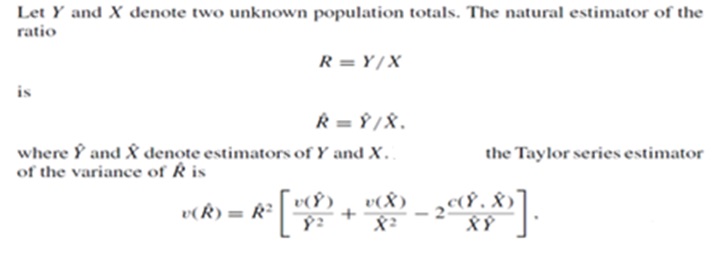
The coefficient of variation is calculated for the totals (number of enterprises with some characteristics). The calculation is made in the R programming language, in the function svyby (package survey) with a stratified sampling design, corresponding to the Horvitz Thomsom formula.
B) Basic formula:
Source: Introduction to Variance Estimation, Wolter, K., Second Edition, col. Statistics for Social and Behavioral Sciences, Springer, 2007
C)Main reference in the literature:
Cochran, W. G. (1977). Sampling techniques. 3rd Edition, New York: Springer.
Lumley, T. (2006). Survey: analysis of complex survey samples. R package version 3.6-5.
Särdnal, C.E., Swensson, B. and Wretman, J. (1992). Model Assisted Survey Sampling. New York: Springer.
D)How has the stratification been taken into account?
The total variance depends on the variance of each stratum and on its dimension.
E)Which strata have been considered?
NACE aggregations
Number of persons employed
Turnover
NUTS I
See point 18.1. Source data part B) Sampling design - Sampling method for more details.
13.3. Non-sampling error
See detailed sections below.
13.3.1. Coverage error
See concept 18.1.1. A) Description of frame population.
13.3.1.1. Over-coverage - rate
For enterprises with 10 or more employees and self-employees 2.3%.
13.3.1.2. Common units - proportion
Not requested
13.3.2. Measurement error
No measurement errors detected.
13.3.3. Non response error
See detailed sections below.
13.3.3.1. Unit non-response - rate
See detailed sections below.
13.3.3.1.1. Unit response
The following table contains the number of units (i.e. enterprises), by type of response to the survey and by the percentage of these values in relation to the gross sample size.
Type of response
Enterprises
0-9 (or 2-9) employees and self-employed persons
10 or more employees and self-employed persons
Number
%
Number
%
Gross sample size (as in section 3.1 C)
5659
100%
1. Response (questionnaires returned by the enterprise)
5134
90.7%
1.1 Used for tabulation and grossing up (Net sample or Final Sample; as in section 3.1 D)
4991
88.2%
1.2 Not used for tabulation
143
2.5%
1.2.1 Out of scope (deaths, misclassified originally in the target population, etc.)
129
2.3%
1.2.2 Other reasons (e.g. unusable questionnaire)
14
0.2%
2. Non-response (e.g. non returned mail, returned mail by post office)
525
9.3%
Comments on unit response, if unit response is below 60%
13.3.3.1.2. Methods used for minimizing unit non-response
Several reminders via e-mail and letters are sent to the enterprise that does not respond.
13.3.3.1.3. Methods used for unit non-response treatment
1. No treatment for unit non-response
2.1 Treatment by re-weighting: Re-weighting by the sampling design strata considering that non-response is ignorable inside each stratum (the naïve model)
X
2.2 Treatment by re-weighting: Re-weighting by identified response homogeneity groups (created using sample-level information)
2.3 Treatment by re-weighting: Re-weighting through calibration/post-stratification (performed using population information) by the groups used for calibration/post-stratification
3. Treatment by imputation (done distinctly for each variable/item)
X
4. Method(s) and the model(s) corresponding to the above or other method(s) used for the treatment of unit non-response. (e.g. Re-weighting using Horvitz-Thompson estimator, ratio estimator or regression estimator, auxiliary variables)
According to Eurostat recommendations, respondents with item non-response or "do not know" are imputed with values from respondents who answered the question. For turnover, non-responses are imputed with background information from the unit (the imputed values are, in general, from the previous year).
13.3.3.1.4. Assessment of unit non-response bias
The unit non-response adjustment is done by re-weighting. When computing estimates, the sampling weights are recalculated as a relation between the totals in the sampling frame and the number of responses in each stratum. The imputation for the stratification variable turnover is done using administrative information.
13.3.3.2. Item non-response - rate
Not applicable.
13.3.3.2.1. Methods used for item non-response treatment
1. No treatment for item non-response
X
2. Deductive imputation An exact value can be derived as a known function of other characteristics.
3. Deterministic imputation (e.g. mean/median, mean/median by class, ratio-based, regression-based, single donor nearest-neighbour) Deterministic imputation leads to estimators with no random component, that is, if the imputation were to be re-conducted, the outcome would be the same.
4. Random imputation (e.g. hot-deck, cold-deck) Random imputation leads to estimators with a random component, that is, if the imputation were re-conducted, it would have led to a different result.
5. Re-weighting
6. Multiple imputation In multiple imputation each missing value is replaced (instead of a single value) with a set of plausible values that represent the uncertainty of the right value to impute. Multiple imputation methods offer the possibility of deriving variance estimators by taking imputation into account. The incorporation of imputation into the variance can be easily derived based on variability of estimates among the multiply imputed data sets.
7. Method(s) and the model(s) corresponding to the above or other method(s) used for the treatment of item non-response.
According to Eurostat recommendations, respondents with item non-response or "do not know" are imputed with values from respondents who answered the question. For turnover, non-response is imputed with background information from the unit (the imputed values are, in general, from the previous year).
In the case of Portugal, partial non-responses, i.e. questions that remain unanswered, are not allowed, as we consider these to be "Error" inconsistencies that must be resolved before the answer record is accepted, since the electronic questionnaire includes validations that do not allow partial answers.
However, some answers were occasionally corrected, but no imputations were made in fields that were missing.
13.3.3.2.2. Questions or items with item response rates below 90% and other comments
Other comments relating to the item non-response
A) Additional issues concerning "item non-response" calculation (e.g. method used in national publications):
No additional comments.
B) Questions and items with low response rates (cut-off value is 90%) and item non-response rate:
No additional comments.
13.3.4. Processing error
No processing errors were detected.
13.3.5. Model assumption error
Not requested
14.1. Timeliness
See detailed sections below.
14.1.1. Time lag - first result
Not applicable
14.1.2. Time lag - final result
Data are to be delivered to Eurostat in the fourth quarter of the reference year (due date for the finalised dataset is 5th October). European results are released before the end of the survey year or in the beginning of the year following the survey year (T=reference year, T+0 for indicators referring to the current year, T+12 months for other indicators referring to the previous year e.g. e-commerce).
At national level:
Results were released at national level in the end of the survey year in November, with time lag T+0 for indicators referring to the current year, T+10 months for other indicators referring to the previous year.
14.2. Punctuality
See detailed section in the full metadata view.
14.2.1. Punctuality - delivery and publication
Data were delivered to Eurostat (via EDAMIS) on 29th of September 2025; 6 days before the deadline.
15.1. Comparability - geographical
The model questionnaire is generally used by the countries that conduct the survey on ICT usage and e-commerce in enterprises. Due to (small) differences in translation, in the used survey vehicle, in non-response treatment or different routing through the questionnaire, some results for some countries may be of reduced comparability. In these cases, notes are added in the data.
Detailed information on differences in the wording of the questions in the national questionnaires is available in “ Annex I. Completeness “ - worksheets related to questionnaire, coverage, additional questions.
Comparability between regions:
Not applicable
Detailed information on the provision of data on NUTS 2 regional level is available in “Annex I. Completeness“ – worksheets related to regional data.
15.1.1. Asymmetry for mirror flow statistics - coefficient
Not applicable
15.2. Comparability - over time
See detailed section in the full metadata view.
15.2.1. Length of comparable time series
The length of comparable time series depends on the module and the variable considered within each survey module. Additional information is available in annexes attached to the European metadata.
The length of comparable time series depends on the module and the variable considered within each survey module.
15.3. Coherence - cross domain
Not applicable
15.3.1. Coherence - sub annual and annual statistics
Not applicable
15.3.2. Coherence - National Accounts
Not applicable
15.4. Coherence - internal
Not applicable
Restricted from publication
17.1. Data revision - policy
Revision policy of ICT usage and e-commerce data is done in accordance with general revision policy in order to ensure transparency, which must underline the production and dissemination of official statistics. More information can be found in the revisions policy publication, published in the Statistics Portugal's website. The document on the revisions policy set out by Statistics Portugal, hereby presented, seeks to clarify the key factors of a revision, the typology of revision that may occur and the dimensions governing a revision’s analysis. It also explains the General and Operational Principles of the revisions policy that Statistics Portugal will consolidate in the future.
Frame population description and distribution: For more information see concept 18.1.1.
Sampling design - Sampling method: Description of the sampling method used (e.g. stratified random sample, quota sampling, cluster sampling; one-stage or two-stage sampling) and information which variables were used to stratify, the categories of those variables, in particular for the NACE Rev. 2 categories related to the "possible calculation of European aggregates", and the final number of strata:
The target population is the set of enterprises located in Portugal with main economic activity classified in NACE-Rev.2 Sections C, D, E, F, G, H, I, J, L, M, N and S. The sampling frame is based on the reference population for structural business statistics (SBS), which was updated on December of 2024, and in accordance to model questionnaire recommendations regarding economic activity, enterprise size and geographic scope.
The sampling frame is stratified by groups of main economic activity, employment size and classes of turnover, as follows:
Economic activity (NACE Rev.2 – as two digits level, except when other aggregation is specified) (see annex 18.1.Economic Activity_Breakdown.xlsx):
NACE Rev. 2
Section
Aggregation
Classification levels
C
agr01
10-12
agr02
13-15
agr03
16-18
agr04
19
agr05
20
agr06
21
agr07
22-23
agr08
24-25
agr09
265
agr10
266+267
agr11
2611+2612+2620+2630+2640+2680
agr12
27
agr13
28
agr14
29-30
agr15
31-33
D+E
agr16
35
agr17
36-39
F
agr18
41-43
G
agr19
45
agr20
46 (except: 4651; 4652)
agr21
4651+4652
agr22
47
H
agr23
49-53
I
agr24
55
agr25
561
agr26
562+563
J
agr27
58-60 (except: 5821; 5829)
agr28
5821+5829
agr29
61
agr30
62
agr31
63 (except: 6311; 6312)
agr32
6311+6312
L
agr33
68
M
agr34
69-71
agr35
72
agr36
73-75
N
agr37
77-78+80-82
agr38
79
S
agr39
951
Number of persons employed (10-49; 50-149; 150-249; 250 and more)
A maximum a priori coefficient of variation of 5% for total turnover by economic activity class and employment size.
A maximum standard error of 5 percentage points for proportions of internet connected computer users and enterprises with website, by economic activity class and employment size. A maximum standard error of 2 percentage points for the corresponding global proportions. These values are estimated based on the results observed in the last two years.
Sample selection according to sequential sampling.
A minimum of five enterprises per strata.
A census is adopted for larger enterprises (250 and more employed persons or turnover greater or equal to 25,000,000€).
Gross sample distribution: Detailed information is available in “ Annex III. Sample and standard error tables 2025 “ (Worksheet: GROSS SAMPLE).
Net sample distribution: Detailed information is available in “ Annex III. Sample and standard error tables 2025 “ (Worksheet: NET SAMPLE).
18.1.1. Source data - frame population
A) Description of frame population
a) When was the sample for the ICT usage and e-commerce in enterprise survey drawn?
The sample for the ICT usage and e-commerce in enterprise survey was drawn in January 2025.
b) Last update of the Business register that was used for drawing the sample of enterprises for the survey:
The Business register was updated in December 2024 which was the time when all administrative information is put together.
c) Indication if the frame population is the same as, or is in some way coordinated with, the one used for the Structural Business Statistics (different snapshots):
The frame population is coordinated with the frame population for the Structural Business Statistics, filtered by sectors of activity in the context of this survey.
d) Description if different frames are used during different stages of the statistical process (e.g. frame used for sampling vs. frame used for grossing up):
The same frame is used in different stages. Thus, the sampling data frame is the same used for grossing up, with the exception of business that are excluded by end of activity.
e) Indication the shortcomings in terms of timeliness (e.g. time lag between last update of the sampling frame and the moment of the actual sampling), geographical coverage, coverage of different subpopulations, data available etc., and any measures taken to correct it, for this survey.
The main shortcoming in terms of timeliness is that the updated administrative data relate to the activity of the year before and the real business demography is only fully known when businesses that respond to this or other business survey.
B) Frame population distribution
Detailed information is available in “ Annex III. Sample and standard error tables 2025 “ (Worksheet: FRAME POPULATION)
18.2. Frequency of data collection
Annual
18.3. Data collection
See detailed sections below.
18.3.1. Survey period
Survey / Collection
Date of sending out questionnaires
Date of reception of the last questionnaire treated
General survey
3rd February 2025
30th June 2025
Micro-enterprises
x
x
18.3.2. Survey vehicle – general survey
General survey - Stand-alone survey
18.3.3. Survey vehicle – micro-enterprises
Not applicable
18.3.4. Survey type
The national survey combines two modes of data collection: web survey and postal.
18.3.5. Survey participation
Mandatory
18.4. Data validation
Statistics Portugal is able to contact and if it is the case, data from statistical units can be revised. In order to compile the ICT usage and e-commerce data, Statistics Portugal has implemented: -completeness checks (data integrity rules); -validity checks (internal consistency); -plausibility checks. Statistics Portugal uses the server based version of SDMX validation program provided by Eurostat for validation.
18.5. Data compilation
Grossing-up procedures
Grossing-up procedures Three different weights are used in grossing-up: - a weight based on the number of enterprises; - a weight based on turnover; - a weight based on persons employed. In general results will be weighted by the number of enterprises, except in the case of percentages regarding turnover for e-commerce where the turnover based weight will be used, and in the case of variables related to persons employed where the employment based weight will be used.
18.5.1. Imputation - rate
See sections 13.3.3.1 and 13.3.3.2 for unit and item non-response, respectively.
18.6. Adjustment
Not applicable
18.6.1. Seasonal adjustment
Not applicable
Problems encountered and lessons to be learnt:
19.1. Documents
Questionnaire in national language
PT ICT Enterprises 2025 Questionnaire.pdf
Questionnaire in English (if available)
National reports on methodology (if available)
Analysis of key results, backed up by tables and graphs in English (if available)
Data on the Information and Communication Technologies (ICT) usage and e-commerce in enterprises are survey data. They are collected by the National Statistical Institutes or Ministries and are in principle based on Eurostat's annual model questionnaires on ICT usage and e-commerce in enterprises.
The legal basis for ICT enterprise statistics for survey year 2025 is Commission Implementing Regulation (EU) 2024/1883 of 9 July 2024 laying down the technical specifications of data requirements for the topic 'ICT usage and e-commerce' for the reference year 2025. Large part of the data collected is used to support measuring the implementation and monitoring of the EU’s digital targets for 2030, set by the Digital Decade Policy Programme.
Four of the key performance indicators (KPIs) of the current programme stem from the statistics for which the implementing and delegated acts are enclosed for adoption: Artificial Intelligence, cloud, data analytics and the digital intensity index (DII) - a composite indicator reflecting the digital transformation of business
The aim of the European survey on ICT usage and e-commerce in enterprises is to collect and disseminate harmonised and comparable information at European level.
Name of data collection
Inquérito à Utilização de Tecnologias da Informação e da Comunicação nas Empresas 2025
The model questionnaire on ICT usage and e-commerce in enterprises provides a large variety of variables covering among others the following topics:
Access and use of the Internet
E-commerce sales
Data utilisation and analytics
Use of cloud computing services
Artificial intelligence
ICT and the environment.
The annual model questionnaires and the European businesses statistics compliers’ manual for ICT usage and e-commerce in enterprises comprise definitions and explanations regarding the topics of the survey.
The statistical unit is the enterprise (sampling at ENT level and data collection at LeU level).
Target Population
As required by Annex of the Commission Implementing Regulation, enterprises with 10 or more employees and self-employed persons are covered by the survey.
For micro-enterprises see the sub-concepts below.
Detailed information on the provision of data on NUTS 2 regional level is available in “Annex I. Completeness“.
The whole national territory was considered (Continente, Região Autónoma dos Açores and Região Autónoma da Madeira).
Where not specified the reference period is current situation (survey period in 2025). Year 2024 for the value or % of sales data and where specified.
Comments on reliability and representativeness of results and completeness of dataset
These comments reflect overall standard errors reported for the indicators and breakdowns in section 13.2.1 (Sampling error - indicators) and the rest of the breakdowns for national and European aggregates, as well as other accuracy measurements. The estimated standard error should not exceed 2pp for the overall proportions and should not exceed 5pp for the proportions related to the different subgroups of the population (for those NACE aggregates for the calculation and dissemination of national aggregates). If problems were found, these could have implications for future surveys (e.g. need to improve sampling design, to increase sample sizes, to increase the response rates).
Detailed information is available in “ Annex II. Accuracy “ - related to European aggregates, comments on reliability and use of flag.
Percentages of enterprises, Percentages of turnover, Percentages of employees and self-employed persons, Million euro (for selected indicators).
Grossing-up procedures
Grossing-up procedures Three different weights are used in grossing-up: - a weight based on the number of enterprises; - a weight based on turnover; - a weight based on persons employed. In general results will be weighted by the number of enterprises, except in the case of percentages regarding turnover for e-commerce where the turnover based weight will be used, and in the case of variables related to persons employed where the employment based weight will be used.
Frame population description and distribution: For more information see concept 18.1.1.
Sampling design - Sampling method: Description of the sampling method used (e.g. stratified random sample, quota sampling, cluster sampling; one-stage or two-stage sampling) and information which variables were used to stratify, the categories of those variables, in particular for the NACE Rev. 2 categories related to the "possible calculation of European aggregates", and the final number of strata:
The target population is the set of enterprises located in Portugal with main economic activity classified in NACE-Rev.2 Sections C, D, E, F, G, H, I, J, L, M, N and S. The sampling frame is based on the reference population for structural business statistics (SBS), which was updated on December of 2024, and in accordance to model questionnaire recommendations regarding economic activity, enterprise size and geographic scope.
The sampling frame is stratified by groups of main economic activity, employment size and classes of turnover, as follows:
Economic activity (NACE Rev.2 – as two digits level, except when other aggregation is specified) (see annex 18.1.Economic Activity_Breakdown.xlsx):
NACE Rev. 2
Section
Aggregation
Classification levels
C
agr01
10-12
agr02
13-15
agr03
16-18
agr04
19
agr05
20
agr06
21
agr07
22-23
agr08
24-25
agr09
265
agr10
266+267
agr11
2611+2612+2620+2630+2640+2680
agr12
27
agr13
28
agr14
29-30
agr15
31-33
D+E
agr16
35
agr17
36-39
F
agr18
41-43
G
agr19
45
agr20
46 (except: 4651; 4652)
agr21
4651+4652
agr22
47
H
agr23
49-53
I
agr24
55
agr25
561
agr26
562+563
J
agr27
58-60 (except: 5821; 5829)
agr28
5821+5829
agr29
61
agr30
62
agr31
63 (except: 6311; 6312)
agr32
6311+6312
L
agr33
68
M
agr34
69-71
agr35
72
agr36
73-75
N
agr37
77-78+80-82
agr38
79
S
agr39
951
Number of persons employed (10-49; 50-149; 150-249; 250 and more)
A maximum a priori coefficient of variation of 5% for total turnover by economic activity class and employment size.
A maximum standard error of 5 percentage points for proportions of internet connected computer users and enterprises with website, by economic activity class and employment size. A maximum standard error of 2 percentage points for the corresponding global proportions. These values are estimated based on the results observed in the last two years.
Sample selection according to sequential sampling.
A minimum of five enterprises per strata.
A census is adopted for larger enterprises (250 and more employed persons or turnover greater or equal to 25,000,000€).
Gross sample distribution: Detailed information is available in “ Annex III. Sample and standard error tables 2025 “ (Worksheet: GROSS SAMPLE).
Net sample distribution: Detailed information is available in “ Annex III. Sample and standard error tables 2025 “ (Worksheet: NET SAMPLE).
Annual
See detailed sections below.
The model questionnaire is generally used by the countries that conduct the survey on ICT usage and e-commerce in enterprises. Due to (small) differences in translation, in the used survey vehicle, in non-response treatment or different routing through the questionnaire, some results for some countries may be of reduced comparability. In these cases, notes are added in the data.
Detailed information on differences in the wording of the questions in the national questionnaires is available in “ Annex I. Completeness “ - worksheets related to questionnaire, coverage, additional questions.
Comparability between regions:
Not applicable
Detailed information on the provision of data on NUTS 2 regional level is available in “Annex I. Completeness“ – worksheets related to regional data.