
11. Transport
Two particular units are used for transport measurement — tonne-kilometre (tonne-km) and passenger-kilometre (passenger-km) — representing the transport of one tonne of goods (freight) or one passenger over a distance of one kilometre.
Air transport
Worldwide, the number of air passengers carried in 2018 was around 4.2 billion, an overall increase of 92 % compared with 2008. Relative to the size of the population, the number of air passengers worldwide in 2008 was 327 per 1 000 inhabitants and this ratio increased by 71 % to 557 per 1 000 inhabitants in 2018 (see Figure 11.1).
In 2018, the highest ratio of air passengers to population among the G20 members was 3 028 per 1 000 inhabitants in Australia, followed by 2 717, 2 487 and 2 412 per 1 000 inhabitants in the United States, the United Kingdom and Canada respectively. Four other G20 members — South Korea, the EU-27 (incomplete data), Turkey and Saudi Arabia — also reported more passengers carried than their number of inhabitants. At the other end of the ranking, India reported 121 air passengers per 1 000 inhabitants in 2018, far less than the ratio of 406 per 1 000 inhabitants in Argentina which was the next lowest ratio among the G20 members.
Figure 11.1: Number of air passengers carried, 2008 and 2018
(per 1 000 inhabitants)

(1) Excluding Denmark and Sweden; 2017 data for Slovakia.
Source: the World Bank (World Development Indicators); data with a different definition are published by Eurostat (online data codes: avia_paoc and demo_gind)
Several G20 members recorded a fall in their number of air passengers in 2008 and/or 2009, at the peak of the financial and economic crisis, but overall between 2008 and 2018 all of the G20 members recorded faster growth for the number of air passenger than for inhabitants, such that the ratio shown in Figure 11.1 increased. During this period, the number of passengers relative to population size grew (in percentage terms) most strongly in Turkey where it nearly quadrupled, while it also more than trebled in Indonesia, China and Mexico and more than doubled in India, Argentina, Russia and South Korea. The weakest overall growth was reported for the United States where the ratio of air passengers to population size was 18 % higher in 2018 than it had been in 2008; for comparison, the next lowest growth was 25 % in Australia.
In terms of passenger numbers, the busiest airport in the world in 2017 was Hartsfield-Jackson Atlanta in the United States, with 103.9 million passengers, followed by Beijing Capital International in China with 95.8 million (see Figure 11.2). The busiest airport outside of the G20 members was Dubai International in the United Arab Emirates with 88.2 million passengers in 2017. Paris Charles de Gaulle in France had 69.5 million passengers, making it the busiest passenger airport in the EU-27. Apart from Dubai International, Changi airport in Singapore was the only other airport in the top 20 that was not located in one of the G20 members.
Figure 11.2: Top 20 airports for passengers, 2017
(million passengers)

Note: airports shown in orange are in countries that are non-EU G20 members, airports shown in blue are in the EU, while airports shown in green are in countries that are not G20 members.
Source: Eurostat (online data code: avia_paoa) and the Airports Council International (ACI)
Maritime transport
The world’s maritime fleet (civilian seagoing ships for carrying freight or passengers) reached 1.98 billion deadweight tonnes (DWT) in 2019, according to the United Nations Conference on Trade and Development. Deadweight tonnage is the weight measure of a vessel’s carrying capacity and includes cargo, fuel and stores.
The EU-27’s maritime fleet in 2019 was considerably larger than in any of the other G20 members; in fact, it accounted for a larger share (15.8 %) of the world total than the fleets of all of the other G20 members combined (14.5 %). It should be noted that there are several smaller countries outside of the G20 that account for a large share of the world maritime fleet, notably Panama, Liberia and the Marshall Islands, all associated with flags of convenience.
As well as showing the shares of the world’s merchant fleet, Figure 11.3 also shows the average vessel size. To some extent this is influenced by the different types of vessels in each country’s fleet. Saudi Arabia, which had the largest average vessel size (35.1 DWT) of the G20 members, has a fleet dominated by oil tankers: these represented 84 % of the DWT of its fleet compared with a world average of 29 %. The United Kingdom had the second largest average vessel size (31.5 DWT) among G20 members, with its fleet having the second highest DWT share (20 %) of container ships among G20 members after the United States (25 %); the world average DWT share for container ships was 13 %. With an average vessel size of 26.0 DWT, the EU-27 was the only other G20 member with an average vessel size above the world average of 20.5 DWT and it had a similar share for container ships (20 % of the total DWT) and a share for oil tankers (34 %) that was also above the world average.
Figure 11.3: Merchant fleet by flag of registration, 2019

Note: ranked on average vessel size. Deadweight tonnage (DWT) is the weight measure of a vessel’s carrying capacity. It includes cargo, fuel and stores. Data refer to the beginning of the year. Data concern seagoing propelled merchant ships (for freight or passengers) of 100 gross tons and above. The data exclude inland waterway vessels, fishing vessels, military vessels, yachts, and offshore fixed and mobile platforms and barges (with the exception of floating production, storage and offloading vessels and drillships).
(1) Includes the Isle of Man.
(2) Includes the Great Lakes Fleet and the United States Reserve Fleet.
(3) Includes the Great Lakes Fleet.
Source: the United Nations Conference on Trade and Development (Maritime transport)
The United Nations Conference on Trade and Development provides port call and performance statistics. According to these data, worldwide there were 4.1 million arrivals of merchant ships of 1 000 gross tons and above in 2018. Ports in the EU-27 recorded 1.3 million arrivals of such vessels in 2018, close to one third (31.2 %) of the world total (see Figure 11.4). Collectively ports in the other G20 members recorded 1.7 million arrivals, such that the G20 share of the world total was close to three quarters (73.5 %).
Figure 11.4: Number of arrivals of vessels in ports, 2018

Note: includes arrivals of vessels of 1 000 gross tons and above.
Source: the United Nations Conference on Trade and Development (Maritime transport)
Road transport
Relative to the size of their populations, the quantity in tonne-km of road freight transport was particularly high in the United States, Australia, Canada and China (see Figure 11.5). These very high figures reflect not only an extensive use of road freight transport as a mode of freight transport, but also the large distances involved in transporting goods around large land areas. Comparing data for the two years shown, the most notable development was the increase in the amount of Indian road freight: the level in 2017 was just over twice as high as the level in 2008. China also reported strong growth, with road freight (relative to population size) nearly doubling between 2008 and 2017. The United Kingdom, the United States (2008-2017) and Japan were the only G20 members (for which data are available) reporting a fall for this indicator, although in the two last cases this may be influenced by a break in series.
Figure 11.5: Road freight transport, 2008 and 2018
(tonne-km per inhabitant)

Note: Argentina, Brazil, Indonesia, Saudi Arabia and South Africa, not available.
(1) 2010 instead of 2008.
(2) 2017 instead of 2018.
(3) Break in series.
(4) 2017: estimate.
Source: Eurostat (online data codes: road_go_ta_tott and demo_gind), the OECD (International transport forum) and the United Nations Department of Economic and Social Affairs, Population Division (World Population Prospects 2019)
Mobility often comes at a cost, not just in terms of paying for transport and a potential impact on the environment, but also the risk of injury or death through transport accidents. An evaluation of the risk of death in a road traffic accident may be best expressed as a ratio of the number of road traffic deaths relative to the distance passengers have been transported, in other words relative to the number of passenger-kilometres or vehicle-kilometres. In the absence of reliable data on road traffic performance, Figure 11.6 uses a ratio of road traffic deaths per 100 000 inhabitants.
Among the G20 members, the highest incidence of road traffic deaths relative to population size in 2016 was observed in Saudi Arabia where there were 29 such deaths per 100 000 inhabitants. This was followed by South Africa (26 per 100 000 inhabitants), India (23 per 100 000 inhabitants) and Brazil (20 per 100 000 inhabitants). In Figure 11.6 it can be seen that five G20 members recorded ratios of road traffic deaths relative to population size that were notably lower than in the rest of the G20, ranging from 6 deaths per 100 000 inhabitants in Canada and Australia, through 5 and 4 deaths per 100 000 inhabitants in the EU-27 and Japan to 3 deaths per 100 000 inhabitants in the United Kingdom.
Figure 11.6: Road traffic deaths, 2016
(per 100 000 inhabitants)

Note: more recent data are available from Eurobase for the EU‑27 and the United Kingdom. Argentina, Brazil, Indonesia, Saudi Arabia and South Africa, not available.
Source: Eurostat (online data codes: tran_sf_roadse and demo_gind), the World Health Organisation and the United Nations Department of Economic and Social Affairs, Population Division (World Population Prospects 2019)
Rail transport
The extent of the use of rail transport among G20 members in 2018 is presented in Figures 11.7 and 11.8. The G20 members can be split into several groups depending on the extent to which this mode is used for passenger and/or freight transport. Argentina (2017 data) and Turkey had a relatively low overall use of rail transport. In Canada and the United States, rail transport was focused mainly on freight transport, while passenger transport was dominant in Japan (2017 data), the United Kingdom, India (2017 data) and South Korea. A relatively high use of rail transport for both freight and passengers was observed in Russia, Australia (2016 data for freight) and the EU-27.
Between 2008 and 2018, rail passenger transport (relative to the number of inhabitants) increased in the EU-27 (see Figure 11.7 for the precise coverage) by 11.0 %. In relative terms, a much larger increase (the 2018 ratio was 8 times as high as the 2008 ratio) was observed in Mexico, although the level of rail passenger transport remained low. Turkey, Indonesia (2008-2017), India (2008-2017) and the United Kingdom recorded larger increases than in the EU-27 during this period, while Japan (2008-2017) and Australia reported smaller increases. The remaining G20 members reported a lower ratio of passenger-km per inhabitant in 2018 than 10 years earlier, with the largest decrease in percentage terms in Saudi Arabia and the largest decrease in absolute terms in Russia.
Figure 11.7: Rail passenger transport, 2008 and 2018
(passenger-km per inhabitant)

Note: data for some countries may be limited to International Union of Railways (UIC) members.
(1) Excluding Belgium, Hungary and the Netehrlands. 2018: including 2017 data for Poland.
(2) 2017 instead of 2018.
(3) 2017: estimate.
(4) 2007 instead of 2008. 2018: not available.
(5) 2008: not available.
(6) 2018: provisional.
Source: Eurostat (online data codes: rail_pa_total and demo_gind), the World Bank (World Development Indicators), the OECD (International transport forum) and the United Nations Department of Economic and Social Affairs, Population Division (World Population Prospects 2019)
Rail freight transport (relative to the number of inhabitants) decreased between 2008 and 2018 in the EU-27 (excluding Belgium) by 6.0 %. In relative terms, larger decreases were observed in Argentina (2008-2017), South Korea, the United Kingdom, China and the United States (note that there is a break in series). A smaller decrease was observed in Japan (2008-2017). Elsewhere, the remaining G20 members reported a higher ratio of tonne-km per inhabitant in 2018 than 10 years earlier, with the largest increase in percentage and absolute terms in Australia (2008-2016).
Figure 11.8: Rail freight transport, 2008 and 2018
(tonne-km per inhabitant)

Note: data for some countries may be limited to International Union of Railways (UIC) members.
(1) Excluding Belgium.
(2) 2016 instead of 2018.
(3) Break in series.
(4) 2018: not available.
(5) 2017 instead of 2018.
(6) 2017: estimate.
(7) 2007 instead of 2008.
Source: Eurostat (online data codes: rail_go_total and demo_gind), the World Bank (World Development Indicators), the OECD (International transport forum) and the United Nations Department of Economic and Social Affairs, Population Division (World Population Prospects 2019)
12. Energy
Primary production
Primary production of energy is any extraction of energy products in a useable form from natural sources. This occurs either when natural sources are exploited (for example, in coal mines, crude oil fields, hydro power plants) or in the fabrication of biofuels. Primary production of energy in the EU-27 totalled 641 million tonnes of oil equivalent (toe) in 2017, while worldwide production reached 13.65 billion toe.
In 2017, the G20 members’ share of the world total for primary production was 71.7 % (see Map 12.1). The EU-27’s share of world production was 4.6 %. Among the G20 members, four recorded higher levels of production than the EU-27 as can be seen from Map 12.1: China’s share of world primary energy production was 17.1 %, the United States’ share was 14.3 % and Russia’s share was 10.2 %, while the 4.7 % share from Saudi Arabia was just above that recorded for the EU-27.
Renewable energy sources are sources that replenish (or renew) themselves naturally and include biomass and renewable wastes, hydro power, geothermal energy, wind energy, solar energy, wave and tidal power. Non-renewable waste may be industrial or municipal waste.
Map 12.1: World primary production of energy, 2017
(%)

Note: Japan, 0.3 %; Turkey, 0.3 %. More recent data are available from Eurobase for the EU-27 and the United Kingdom.
Source: Eurostat (online data code: nrg_bal_s) and the United Nations Department of Economic and Social Affairs, Statistics Division (Energy Statistics Yearbook and Energy Balances)
For many of the G20 members, the mix of energy sources for primary production in 2017 was dominated by just one energy type (see Figure 12.1).
Crude oil was dominant in Saudi Arabia and Mexico, accounting for 85 % and 68 % of primary production respectively. In South Africa, 91 % of all primary production came from solid fuels (for example, coal and lignite), with this source accounting for more than half of production in China, Australia and Indonesia. In South Korea, nuclear energy contributed by far the largest share (79 %), and in Japan (after the suspension of the operation of many nuclear plants) the main source of primary production was renewables (55 %). Production in Turkey, Brazil and India was a mixture from renewables and waste as well as one type of fossil fuel: crude oil for Brazil and solid fuels for India and Turkey. By contrast, Argentina, Canada, Russia, the United Kingdom and the United States had substantial shares of production spread across two or three types of fossil fuels, with none of them accounting for more than half of their total production.
Primary production in the EU-27 was more varied than in nearly all of the other G20 members with only crude oil among the five types of energy sources shown in Figure 12.1 failing to attain at least a 10 % share of total production in 2017, while none of the other types of energy saw their share reach one third. Only the United States among the other G20 members reported production spread across four or five energy sources in a manner similar to that in the EU-27, albeit more focused on fossil fuels. This varied pattern of primary energy production in the EU-27 reflects the availability of different fossil fuel deposits and the potential for hydro power among EU Member States as well as differing policies towards nuclear fuels and renewables.
Figure 12.1: Primary production by energy type, 2017
(% of total production)

Note: ranked on the share of petroleum products. More recent data are available from Eurobase for the EU‑27 and the United Kingdom. Shares do not always sum to 100 % as some smaller other sources are not shown.
Source: Eurostat (online data code: nrg_bal_s) and the United Nations Department of Economic and Social Affairs, Statistics Division (Energy Balances)
Trade in energy products
The main difference between levels of primary energy production and total energy supply is international trade: a shortfall of production needs to be met by net imports (the balance of imports minus exports) and a production surplus is generally accompanied by net exports.
Among the G20 members, the largest net exporters of energy in 2017 were Russia and Saudi Arabia, while net exports from Australia, Indonesia and Canada were also substantial (see Figure 12.2); South Africa also recorded a small trade surplus for energy products. The largest net importer of energy among the G20 members was the EU-27, followed by China, Japan, India, South Korea and the United States.
Figure 12.2: Energy imports and exports, 2017
(million tonnes of oil equivalent)

Note: ranked on net imports. More recent data are available from Eurobase for the EU‑27 and the United Kingdom.
(1) A negative value for net imports indicates that that the country concerned is a net exporter.
Source: Eurostat (online data code: nrg_bal_s) and the United Nations Department of Economic and Social Affairs, Statistics Division (Energy Balances)
A study of the composition of gross energy imports (see Figure 12.3) shows that petroleum products (including crude oil) tended to dominate energy imports in the majority of G20 members. These products accounted for close to or more than half of all energy imports in each of the G20 members except for Turkey, Argentina and Russia; gas formed a large part of Argentina’s and Turkey’s energy imports, while in Russia more than half of all energy imports were solid fuels.
Figure 12.3: Gross imports by type of energy, 2017
(% of gross imports)

Note: ranked on petroleum products. More recent data are available from Eurobase for the EU‑27 and the United Kingdom.
(1) Biofuels and waste: estimate.
Source: Eurostat (online data code: nrg_bal_s) and the United Nations Department of Economic and Social Affairs, Statistics Division (Energy Balances)
As noted above, the EU-27 was dependent on imports to meet its needs for energy. Figure 12.4 identifies the main countries of origin for the EU-27’s gross imports of fossil fuels from non-member countries. Russia was the single largest supplier of EU-27 imports for all three fossil fuel categories in 2018, providing 32 % of petroleum products, 42 % of solid fuels, and 40 % of natural gas. Saudi Arabia was the second largest supplier of petroleum products, while Norway was the third largest supplier of these products as well as the second largest supplier of natural gas. Imports of solid fuels and of natural gas into the EU-27 were particularly concentrated among the largest suppliers. For example, the top four providers of solid fuels together supplied 86 % of the EU-27’s imports from all non-EU countries. By contrast, despite the large share of imports from Russia, the supply of petroleum products was less concentrated, as the top seven providers together supplied 69 % of the EU-27’s imports from non-EU countries.
Figure 12.4: Main origins of extra-EU imports, EU‑27, 2018
(%)

Source: Eurostat (online data codes: nrg_ti_sff, nrg_ti_oil and nrg_ti_gas)
Total energy supply
Total energy supply is the total energy demand of a country or region; it represents the quantity of energy necessary to satisfy inland consumption of the geographical entity under consideration. This covers consumption by the energy sector itself, distribution and transformation losses, and final energy consumption by end users.
Global total energy supply was 13.2 billion toe in 2017, of which the G20 members accounted for around four fifths (81 %), significantly higher than their collective share of primary production. China consumed one fifth (22 %) of the world energy total in 2017 (see Map 12.2), more than any other G20 member, followed by the United States (16 %) and the EU-27 (11 %); these three members together consumed nearly half (49 %) of all energy worldwide.
Map 12.2: World total energy supply, 2017
(%)

Note: more recent data are available from Eurobase for the EU‑27 and the United Kingdom.
Source: (online data code: nrg_bal_s) and the United Nations Department of Economic and Social Affairs, Statistics Division (Energy Statistics Yearbook and Energy Balances)
In 2017, total energy supply was entirely made up of fossil fuels in Saudi Arabia: 54.9 % from petroleum products and 45.1 % from gas (see Figure 12.5). Petroleum products, solid fuels and gas provided more than 90 % of total energy supply in Australia, South Africa and Japan, and between 80 % and 90 % in China, Russia, Mexico, Argentina, Turkey, South Korea and the United States. In the EU-27, the share of these sources was 71 %; the only G20 members to record lower shares were Indonesia (70 %) and Brazil (57 %).
The EU-27 and South Korea had the highest shares of nuclear energy in total energy supply, both 13.6 %. South Korea’s share of nuclear energy in total energy supply was considerably lower than the equivalent share for primary production, indicating South Korea’s high dependency on imported fossil fuels, notably petroleum products and solid fuels. The next highest shares of nuclear energy in total energy supply were observed in the United Kingdom, the United States, Canada and Russia.
As for primary production, Brazil, Indonesia and India recorded high shares for biofuels and waste in total energy supply, all over 20 %. By contrast, Russia and Saudi Arabia recorded the lowest shares for biofuels and waste in total energy supply.
Figure 12.6 reveals the extent to which total energy supply was met by net imports as opposed to primary production for countries that were net importers, in other words the energy dependency. For net exporters it shows the size of their net exports relative to their own needs (the total energy supply). Among the G20 members, Japan, South Korea, Turkey and the EU-27 all recorded net imports that covered more than half of their total energy supply. Energy dependency ratios of 20 % or lower were recorded in 2017 for China, Argentina, Mexico, the United States and Brazil. By contrast, Australia’s and Saudi Arabia’s net exports were around twice as high as their total energy supply.
Figure 12.5: Total energy supply by type of energy, 2017
(% of total energy supply)

Note: ranked on petroleum products. More recent data are available from Eurobase for the EU‑27 and the United Kingdom.
Source: the United Nations Department of Economic and Social Affairs, Statistics Division (Energy Balances); data with a different definition are published by Eurostat (online data code: nrg_bal_s)
Between 2012 and 2017, Mexico moved from being a net exporter to being a net importer of energy, despite a contraction in its total energy supply. During the same period, the dependence on imports increased in India, Argentina, Turkey, China, the EU-27 and South Korea, as their net imports grew more rapidly than their energy supply (in the EU-27, total energy supply actually fell slightly during the period under consideration). The dependency on imports reduced between 2012 and 2017 in Brazil, the United States, the United Kingdom and Japan: net imports fell in all of these countries, while total energy supply fell less strongly in Japan and the United Kingdom and continued to expand in Brazil and the United States.
Relative to its total energy supply, net exports decreased between 2012 and 2017 in Saudi Arabia, as total energy supply increased faster than net exports. The reverse situation was observed in Canada, as net exports increased faster than total energy supply. In the four other G20 members that were net exporters in 2012 and 2017 — Australia, Indonesia, Russia and South Africa — net exports increased while total energy supply contracted.
Figure 12.6: Net imports/exports relative to total energy supply, 2012 and 2017
(%)

Note: different scales used for the two parts of the figure; Mexico is shown in both parts of the figure a it was a net exporter in 2012 and a net importer in 2017. More recent data are available from Eurobase for the EU‑27 and the United Kingdom.
Source: Eurostat (online data code: nrg_bal_s) and the United Nations Department of Economic and Social Affairs, Statistics Division (Energy Balances)
Energy intensity
Energy intensity is an indicator of an economy’s energy efficiency and relates the quantity of energy consumed to the level of economic output, the latter represented by gross domestic product (GDP). To facilitate spatial comparisons, GDP is calculated in a common currency (United States dollars are used in Figure 12.7) using purchasing power parities (PPPs) rather than market exchange rates: PPPs are indicators of price level differences across countries.
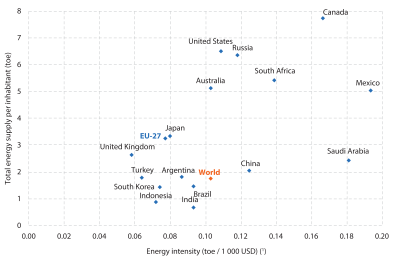
Mexico, Saudi Arabia and Canada had the most energy intense economies in 2017 among the G20 members, followed by South Africa. By contrast, the United Kingdom, Turkey, Indonesia, South Korea, the EU-27 and Japan had the lowest levels of energy intensity. It should be noted that the economic structure of an economy plays an important role in determining energy intensity, as post-industrial economies with large service sectors tend to have considerably lower energy use than economies characterised by heavy, traditional, industrial activities.
Figure 12.7 also shows the level of total energy supply per inhabitant. Six of the G20 members recorded notably higher levels of energy supply per inhabitant than the others, averaging 5.0-7.7 toe per inhabitant in Canada, the United States, Russia, South Africa, Australia and Mexico, whereas energy supply per inhabitant was at most 3.3 toe per inhabitant elsewhere. The lowest levels of energy supply per inhabitant were in Indonesia and India, both below 1.0 toe per inhabitant.
Figure 12.7: Energy intensity, 2017
Note: more recent data are available from Eurobase for the EU‑27 and the United Kingdom.
(1) Energy intensity is the ratio between total energy supply and gross domestic product (GDP). The GDP figures are expressed in United States dollars (USD) converted using purchasing power parities.
Source: Eurostat (online data codes: nrg_bal_s and demo_gind), the United Nations Department of Economic and Social Affairs, Statistics Division (Energy Statistics Yearbook and Energy Balances), the World Bank (World Development Indicators) and the United Nations Department of Economic and Social Affairs, Population Division (World Population Prospects 2019)
Electricity generation
Gross electricity generation (also known as gross electricity production), is the total amount of electrical energy produced by transforming other forms of energy, for example nuclear or wind power. Total gross electricity generation worldwide was 25.6 million gigawatt hours (GWh) in 2017, of which 84 % was generated by G20 members (see Map 12.3). China, the United States and the EU-27 accounted for the highest shares of electricity generation among G20 members, generating 25 %, 17 % and 12 % of the world total respectively.
Map 12.3: World gross electricity generation, 2017
(%)

Note: more recent data are available from Eurobase for the EU‑27 and the United Kingdom.
(1) Estimate.
Source: Eurostat (online data code: nrg_bal_peh) and the United Nations Department of Economic and Social Affairs, Statistics Division (Energy Statistics Yearbook)
Combustible fuel power stations generated two thirds (66.7 %) of electricity worldwide in 2017, a share that was surpassed in all but six of the G20 members: the United States, Russia, the United Kingdom, the EU-27, Brazil and Canada. Saudi Arabia generated practically all of its electricity from combustible fuels, with the share close to nine tenths in South Africa (89.0 %) and Indonesia (88.8 %).
Hydro-electric power supplied 16.3 % of the world’s electricity in 2017. Notably higher shares were recorded in Brazil (62.9 %), Canada (59.6 %) and Argentina (28.6 %), while shares above the world average were also recorded in Turkey, China and Russia; in the EU-27 the share of electricity generated from hydropower was 10.9 %— see Figure 12.8.
Nuclear power contributed some 25.7 % of the electricity generated in the EU-27 in 2017, which was more than double the world average (10.3 %) and the second highest share among G20 members, behind South Korea (26.2 %).
Figure 12.8 presents data for two other types of renewable energy, namely wind and solar. The G20 members with the highest proportion of gross electricity generation from wind were the United Kingdom (14.8 %) and the EU-27 (10.6 %), where the contribution of this source was more than double the world average (4.4 %). Solar power provided 5.2 % of the electricity generated in Japan, while relatively high shares were also recorded in the EU-27 (3.7 %), the United Kingdom (3.4 %) and Australia (3.1 %), compared with a world average of 1.6 %.
Figure 12.8: Gross electricity generation by source, 2017
(% of gross electricity generation)

Note: ranked on the share for combustible fuels. More recent data are available from Eurobase for the EU‑27 and the United Kingdom. Shares do not always sum to 100 % as some smaller other sources are not shown.
(1) Estimates.
(2) Other: estimate.
Source: Eurostat (online data code: nrg_bal_peh) and the United Nations Department of Economic and Social Affairs, Statistics Division (Energy Statistics Yearbook)
Relative to population size, Canada had by far the highest electricity generation among the G20 members, 17.9 MWh per inhabitant in 2017, around five times as high as the world average (see Figure 12.9). The EU-27 ranked in the middle of the G20 members, with 6.6 MWh of electricity generated per inhabitant in 2017, a little less than double the world average. Argentina, Brazil, Mexico, India and Indonesia were the only G20 members with ratios of electricity generation to population size that were below the world average.
The United Kingdom, Australia, the EU-27, the United States, Japan and Argentina recorded relatively high GDP per inhabitant in contrast to their levels of electricity generation per inhabitant, while the reverse was true in Saudi Arabia, China, India, Russia and South Africa.
Figure 12.9: Gross electricity generation and GDP per inhabitant, 2017

Note: more recent data are available from Eurobase for the EU‑27 and the United Kingdom.
(1) Estimates.
Source: Eurostat (online data codes: nrg_bal_peh, demo_gind and nama_10_pc), the United Nations Department of Economic and Social Affairs, Statistics Division (Energy Statistics Yearbook), and the United Nations Department of Economic and Social Affairs, Population Division (World Population Prospects 2019) and Statistics Division (Analysis of Main Aggregates)
13. Environment
Environmental taxes
An environmental tax is one whose tax base is a physical unit (or a proxy of one) of something that has a proven, specific negative impact on the environment. Examples are taxes on energy, transport and pollution, with the first two dominating revenue raised through these taxes in nearly all countries. As well as raising revenue, environmental taxes may be used to influence the behaviour of producers or consumers.
In 2018, the EU-27 Member States raised EUR 325 billion of revenue from environmental taxes, equivalent to 2.41 % of gross domestic product (GDP). Figure 13.1 compares the relative importance of environmental taxes among the G20 members (no data available for India, Indonesia, Russia and Saudi Arabia). The highest revenues from environmental taxes, relative to GDP, were in South Korea (2014 data) and South Africa (2017 data) where these taxes were equivalent to 2.80 % and 2.69 % of GDP respectively; the EU-27 ratio (2.41 %) was the next highest. The United Kingdom and Turkey (2.34 % and 2.32 %) were the only other G20 members to record ratios above 2.00 %. The lowest levels were recorded in the United States (0.71 %; 2016 data), China (0.70 %; 2015 data) and Brazil (0.65 %; 2014 data).
Figure 13.1: Environment related taxes, 2018
(%)

Note: India, Indonesia, Russia and Saudi Arabia, not available.
(1) Incomplete data.
(2) Estimate.
(3) Brazil, Canada and South Korea: 2014. China: 2015. Australia and the United States: 2016. Argentina and South Africa: 2017.
Source: Eurostat (online data code: env_ac_tax) and the OECD (Green growth indicators)
Revenue from environmental taxes contributed 5.84 % of all tax revenues in the EU-27 in 2018. In South Korea the share of tax revenues derived from environmental taxes was considerably higher than in the other G20 members, reaching 11.39 % (2014 data). The next highest shares were 9.59 % in Turkey and 9.46 % in South Africa (2017 data), followed at some distance by Japan, the United Kingdom, Mexico, Australia (2016 data) and the EU-27 in the range of 5.84 % to 7.03 %. Elsewhere the share of environmental taxes in total tax revenue was below 5.00 %, with Brazil recording the lowest share at 2.04 % (2014 data). As can be seen from Figure 13.1, there is a strong correlation (0.86) between the ratios of environmental taxes to GDP and the shares of environmental taxes within all tax revenue.
Figure 13.2 presents a similar comparison, again based on the ratio of environment related taxes to GDP but comparing this with GDP per inhabitant. Although there is a group of G20 members with relatively low ratios of environment related taxes to GDP combined with relatively low GDP per inhabitant, there is no clear relation between these indicators (the correlation coefficient is very weak at − 0.06). For example, South Africa combined the lowest GDP per inhabitant of all G20 members with the second highest ratio of environmental taxes to GDP, while the United States combined the highest GDP per inhabitant with the third lowest ratio of environmental taxes to GDP.
Figure 13.2: Environment related taxes and GDP, 2018

Note: India, Indonesia, Russia and Saudi Arabia, not available.
(1) Environment related taxes: incomplete data.
(2) Environment related taxes: estimate.
(3) Brazil, Canada and South Korea: 2014. China: 2015. Australia and the United States: 2016. Argentina and South Africa: 2017.
Source: Eurostat (online data codes: env_ac_tax, nama_10_pc and ert_bil_eur_a), the OECD (Green growth indicators) and the United Nations Department of Economic and Social Affairs, Statistics Division (Analysis of Main Aggregates)
Air emissions
Data relating to greenhouse gas (GHG) emissions are collected under the UN’s Framework Convention on Climate Change (UNFCCC). The Kyoto Protocol is an international agreement linked to the UNFCCC, adopted in 1997 and entered into force in February 2005. Under the Protocol a list of industrialised and transition economies — referred to as Annex I parties — committed to targets for the reduction of six greenhouse gases or groups of gases. The G20 members that are Annex I parties are shown in Figure 13.4, based on the latest data which are for 2017. The EU (prior to the accession of Croatia and the withdrawal of the United Kingdom) committed to a 20 % reduction with respect to 1990 by 2020. Other pledges for reductions by 2020 made by Annex I parties include: a 5-25 % reduction with respect to 2000 levels in Australia; a 17 % reduction with respect to 2005 levels in Canada and the United States; a 3.8 % reduction with respect to 2005 levels in Japan; and a 15-25 % reduction with respect to 1990 levels in Russia. In 2015, 196 parties adopted the Paris Agreement that aims at governing emission reductions from 2020 onwards through national commitments; this entered into force in November 2016.
Emissions of different greenhouse gases are converted to carbon dioxide equivalents based on their global warming potential to make it possible to compare and aggregate them. According to the World Bank, worldwide greenhouse gas emissions in 2012 were 53.5 billion tonnes of CO2-equivalents. The G20 members (excluding Saudi Arabia and South Africa) accounted for 71.9 % of the total in 2012 (see Figure 13.3). China (23.3 %) and the United States (11.9 %) were the largest emitters, followed by the EU-27 (7.7 %), India, Brazil (both 5.6 %) and Russia (5.2 %).
Figure 13.3: World greenhouse gas emissions, 2012
(%)

(1) Excluding Saudi Arabia and South Africa.
(2) Excluding Saudi Arabia and South Africa.
Source: the World Bank (World Development Indicators)
Changes in the level of emissions from G20 members are shown in Figure 13.4, separating the Annex I parties from the others. Between 1990 and 2017, the United Kingdom’s greenhouse gas emissions fell overall by 41 %, while the emissions from Russia fell by 32 % and those from the EU-27 by 21 %. Turkey’s emissions more than doubled, while emissions also increased from the other G20 Annex I parties, although only very slightly from the United States and Japan. Turning to the G20 members that are not Annex I parties, emissions from Saudi Arabia more than trebled between 1990 and 2012 as they also did from China between 1994 and 2014. Emissions from South Korea more than doubled between 1990 and 2016 as they also did from India between 1990 and 2012. Indonesia (1990-2012) was the only G20 member that was not an Annex 1 party to record a fall in emissions.
Figure 13.4: Change in greenhouse gas emissions, since 1990
(%)

Note: without land use, land use change and forestry.
(1) South Africa: 1990‑2007. Argentina: 1990‑2014. Brazil and Mexico: 1990‑2015. South Korea: 1990‑2016. China: 1994‑2014.
Source: Eurostat (online data code: env_air_gge), the United Nations Framework Convention on Climate Change (UNFCCC), the World Bank (World Development Indicators) and the OECD (Environment)
Figure 13.5 provides information on the source of greenhouse gas emissions. Energy (including energy supply, transport and other energy) accounted for at least 70 % of all greenhouse gas emissions in the G20 members that are Annex I parties. Among the energy sectors, energy supply had the largest share of emissions in Japan, Australia, Russia and Turkey, whereas other energy had the largest share in Canada, the EU-27, the United States and the United Kingdom. The United Kingdom and the United States were the only two G20 members that are Annex I parties where the share of emissions from transport was greater than that from energy supply. Agricultural process accounted for more than 10.0 % of emissions in Australia, Turkey and the EU-27, as did industrial processes in Turkey and Russia. Among the G20 members that are not Annex I parties, waste made a relatively large contribution to the level of greenhouse gas emissions in Indonesia (2000 data) as did agriculture in Brazil (2015 data) and Argentina (2012 data).
Figure 13.5: Greenhouse gas emissions, by sector, 2017
(%)

Note: ranked according to emissions related to energy supply. Annex I parties shown separately from other G20 members. Without solvents, land use, land use change and forestry.
(1) South Africa: 1994. Indonesia: 2000. India: 2010. Argentina and Saudi Arabia: 2012. China: 2014. Brazil and Mexico: 2015. South Korea: 2016.
Source: Eurostat (online data code: env_air_gge), the United Nations Framework Convention on Climate Change (UNFCCC) and the OECD (Environment)
Figure 13.6 provides information on emissions of carbon dioxide calculated relative to the population size. This ratio varied considerably between G20 members reflecting, among other factors, the structure of each economy (for example, the relative importance of heavy, traditional industries), the national energy mix (the share of low or zero-carbon technologies compared with the share of fossil fuels), heating and cooling needs and practices, and the propensity for motor vehicle use.
Australia, the United States and Canada all reported more than 15.0 tonnes of CO2 emissions per inhabitant in 2017. With 7.0 tonnes of emissions per inhabitant, the EU-27 was at the lower end of the range for an intermediate group where emissions varied from 7.0 to 12.5 tonnes per inhabitant, including also South Korea (2016 data), Russia and Japan. All of the other G20 members had CO2 emissions below 6.0 tonnes per inhabitant, with Indonesia (2014 data) reporting the lowest intensity, 2.5 tonnes per inhabitant. Between 2007 and 2017, the ratio of emissions to population size decreased by more than 2.0 tonnes per inhabitant in the United States, the United Kingdom, Canada, Australia and by a smaller amount in the EU-27, Japan and Mexico (2007-2015). In the other G20 members, emissions increased, by small amounts (up 0.1-0.7 tonnes per inhabitant) in Argentina (2007-2014), Russia and Turkey and by a larger amount in South Korea (up 1.8 tonnes per inhabitant; 2007-2016).
Figure 13.6: Carbon dioxide emissions, 2007 and 2017
(tonnes per inhabitant)

Note: Saudi Arabia and South Africa, not available.
(1) Brazil and China: 2005 instead of 2007. India: 2010 instead of 2007. Argentina and Indonesia: 2014 instead of 2017. Mexico: 2015 instead of 2017. South Korea: 2016 instead of 2017.
(2) 2017: not available.
(3) 2007: not available.
Source: Eurostat (online data codes: env_air_gge and demo_gind), the OECD (Environment, Air and climate) and the United Nations Department of Economic and Social Affairs, Population Division (World Population Prospects 2019)
The Gothenburg Protocol is one of several concluded under the United Nations Economic Commission for Europe Convention on Long Range Transboundary Air Pollution; it aims to control transboundary air pollution and associated health and environmental impacts, notably acidification, eutrophication and ozone pollution. Ozone depleting substances (ODS) contribute to ozone depletion in the Earth’s atmosphere and include hydrochlorofluorocarbons (HCFCs). These substances are listed in the Montreal Protocol which is designed to phase out their production and consumption.
Across G20 members, there has been a considerable reduction in the consumption of ODS in recent years. As of 2018, the EU-27 and the United Kingdom collectively had a negative consumption of HCFCs, indicating that exports and destruction of these substances were greater than the level of production plus imports (see Figure 13.7). Although 6.5 % lower than 10 years earlier, China’s consumption of HCFCs in 2018 remained 2.5 times as high as the level of consumption in all of the other G20 members combined.
Figure 13.7: Air pollution — consumption of hydrochlorofluorocarbons (HCFCs), 2008 and 2018
(tonnes of ozone depleting potential)

Note: different scales used for the two parts of the figure.
(1) A negative value indicates that exports plus destruction exceeded actual production plus imports.
Source: the United Nations Environment Programme (Ozone Secretariat)
Waste
The management and treatment of waste can have serious environmental impacts, taking up space and potentially releasing pollution into the air, water or soil. Municipal waste is collected by or on behalf of municipalities, by public or private enterprises and originates from households, commerce and trade, small businesses, office buildings and institutions (for example, schools, hospitals or government buildings) and some municipal services. For areas not covered by a municipal waste collection scheme the amount of waste generated is estimated.
Figure 13.8 shows that the amount of municipal waste generated in 2007 was particularly low in Indonesia and China, although no recent data are available. The EU-27 average was 482 kg of waste generated per inhabitant in 2017 and the available data indicate a higher level of waste generation in 2015 for both Australia (558 kg per inhabitant) and the United States (742 kg per inhabitant). Among the G20 members with data for both years shown in the figure, decreases in the level of waste generated relative to population size were recorded in all countries except for South Korea where there was a slight increase between 2007 and 2016. In relative terms, the largest decreases were observed for Japan (down 15 %; 2007-2016) and the United Kingdom (down 17 %; 2007-2017).
Figure 13.8: Municipal waste generation, 2007 and 2017
(kg per inhabitant)

Note: more recent data are available from Eurobase for the EU‑27 and the United Kingdom. Argentina, India, Saudi Arabia and South Africa: not available.
(1) Estimates.
(2) Canada: 2006 instead of 2007. Australia and the United States: 2015 instead of 2017. Canada, Japan and South Korea: 2016 instead of 2017.
(3) 2017: estimate. Break in series.
(4) Municipal waste from households only.
(5) 2007: not available.
(6) Incomplete data.
Source: Eurostat (online data code: env_wasmun), the OECD (Environment, Waste) and the United Nations Department of Economic and Social Affairs, Population Division (World Population Prospects 2019)
Landfilling is the final placement of waste into or onto the land in a controlled or uncontrolled way. Incinerating is the controlled combustion of waste with or without energy recovery. Recycling is any reprocessing of waste material in a production process that diverts it from the waste stream, except reuse as fuel; both reprocessing as the same type of product and for different purposes should be included, while recycling at the place of generation should be excluded. Composting is a biological process that submits biodegradable waste to anaerobic or aerobic decomposition and that results in a product that is recovered and can be used to increase soil fertility.
Among the G20 members with data available (see Figure 13.9), Turkey (90.2 %) reported the most frequent use of landfill in 2017 and Japan reported the most frequent use of incineration (78.5 %; 2016 data) to treat municipal waste. In South Korea, almost three fifths (59.2 %) of all municipal waste was recycled in 2016, with the next highest share in Australia (42.0 %; 2015 data), followed by the EU-27 (30.8 %), the United Kingdom (27.6 %) and the United States (25.8 %; 2015 data). In the United Kingdom and the EU-27, 17.3 % and 17.0 % of municipal waste was composted in 2017, approximately double the next highest share among the G20 members, 8.9 % in the United States in 2015.
Figure 13.9: Municipal waste treatment, 2017
(%)

Note: ranked on landfill. More recent data are available from Eurobase for the EU‑27 and the United Kingdom. Argentina, Brazil, Canada, China, India, Indonesia, Russia, Saudi Arabia and South Africa: not available. Due to rounding, the sum of the shares does not always equal 100.0 %.
(1) Estimates.
(2) 2016.
(3) 2015.
Source: Eurostat (online data code: env_wasmun) and the OECD (Environment, Waste)
14. Agriculture, forestry and fisheries
Structure
The total agricultural area of the EU-27 was 161.4 million hectares (100 hectares is one km²) in 2016, some 39.3 % of its land area (see Figure 14.1). Forest cover within the EU-27 extended to 157.8 million hectares in 2015, around 38.4 % of its land area. Among the G20 members, the most extensive total agricultural areas in 2017 were recorded for China (529 million hectares; 56.1 % of the land area) and the United States (406 million hectares; 72.0 %) while the most extensive forest areas were in Russia (815 million hectares; 49.8 %) and Brazil (494 million hectares; 59.0 %).
Among the G20 members, the ratio of the total agricultural area to the land area in 2017 was 72.0 % in the United Kingdom, 60.4 % in India and between 54 % and 56 % in China, Mexico and Argentina. The share of agricultural land within the total land area was below 50.0 % among the other G20 members), below one fifth in South Korea, Russia and Japan, and below one tenth in Canada.
In 2017, more than half of the land area in Japan, South Korea and Brazil was forested, while the shares in Russia and Indonesia were just below half. Among the other G20 members, Australia, Turkey and the United Kingdom recorded shares that were within the range of 10-20 %, while the lowest share of land that was covered by forests was in Argentina (9.9 %).
Comparing these two ratios it can be seen that the agricultural share (2016 data) of the EU-27’s land area was just 0.9 percentage points larger than its forest share (2015 data). The other G20 members reported much less balanced positions between these two ratios. A small majority recorded larger agricultural than forest areas, with the largest difference observed in the United Kingdom where the agricultural area in 2017 was 59.0 points higher than the forest area in 2015. Six of the G20 members — Indonesia, Brazil, Canada, Russia, South Korea and Japan — recorded larger forest than agricultural areas, with the difference in Japan reaching 56.3 points.
Figure 14.1: Agricultural and forest area, 2017
(% of land area)

Note: Saudi Arabia and South Africa not included due to lack of comparable land use data. Estimates. May include official, semi-official, estimated or calculated data.
(1) Agricultural area: 2016. Forest area: 2015.
(2) Forest area: 2015.
Source: Eurostat (online data code: for_area) and the Food and Agriculture Organisation of the United Nations (FAOSTAT: Inputs)
In most G20 members, agriculture, forestry and fishing accounted for less than one tenth of total employment in 2018, according to data from the United Nations’ International Labour Organisation (ILO). Nevertheless, this share exceeded one quarter in China (27.0 %) and Indonesia (29.6 %) and exceeded two fifths in India (43.3 %). The employment share of agriculture, forestry and fisheries in the EU-27 was 4.5 %.
In nearly all G20 members — India and Turkey were the only exceptions — the employment share of agriculture, forestry and fisheries in 2018 was higher for men than for women (see Figure 14.2). This was most notably the case in Mexico where there was a difference of 14.8 points between the two shares and in Brazil where the difference was 9.0 points. In the EU-27, 5.5 % of men in employment worked in these activities compared with 3.3 % of women, a difference of 2.2 points. In Turkey and India the proportions of women working in agriculture, forestry and fisheries were 11.2 points and 15.5 points higher than for men. In India, more than half (55.5 %) of all women worked in these activities, by far the highest share among the G20 members.
Figure 14.2: Employment in agriculture, forestry and fisheries, 2018
(% of total employment)

Note: ranked on the overall share for both sexes combined. More recent data are available for some countries from the ILO. Argentina, not available.
(1) Analysis by sex: not available.
(2) Statistics of the Russian Federation include statistical data for the Autonomous Republic of Crimea and the city of Sevastopol, Ukraine, temporarily occupied by the Russian Federation. The EU does not recognise the illegal annexation of Crimea and Sevastopol to the Russian Federation.
(3) Excluding forestry and fishing.
Source: Eurostat (online data code: lfsa_egan2) and the International Labour Organisation (ILOSTAT)
Agricultural products
The production of a range of different crops across the G20 members is presented in Figure 14.3. Crop production refers to the harvested quantity of production. China was the largest producer of cereals among the G20 members in 2018, followed by the United States, India and the EU-27; together the G20 members accounted for 77.0 % of world production. The United States had the highest maize production, followed by China and the combined production of G20 members was 84.5 % of the world total. Rice production in G20 members was dominated by China, India and Indonesia, together producing 91.4 % of the G20 total; in tune, the G20 members together produced 65.7 % of the world’s rice. China, India and the EU-27 were the largest producers of potatoes; together the G20 members accounted for 70.6 % of the world’s potato harvest. Sugar cane production was particularly high in Brazil (747 million tonnes), nearly two fifths of world production.
Figure 14.3: World production of selected crops, 2018
(%)

Note: may include official, semi-official, estimated or calculated data.
(1) Excluding Canada, Russia, Saudi Arabia, South Korea, Turkey and the United Kingdom.
(2) Excluding Canada.
Source: Eurostat (online data code: apro_cpnh1) and the Food and Agriculture Organisation of the United Nations (FAOSTAT: Production)
The share of world production for a selection of meat products and for milk is presented in Figure 14.4. Meat production covers the carcass weight of slaughtered animals whose meat is declared fit for human consumption. The G20 members produced nearly four fifths (79.1 %) of the 342 million tonnes of meat produced worldwide in 2018, with China, the EU-27, the United States and Brazil collectively producing 60.8 % of the world total. The G20 members were particularly specialised in the production of pig meat, accounting for 88.3 % of the world total, while the lowest share for G20 members for the types of meat shown in Figure 14.4 was 54.6 % for sheep and goat meat.
China alone contributed 25.7 % of world meat production in 2018, considerably more than the next largest shares among G20 members, 13.7 % for the United States, 12.8 % for the EU-27 and 8.6 % for Brazil: none of the other G20 members produced more than 3.5 % of the world’s meat.
Figure 14.4: World production of meat and milk, 2018
(%)

Note: may include official, semi-official, estimated or calculated data.
(1) Estimates based on FAO data.
(2) Excluding Saudi Arabia and Turkey.
(3) Including Saudi Arabia and Turkey.
Source: Eurostat (online data code: apro_mk_farm) and the Food and Agriculture Organisation of the United Nations (FAOSTAT: Production)
More than half of the total meat production of the four selected meat products shown in Figure 14.4 in Argentina was cattle meat, while a similar level of specialisation was recorded in China, South Korea and the EU-27 for pig meat, and in Saudi Arabia, Indonesia, Turkey, Japan, South Africa and Brazil for poultry meat. In several countries, the relatively low levels of meat production in general and of some types of meat in particular reflect, at least to some degree, predominant religious beliefs.
Figure 14.5 presents information on the levels of meat and milk production relative to population size. Worldwide 2.5 times as much milk was produced as meat in 2018, averaging 110 kg of milk per inhabitant and 45 kg of meat. Average production per inhabitant in the EU-27 was higher, more than double the world average for meat (98 kg) and more than treble the world average for milk (351 kg). In most G20 members, meat production per inhabitant exceeded the world average, the exceptions being India, Indonesia, Saudi Arabia, Japan and Turkey, with the last of these only marginally below the world average. Averages above 100 kg per inhabitant were recorded in Canada, Argentina, Brazil and the United States, while the highest level of meat production per inhabitant was in Australia, at 187 kg per inhabitant. Australia produced 373 kg of milk per inhabitant in 2018 which was the highest level among G20 members, ahead of the EU-27’s production of 351 kg per inhabitant and the United States’ 302 kg per inhabitant. At the other end of the range, less than 50 kg of milk per inhabitant was produced in Saudi Arabia and China, while the lowest milk production of all G20 members was 5.6 kg per inhabitant in Indonesia.
Figure 14.5: Meat and milk production, 2018
(kg per inhabitant)

Note: ranked on the production of meat. May include official, semi-official, unofficial, estimated or calculated data.
(1) Estimates based on FAO data.
Source: the Food and Agriculture Organisation of the United Nations (FAOSTAT: Production) and the United Nations Department of Economic and Social Affairs, Population Division (World Population Prospects 2019)
Forestry
Forests occur under a huge variety of climatic, geographic, ecological and socio-economic conditions and are an essential part of the natural environment. They have an impact on water resources, act as a stabiliser for the Earth’s climate, provide shelter to animal and plant life, provide food, medicinal and cosmetic resources, genetic breeding stock, seeds for cultivation, wood and similar materials to be used for manufacturing, construction and as a fuel. Forestry also provides employment in many rural areas and diverse opportunities for outdoor recreation attracting tourists.
Forest cover within the EU-27 extended to 158 million hectares in 2015, around 38.4 % of its total land area (see Figure 14.1). Between 1990 and 2015, the area increased by 12.6 million hectares, an overall increase of 8.7 %, equivalent to an average of 0.3 % per year.
In absolute terms, the world’s forest area declined by 129.1 million hectares between 1990 and 2015. Among the G20 members, the largest decreases were observed in Brazil (down 53.2 million hectares) and Indonesia (down 27.5 million hectares). The largest increase was in China, where the forest area was 51.2 million hectares larger in 2015 than in 1990.
Between 1990 and 2015, the area covered by forests increased on average by 1.1 % per year in China, 0.8 % per year in Turkey, 0.5 % per year in the United Kingdom and 0.4 % per year in India — see Figure 14.6. The world’s forest area declined on average by 0.1 % per year between 1990 and 2015. The largest declines in relative terms were in Argentina (down 1.0 % per year) and Indonesia (down 1.1 % per year).
Figure 14.6: Annual average change in forest area, 1990‑2015
(%)

Note: Russia, not available. May include official, semi-official, unofficial, estimated or calculated data.
Source: Eurostat (online data code: for_area) and the Food and Agriculture Organisation of the United Nations (FAOSTAT: Inputs)
Roundwood production (also known as removals) comprises all quantities of wood removed from forests, other wooded land, or other tree felling sites. Roundwood production in the EU-27 was 490 million m3 (9.9 % of the world total) in 2018, making the EU-27 the largest producer within the G20 with a 12.3 % world share (see Figure 14.7). The United States had an 11.0 % share of the world total, followed by India, China, Brazil and Russia, all with shares over 5.0 %. In total, G20 members accounted for 65.9 % of roundwood production worldwide in 2018.
The EU-27 was also the largest producer of sawnwood, with an output of 109 million m³ in 2018, equivalent to 22.0 % of the world total. Sawnwood is produced either by sawing lengthways or by a profile-chipping process and, with a few exceptions, is greater than 6 millimetres (mm) in thickness. Sawnwood production in China and the United States was somewhat less than in the EU-27, contributing 18.3 % and 16.7 % to the world total. Collectively the G20 members (excluding Saudi Arabia) produced 87.2 % of world sawnwood production, a considerably greater share than for roundwood.
Figure 14.7: Production of roundwood and sawnwood, 2018
(% of world total based on cubic metres)

(1) Excluding Saudi Arabia. May include official, semi-official, unofficial, estimated or calculated data.
Source: Eurostat (online data codes: for_basic and for_swpan) and the Food and Agriculture Organisation of the United Nations (FAOSTAT: Forestry)
Fisheries
Aside from fish farming, fish are not owned until they have been caught, and so fish stocks continue to be regarded as a common resource, requiring collective management. This has led to a range of policies and international agreements that regulate the amount of fishing, as well as the types of fishing techniques and gear used to catch fish.
The fish catch refers to all catches of fishery products (including fish, molluscs, crustaceans and other aquatic animals, residues and aquatic plants) taken by all types and classes of fishing units that are operating in inland, inshore, offshore and high-seas fishing areas: the small quantity of aquatic mammals that are caught have been excluded from the data shown in Figure 14.8 for reasons of comparability. The catch statistics exclude quantities of fishery products which are caught but which, for a variety of reasons, are not landed.
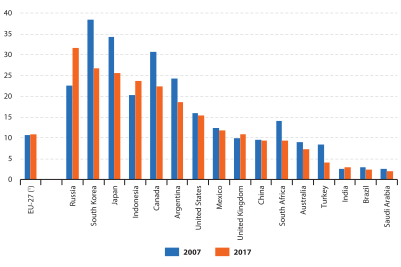
The total fish catch by the EU-27 fishing fleet was 4.8 million tonnes in 2017, 3.7 % less than had been caught in 2007. Relative to population size this was equivalent to 10.9 kg per inhabitant in 2017. The largest fish catch relative to population size among G20 members in 2017 was reported for Russia, 31.6 kg per inhabitant, some 2.9 times the level for the EU-27. Seven G20 members reported lower levels of fish catch per inhabitant than the EU-27: China, South Africa, Australia, Turkey, India, Brazil and Saudi Arabia.
Between 2007 and 2017, the fish catch relative to population size increased in Russia by 9.1 kg per inhabitant, far more than in any other G20 member (see Figure 14.8). Indonesia (up 3.3 kg per inhabitant), the United Kingdom (up 1.0 kg per inhabitant), India (up 0.3 kg per inhabitant) and the EU-27 (up 0.2 kg per inhabitant) were the only other G20 members to report an increase. South Korea, Japan and Canada had the largest levels of fish catch relative to population size in 2007 and they reported the largest decreases between 2007 and 2017 in their fish catches relative to their population size, each down by between 8.5 kg and 11.8 kg per inhabitant.
Figure 14.8: Fish catch, 2007 and 2017
(kg per inhabitant)
Note: more recent data are available from Eurobase for the United Kingdom. Catches in marine areas of all aquatic organisms except aquatic mammals.
(1) Estimates based on FAO data.
Source: Eurostat (online data code: demo_gind), the Food and Agriculture Organisation of the United Nations (Global Capture Production) and the United Nations Department of Economic and Social Affairs, Population Division (World Population Prospects 2019)
Aquaculture (also known as fish farming) refers to the farming of aquatic (freshwater or saltwater) organisms, such as fish, molluscs, crustaceans and plants for human use or consumption, under controlled conditions. Aquaculture implies some form of intervention in the natural rearing process to enhance production, including regular stocking, feeding and protection from predators.
Aquaculture production in the EU-27 was estimated at 2.5 kg per inhabitant (see Figure 14.9). While this was larger than in six of the other G20 members, it was far behind the levels of production observed in three Asian members in 2017, namely, South Korea (45.1 kg per inhabitant), China (45.3 kg per inhabitant) and Indonesia (60.1 kg per inhabitant).
Aquaculture production relative to population size fell between 2007 and 2017 in Japan and very slightly in the United States and the EU-27, while there was almost no change in the size of the relatively small levels of aquaculture in South Africa and Argentina. Elsewhere, increases in aquaculture production were greater than population increases, with particularly strong growth in the three Asian members with the highest levels of output per inhabitant, rising by 13.7 kg per inhabitant in China, 16.6 kg per inhabitant in South Korea and 46.6 kg per inhabitant in Indonesia. In relative terms, the highest increase in aquaculture production per inhabitant between 2007 and 2017 was also recorded in Indonesia, where output in 2017 was more than four times as high as it had been in 2007, while in Saudi Arabia production per inhabitant more than doubled.
Relative to population size, the EU-27’s combined fish catch and aquaculture production was estimated at 13.4 kg per inhabitant in 2017, a relatively low level compared with most other G20 members. The highest levels of production were witnessed in Indonesia and South Korea, with 83.8 kg per inhabitant and 71.8 kg per inhabitant respectively in 2017.
Figure 14.9: Aquaculture production, 2007 and 2017
(kg per inhabitant)

Note: production in inland waters and marine areas of all aquatic organisms except aquatic mamals.
(1) Estimates based on FAO data.
Source: Eurostat (online data codes: demo_gind), the Food and Agriculture Organisation of the United Nations (Global Aquaculture Production) and the United Nations Department of Economic and Social Affairs, Population Division (World Population Prospects 2019)