




-
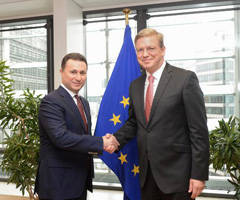 Commissioner Š.Füle met Prime Minister N. Gruevski
24/10/2014
Brussels (24 October) - Commissioner for Enlargement and European Neighbourhood Policy Štefan Füle met the Prime Minister of the former Yugoslav Republic of Macedonia Nikola Gruevski in Brussels today.They exchanged views on the findings of the recent Progress Report and looked back on the close co-operation over the past five years, and efforts that have been made to bring the country closer to the EU, including through the High Level Accession Dialogue. -
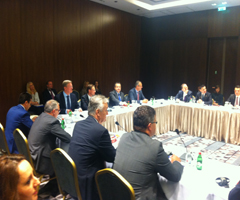 Economic governance and better connectivity: opportunities for Western Balkans
23/10/2014
Belgrade, (23 October) - Commissioner for Enlargement and European Neighbourhood Policy Štefan Füle together with Vice-President of the Commission Jyrki Katainen is attending the "Western Balkans Six" Ministerial Conference about new economic governance and better connectivity in the region. The meeting in Belgrade is attended by the Foreign Ministers and Economy or Finance Ministers from Albania, Bosnia and Herzegovina, former Yugoslav republic of Macedonia, Kosovo, Montenegro and Serbia. The aim of the discussions is discuss measures to strengthen economies, boost competitiveness, growth, investments and job creation in the countries of the Western Balkans in the framework of their EU accession process. -
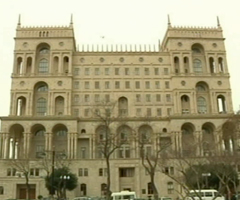 Statement by the Spokespersons of Catherine Ashton, the EU High Representative/Vice President, and Štefan Füle, Commissioner for Enlargement and European Neighbourhood Policy, on the amnesty announced by President Aliyev of Azerbaijan
20/10/2014
Brussels (20 October) - We welcome the amnesty announced by the President of Azerbaijan, Ilham Aliyev, on Friday 17 October, leading to the pardon and release of around 80 prisoners including at least four civil society activists. We greet this amnesty as a positive first step in reversing the trend of recent months. We urge the authorities in Azerbaijan to build upon this step by extending the amnesty to other individuals belonging to civil society organisations who currently face imprisonment. -
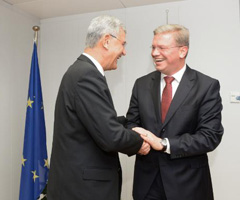 EU-Turkey: Meeting with Minister V.Bozkir in Brussels
16/10/2014
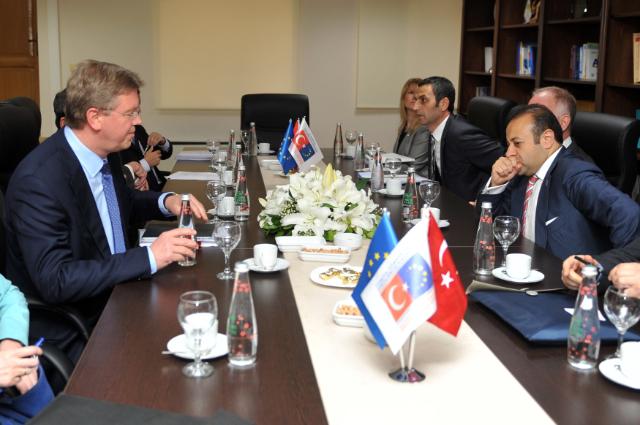
Brussels (16 October) - Commissioner for Enlargement and European Neighbourhood Policy Štefan Füle met the Turkish Minister of European Affairs and Chief Negotiator Volkan Bozkır in Brussels today. Commissioner Füle welcomed Minister Bozkir's ongoing commitment to the accession process and assured him of the Commission's support. He expressed his conviction that under the Minister's determined guidance, future reforms will bring Turkey closer to the EU.
European Commission
Štefan Füle
Accessibility tools
Service tools
Language selector
- cs
- Current languageen
Navigation path
- European Commission
- The Commissioners (2010-2014)
- Štefan Füle

01/11/14


Main menu
Contact
DIARY HIGHLIGHTS
Monday 27 October
Commissioner FÜLE in Naples, Italy: participates in event organised by Anna Lindh Foundation on the occasion of its 10th anniversary
Tuesday 28 October
Commissioner FÜLE in Naples, Italy: participates in the Mediterranean Award for Civil Society ceremony
Diary



Enlargement and European Neighbourhood Policy
- HEADLINES
-
- 1
- 2
- 3
- 4
PHOTO GALLERY






- 28/01/14 - Statement by President Barroso following the EU-Russia Summit
- 23/01/14 - EU-Moldova: relations developing at full speed
- 20/12/13 - New funding to support economic development, civil society and institution building in Armenia
- 16/12/13 - New EU regional development and protection programme for refugees and host communities in Lebanon, Jordan and Iraq
Stories from the Field
Reply to the petition of 'Free Belarus Now' on human rights violations in Belarus  [19 KB]
[19 KB]
The European Union closely follows the situation in Belarus and fully shares the concerns expressed in your petition as regards the human rights situation in Belarus. The EU has on numerous occasions expressed its grave concern regarding the lack of respect for human rights, the rule of law and democratic principles...

Customs Legislation Closer to EU Standards [192 KB]
[192 KB]
Customs legislation in the former Yugoslav Republic of Macedonia is well aligned with the body of EU law. But further measures are necessary. That is why, with the help of EU experts, the Macedonian customs legislation and procedures were assessed, and evaluated against the requirements of EU law.

"Garden of Serbia" - Helping Serbia's Agriculture Sector [662 KB]
[662 KB]
Even though it is one of the oldest industries in Serbia, agricultural production still faces several weaknesses and gaps in its value chain. Producers are constantly facing new requirements for food safety and quality standards in the processing sector yet there is a lack of demonstration centres for training and support for new initiatives.

Setting Up a National Food Reference Laboratory [349 KB]
[349 KB]
Designation of National Reference Laboratories is one of the requirements of EU legislation on official food and feed controls. In Turkey there was a need for a National Reference Laboratory to provide a higher quality food safety system and guidance for alignment with the relevant standards. The project was launched in 2005 to fill this gap and meet EU accession requirements.

EU Provides Vessels for the Border Police [73 KB]
[73 KB]
For many years Albania has struggled to police effectively its maritime borders. Illicit trafficking has constituted a security threat to Albania and to its neighbours. The Albanian capacity to patrol its maritime borders remains a major concern, although the government’s efforts together with a strong international presence at sea, have had a positive impact.

Helping the Central Bank of Bosnia and Herzegovina adapt to EU Banking Standards [489 KB]
[489 KB]
The Bosnia and Herzegovina Central Bank (CBBH) has contributed to the country’s post-war recovery. It has made significant progress towards introducing administrative and policy mechanisms that will allow it to participate fully in the European System of Central Banks when Bosnia and Herzegovina becomes an EU member.

Ears Wide Open – EU Promotes Inclusion of People with Disabilities [379 KB]
[379 KB]
There are around 430,000 people with disabilities in Croatia, 9.7% of the total population. The Ears Wide Open project was designed to improve working conditions, communication and integration of students with hearing and other disabilities, both in schools and later in workplaces.

“Let me tell you a secret about the environment” [132 KB]
[132 KB]
Teaching children about the environment is vital for the future. That is why the EU, together with the Ministry of Labour and Social Policy of the former Yugoslav Republic of Macedonia, organised a project around a play based on the brochure
"Let me tell you a secret about the environment".

Efficient Energy Use in Public Buildings [580 KB]
[580 KB]
Kosovo faces a big challenge in the field of energy efficiency due to low levels of energy production and high levels of energy consumption. The EU funded a project to invest in energy-saving measures in public buildings, which brought
environmental and economic benefits.

Modernising Quality Infrastructure [153 KB]
[153 KB]
Montenegro's preparations for European Union accession in the area of free movement of goods are moderately advanced. The country needs to build up its institutional and administrative capacity, enhance cooperation between State institutions and align its legal framework with EU legislation.
Last update: 17/11/2014 |
Top