Reference metadata describe statistical concepts and methodologies used for the collection and generation of data. They provide information on data quality and, since they are strongly content-oriented, assist users in interpreting the data. Reference metadata, unlike structural metadata, can be decoupled from the data.
Central Statistics Office, Skehard Road, Cork T12 X00E, Ireland
1.6. Contact email address
Confidential because of GDPR
1.7. Contact phone number
Confidential because of GDPR
1.8. Contact fax number
Confidential because of GDPR
2.1. Metadata last certified
7 July 2026
2.2. Metadata last posted
7 July 2026
2.3. Metadata last update
7 July 2026
3.1. Data description
The CSO’s Production in Building and Construction Index provides a short-term indicator of output in the construction sector. The index monitors trends in the value and the volume of production in building and construction.
The primary purpose of the index is to measure changes in “Value Added" of construction work done at constant prices.
The “Capital Goods price index for building and construction materials” is used as the price deflator for this series.
3.2. Classification system
NACE Rev. 2 - Each company surveyed is asked to break down their work done into product level i.e. the CC categories for residential, non residential and civil engineering. Thus the product level is assigned independent of NACE.
3.3. Coverage - sector
Activity coverage: Sector F (41-43) of NACE Rev. 2.
Size coverage: All enterprises with employment size classes of at least 50 persons are included and the Neyman allocation method is used to optimally select sample sizes for the remaining size classes.
This is a stratified sampling method, splitting the sample into sub-samples.
Size class by NACE Rev. 2 group is considered as a sub-sample when choosing samples for the MSC.
3.4. Statistical concepts and definitions
The subject of the statistics is the value of construction work done. The quarterly production in building and construction index provides quarterly statistics on output in the sector. The index monitors trends in the value and the volume of production in building and construction.
The primary purpose of the index is to measure changes in value added at constant prices.
The volume of work done is derived from the value figures using the Wholesale Prices Index (WPI) “Capital goods for Building and Construction materials” index as a deflator. The CSO collects absolute values and publishes a quarterly index, which is derived by comparing results for the current quarter, and the same quarter in the previous year. For the monthly series transmitted to Eurostat, the current monthly data is compared to the previous month's data.
The Production in Building and Construction Index is calculated using a modified fixed weight Laspeyres index.
3.5. Statistical unit
Administrative Source : Enterprise
Reporting unit: Any enterprise classified to Sector F of NACE Rev. 2.
3.6. Statistical population
The MSC is a sample survey. Approximately 1,500 companies are surveyed each month.
The CSO's Business Register provides the basis for the MSC Sample. Each year a Sampling Frame is provided of all enterprises and the latest available Sampling Frame is used to choose the MSC sample. The population comprises all enterprises classified to Sector F of NACE Rev. 2.
The sampled enterprises are held on a local MSC Register. The Business Register and MSC register are synchronised annually. However, the MSC Register is also updated more frequently based on survey returns and other information received.
3.7. Reference area
Republic of Ireland.
3.8. Coverage - Time
The results from 2003 onwards have been calculated from the survey returns. In the absence of survey data prior to 2003, a retrospectively derived series was calculated, back to 2000, using a combination of data sources.
First results from the survey were published in August 2007
Prior to 2022, quarterly data was collected on a quarterly basis. For 2022-2023, respondents were asked for a monthly breakdown of the quality data. From 2024 onwards, respondents were required to submit monthly values on a monthly basis
3.9. Base period
MSC Base (Reference) Year: 2021
QSC Base (Reference) Year: 2021. The rebasing of the indices occured alongside the Q3 2025 publication.
Data - Collected in Euro.
Data - Disseminated as indices.
Reference Month for Monthly Series
Reference Quarter for Quarterly published series
6.1. Institutional Mandate - legal acts and other agreements
Legal basis:
This survey is carried out in accordance with the Statistics (Monthly Survey of Construction) Order, 2023, Number 446, made under the 1993 Statistics Act. The statistics are also required for EU comparisons under Council Regulation (EC) No 2019/2152 and amended by Regulation (EC) No.2021/1704.
6.2. Institutional Mandate - data sharing
Section 34 of the 1993 Statistics Act states:
The Office may provide, for statistical purposes only, information obtained in any way under this Act or the repealed enactments, in such form that it cannot be directly or indirectly related to an identifiable person or undertaking, to such persons and subject to such charges, conditions and restrictions as the Director General may determine.
The data is not sent to the OECD, UN, IMF or other international organisations.
7.1. Confidentiality - policy
The provision on statistical confidentiality is regulated by Sections 32 and 33 of the 1993 Statistics Act.
Section 32 states:
All information furnished by a person, undertaking or public authority under this Act shall be used only for statistical compilation and analysis purposes.
Section 33 states:
No information obtained in any way under this Act or the repealed enactments which can be related to an identifiable person or undertaking shall, except with the written consent of that person or undertaking or the personal representative or next-of-kin of a deceased person, be disseminated, shown or communicated to any person or body except as follows:
for the purposes of a prosecution for an offence under this Act;
to officers of statistics in the course of their duties under this Act;
for the purposes of recording such information solely for the use of the Office in such form and manner as is provided for by a contract in writing made by the Director General which protects its confidentiality to his satisfaction.
The Office may, for statistical purposes only, assign codes derived from information collected under this Act classifying undertakings listed in the administrative systems of other public authorities by economic activity and size (persons engaged) categories.
The Taoiseach may by order prescribe such further prohibitions on the disclosure of identifiable records or information obtained under this Act or the repealed enactments for such periods as may be prescribed.
Nothing in this Act shall be construed to require any person or undertaking to provide information in relation to a matter on which information was sought in circumstances that would entitle the person or undertaking to decline to give the information in a civil proceeding in any court or on grounds of privilege.
7.2. Confidentiality - data treatment
All data collected is treated as confidential.
8.1. Release calendar
A twelve month advance release calendar is published on the CSO website.
No users have prior access to the data before its general release. Data are made available to all users simultaneously on predefined days on the CSO website:
The production index is further used for estimation purposes in national accounts – Preliminary Series are transmitted to National Accounts within 60 days after the end of the quarterly reference period. Provisional data are transmitted to National Accounts on the same day as the national publication within 75 days of the quarterly reference period. The transmission is done via email.
Transmission to Eurostat:
Preliminary Monthly Series are transmitted to Eurostat within 45 days after the end of the monthly reference period. Provisional monthly data are transmitted within 75 days of the monthly reference period. The transmission is done via eDamis.
Monthly: Eurostat
Quarterly: Nationally
10.1. Dissemination format - News release
News releases for indices of production of building construction and civil engineering are not produced on a regular basis. An advisory note was published with the Q1 2025 data to inform users that a new base year was coming into effect later that year
Following this, the advisory note was edited for the Q3 2025 publication to inform users that the rebasing process had been completed and would not be used going forward.
The MSC is designed as a short term indicator, so while it provides good estimates of month-on-month change, it is not designed to be used to examine long term or structural changes in the construction sector.
11.1.1.2 Non-Sampling Effects
Sample Selection is taken from the CSO Central Business Register. Coverage is dependent on the quality of the Register used. Updates to the Register are made continually throughout each year, to improve the quality.
All enterprises classified under NACE Rev 2, Sector F are available for sample selection.
A Neyman Allocation is used to optimally select the samples by size class and NACE Rev 2 Group for size classes A (1-4 employees), B (5-19 employees) and 50% of C1 (20-49 employees), while all of size classes C2 (50-99 employees) and D (100 or more employees) are included.
Construction firms return data through an online questionnaire.
Extensive follow up of non-responding companies is carried out by telephone, e-mail, and by issuing email reminders.
Data is compared at local level. Data for the current month is compared with data for the previous month.
Edits have been developed to compare values for variables in each category of work done against previous returns. If differences exceed specified thresholds, an edit is raised. The system produces lists of errors for each type of edit each month. These are then analysed and records are corrected as appropriate.
It is assumed that non-respondents have the same characteristics as respondents Grossing or imputation is not used when generating results for the MSC, however, weighting is used. Weights have been derived for each category of construction by size class.
Each firm is size coded at the time of rebasing the series. So the size classes are based on activity in the middle of the base period. It is assumed that each firm remains in the same size class throughout the base period.
11.1.2 Timeliness and Punctuality
11.1.2.1 Provisional Results
Provisional Results are produced for the current month within 75 days of the reference date. The release contains value and volume indices together with annual percentage change for production in Building and Construction and also for subsectors such as Civil Engineering, Residential and Non-Residential, together with EU comparative data.
11.1.2.2 Final Results
Final results are provided for the last published quarter - e.g. if the current quarter published is q1 2025 then final results for q4 2024 will be produced within 150 days of the reference date. The release table details are the same as those outlined in section 5.3.1 for provisional results.
11.1.3 Coherence
Data from the QSC is checked for consistency with other data sources such as:
LFS - numbers employed in construction.
Earnings, Hours and Labour Costs Survey (EHECS) - average hourly and weekly rate, hours worked
Planning Permissions - number of units granted planning permission
New Dwellings Completions Series
Commencement Notices
House Registrations
The MSC and QSC compare reasonably with these indicators in value and volume of construction output in Ireland.
11.1.4 Comparability
Due to the rebasing of the published quarterly series from 2015 to 2021 and a key change in methodology with the explicit removal of subcontractor contributions to the value of work done. Due to the difference in methodology fair comparisons can be made from Q1 2000 to Q2 2025 and from 2021 onwards with the new series.
11.1.5 Accessibility and Clarity
11.1.5.1 Assistance to Users, Special Analyses
The publications, background notes and methodology documents are available on the CSO website.
Further methodological details and other information can be found in point 13. Accuracy.
Data from the MSC is checked for consistency with other data sources such as:
LFS - numbers employed in construction.
Earnings, Hours and Employment Costs Survey (EHECS) - average hourly and weekly rate, hours worked
Planning Permissions - number of units granted planning permission
New Dwelling Completions Series
Commencement Notices
House Registrations
The trends between series are consistent on a quarterly basis regarding numbers employed and hours worked. There is a lag of one quarter between planning permissions and work done. House completions and commencements are more consistent with the QSC/ MSC on an annual basis. As a result, there are no obvious weak points.
12.1. Relevance - User Needs
The QSC/ MSC is designed as a short term indicator, so while it provides good estimates of quarter-on- quarter change, it is not designed to be used to examine long term or structural changes in the construction sector. It is of relevance to the following user groups:-
Eurostat
Government
Economists
Other CSO sections
The general public
Professional Bodies
University students and other interest groups for research purposes
12.2. Relevance - User Satisfaction
No index for user satisfaction is available, but there are regular meetings with national experts and essential users to react to new requirements, if these are not in contrast with legal necessities or constraints. In addition a user’s satisfaction survey takes place in periodic intervals.
12.3. Completeness
The production index is fully compliant regarding Council Regulation (EC) 2019/ 2152 and the amendments made by Council Regulation No. 1893/2006. (All the required series are produced although the classification system used for breakdown of total construction does not follow the STS regulations (NACE Rev. 2 instead of Classification of Types of Construction (CC)).
13.1. Accuracy - overall
For interpretation of results, users have to be aware that every index draws a picture of reality in a simplified way.
There is no statistical model which is able to represent the complexity of reality in total.
A benchmarking exercise is carried out annually by the annual survey of construction against the quarterly returns and the match is excellent on the value of work done. The volume of work done is derived by deflating the value by the price index of building and construction (including wages and materials).
The sample selection technique used minimizes sampling error (details given in 13.2). Also non-response contributes to non-sampling error but with relatively high response rates (circa 40-50%) the effect should be small. Key companies are also targeted for non-response leading to response rate of close to 100% within this list.
Provisional and final indices in general report same trends - Difference in volume index between provisional and final between 2024Q1 and 2024Q4 varied between +0.3% and +2.7%.
13.2. Sampling error
The sample design is as follows:
All enterprises within Sizeclass C2 (50 or more employees-set at rebase) or D (100 or more employees) are included. Also all that responded in either of last 2 quarters are included (except those non-census enterprises who have responded in 5 last consecutive quarters are given survey break). The remainder are divided into strata based on sizeclass (A and B) and NACE. The number to be randomly selected from each stratum is determined using Neyman Allocation (applying minimum strata size where available of 25).
With regards to Sizeclasses A and B:
Sample Size by NACE
Table of sizecodex by nace3
sizecodex
nace3
Total
Frequency
411
412
421
422
429
431
432
433
439
Total
31
210
28
8
24
12
211
168
139
831
A
18
88
11
1
12
4
104
104
72
414
B
13
122
17
7
12
8
107
64
67
417
Frame Size by NACE
Table of sizecodex by nace3
sizecodex
nace3
Total
Frequency
411
412
421
422
429
431
432
433
439
Total
1179
6961
483
184
498
411
6696
7650
4639
28701
A
998
5605
340
129
393
342
5271
6694
3806
23578
B
181
1356
143
55
105
69
1425
956
833
5123
A method of measurement of sampling error is currently under development.
13.3. Non-sampling error
Detailed information on non-sampling errors, as applicable to the MSC are as follows:
Coverage errors - Neyman Allocation should be providing optimal allocation (based on employment levels) for strata A, B and C1 - while strata C2 and D are fully covered.
Data collection errors - Negligible - Forms are sent by email to construction firms. The use of online questionnaires reduces the risk of data capture error.
Edits have been developed to compare values for variables in each category of work done against previous returns. If differences exceed specified thresholds, an edit is raised. The system produces lists of errors for each type of edit each month. These are then analysed and records are corrected as appropriate.
Unit and item non-response (missing data) - Final response levels at approx. 40-45% - All strata should be well represented in responses.
Data processing errors - Minimal - If any they will be picked up while processing for index calculations (There are 2 versions of programs run simultaneously by 2 different persons to ensure processing completed correctly).
Model errors - It is assumed that non- respondents have the same characteristics as respondents. Grossing or imputation is not used when generating results for the MSC and QSC publication, however, weighting is used. Weights have been derived for each category of construction by sizeclass. Each firm is sizecoded at the time of rebasing the series. Thus the sizeclasses are based on activity in the middle of the base period. It is assumed that each firm remains in the same sizeclass throughout the base period.
14.1. Timeliness
At the end of the reference month, online questionnaires are sent by email to the enterprises asking them to fill out the relevant data within a 2 week period.
Missing responses are then requested by email reminders and certain enterprises are also contacted by phone.
Provisional Results are produced for the current month within 45 days of the reference month and current quarter within 75 days of the reference date. The release contains value and volume indices together with annual percentage change for production in Building and Construction and also for subsectors such as Civil Engineering, Residential and Non-Residential, together with EU comparative data.
Provisional monthly results are transmitted to Eurostat through the Edamis platform.
Final quarterly results are published nationally within 150 days of the reference date.
14.2. Punctuality
National publications have always been on time.
Deliveries to Eurostat have also always been on time.
15.1. Comparability - geographical
It is possible to compare calculated Irish aggregates with those of other European countries, due to harmonised STS indices in the European Union.
Moreover, the production index is provided to UN on ISIC Rev. 4 to enable further country comparisons.
15.2. Comparability - over time
Comparisons are made between quarters going back to Q1 2000 and there is no break in the time series.
15.3. Coherence - cross domain
Cross-checks with absolute STS data in industry and construction
Compare over period: compare with previous STS-values (previous month and year)
SBS data (e.g. activity, turnover)
Data from the QSC is also checked for consistency with other data sources such as:
Labour Force Survey (LFS) - numbers employed in construction.
Earnings, Hours and Employment and Costs Survey (EHECS) - average hourly and weekly rate, hours worked
Planning Permissions - number of units granted planning permission
New Dwellings Completions Series
Commencement Notices
House Registrations
An analysis quantifying the differences between the above is not published but one reason is that each data series serves a different purpose. An internal coherence exercise is undertaken on a quarterly basis as follows:
LFS: when the numbers employed in construction rise or fall one would expect the volume of construction to similarly rise or fall.
EHECS: when the number of hours worked in construction rise or fall one would expect the volume of construction to similarly rise or fall.
When I compare trends of planning permissions by product (residential, civil engineering and non residential) planning permissions predict the trend of the QSC by one quarter.
House completions data series are based on the number of new dwellings connected by ESB Networks to the electricity supply. This statistic represents the number of homes completed in a given period and does not reflect any work-in progress.
15.4. Coherence - internal
Non residential and civil engineering products are classified by the enterprise surveyed.
Total cost of survey production: In order to reduce the burden on enterprises a review of the QSC was carried out in 2010 using Lean Six Sigma. As a result a number of methodological changes were introduced, which included reducing the content and complexity of the original questionnaire.
This revision policy is described in footnotes given for the relevant tables and in the description of the respective statistics.
There is at least one quarter advance notice given for major changes in methodology by including footnotes in the respective tables.
We also have a database called PxStat, which contains all published data of the QSC, and it has an audit trail of all revisions going back since the survey was first introduced a decade ago.
Any revisions made nationally are transmitted to Eurostat at the same time.
17.2. Data revision - practice
Revisions are made to provisional data due to late returns or amendments being required on existing returns. Revised data becomes final data.
Data is revised within one quarter and is marked as provisional until then. The data series back to the rebase year is revised during a rebase e.g. data was revised back to Q1 2021 in the most recent rebase.
Production in Construction data is typically revised once. Early indices are published 75 days after the end of the reference period and final indices are published 150 days after the end of the reference period.
Data was revised in March 2021 back to Q1 2015 due to a correction of an error in the applicaton of the Laspeyres Index and to the revision of the deflator that is used.
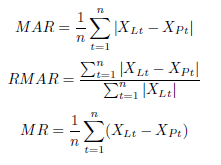
The Quality Indicators used in the data revision practice are: MAR (Mean Absolute Revision) and MR (Mean Revision).
The formulas used to calculate these QI are:
The computed values for the last 20 quarterly Production in Building and Construction indicators are:
Annuanl Growth rates for unadjusted volume data series (YoY):
PROD:F: MAR = 0.030 , RMAR = 0.245 , MR = -0.0049
18.1. Source data
Type of source: Statistical sample survey of enterprises from the MSC Register.
The Central Business Register in the CSO provides the basis for the MSC Register.
The Business Register is updated continuously based on various Revenue sources and on survey returns. The Business Register and MSC Register are synchronised annually. As part of this, manual checks are done on birthing / ceasing enterprises with 50 or more employees or turnover >= 20 million. Other enterprises are birthed automatically. Manual checks are also done before ceasing enterprises which sent in a survey return in the previous year.
The MSC Register is also updated more frequently based on survey returns and other information received.
The MSC is a sample survey. All enterprises classified under NACE Rev 2, Sector F are available for sample selection.
Approximately 1,500 companies are surveyed each quarter. This consists of a census of approximately 300 enterprises with 50 or more persons engaged and the remainder is a random sample of the smaller units stratified by activity (NACE Revision 2) and employment size class.
Frequency of updating the sample: Monthly
18.2. Frequency of data collection
Data is collected on a monthly basis.
18.3. Data collection
Data are collected by online questionnaire.
Emails and telephone calls are used to seek the return of forms from non-respondents.
18.4. Data validation
A number of validation procedures are in place for all returned data. Edits have been developed to compare values for variables in each category of work done against previous returns. If differences exceed specified thresholds, an edit is raised. The system produces lists of errors for each type of edit each quarter. These are then analysed and records are corrected as appropriate.
SDMX is the tool we use in validating the structure of the file and codes used that is submitted to Eurostat. It has been in use since the submission of the Q1 2019 data in June 2019.
18.5. Data compilation
The inquiry is used to obtain information on the value of construction work done.
Volume indices are derived from value figures using the Wholesale Prices Index (WPI) “Capital goods for Building and Construction materials” index as a deflator.
The QSC Index is calculated using a modified fixed weight Laspeyres index:
(∑Wq-1(CTq//CTq-1)/∑W0)*100
W0and W q-1 are the base weights and updated values respectively.
CTqand CTq-1 are the category values of production (or output) for the current and previous quarter respectively.
In the case of the QSC, 3 base weights are used, one for each category of construction work. The compilation of the index for the current quarter (q) is based on the percentage change in the value of quarterly production (based on a matched sample) over the previous quarter.
The quarterly production in building and construction index provides quarterly statistics on output in the construction sector. The index monitors trends in the value and the volume of production in building and construction.
It is assumed that non- respondents have the same characteristics as respondents. Grossing or imputation is not used when generating results for the QSC, however, weighting is used. Weights have been derived for each category of construction by sizeclass.
Each firm is sizecoded at the time of rebasing the series. Thus sizeclasses are based on activity in the middle of the base period. It is assumed that each firm remains in the same sizeclass throughout the base period.
Frequency of weight update: Every 5 years.
Note: This calculation methodology is currently undergoing review within the CSO and changes might be implemented at a future date.
With regards to the MSC. 3 base weights are used (F41, F42 and F43) The calculation of the index for the current month is based on the percentage change in the volume of monthly production (volume is achieved by applying a price deflator to the value amounts) over the previous month.
18.6. Adjustment
Seasonal Adjustment is conducted using the direct seasonal adjustment approach. Under this approach each individual series is independently adjusted. Each individual seasonally adjusted series is calculated based on working day adjusted data.
The adjustments are completed by applying the X-13-ARIMA model, developed by the U.S. Census Bureau to the working day adjusted data. This methodology estimates seasonal factors while also taking into consideration factors that impact on the quality of the seasonal adjustment such as:
The CSO’s Production in Building and Construction Index provides a short-term indicator of output in the construction sector. The index monitors trends in the value and the volume of production in building and construction.
The primary purpose of the index is to measure changes in “Value Added" of construction work done at constant prices.
The “Capital Goods price index for building and construction materials” is used as the price deflator for this series.
7 July 2026
The subject of the statistics is the value of construction work done. The quarterly production in building and construction index provides quarterly statistics on output in the sector. The index monitors trends in the value and the volume of production in building and construction.
The primary purpose of the index is to measure changes in value added at constant prices.
The volume of work done is derived from the value figures using the Wholesale Prices Index (WPI) “Capital goods for Building and Construction materials” index as a deflator. The CSO collects absolute values and publishes a quarterly index, which is derived by comparing results for the current quarter, and the same quarter in the previous year. For the monthly series transmitted to Eurostat, the current monthly data is compared to the previous month's data.
The Production in Building and Construction Index is calculated using a modified fixed weight Laspeyres index.
Administrative Source : Enterprise
Reporting unit: Any enterprise classified to Sector F of NACE Rev. 2.
The MSC is a sample survey. Approximately 1,500 companies are surveyed each month.
The CSO's Business Register provides the basis for the MSC Sample. Each year a Sampling Frame is provided of all enterprises and the latest available Sampling Frame is used to choose the MSC sample. The population comprises all enterprises classified to Sector F of NACE Rev. 2.
The sampled enterprises are held on a local MSC Register. The Business Register and MSC register are synchronised annually. However, the MSC Register is also updated more frequently based on survey returns and other information received.
Republic of Ireland.
Reference Month for Monthly Series
Reference Quarter for Quarterly published series
For interpretation of results, users have to be aware that every index draws a picture of reality in a simplified way.
There is no statistical model which is able to represent the complexity of reality in total.
A benchmarking exercise is carried out annually by the annual survey of construction against the quarterly returns and the match is excellent on the value of work done. The volume of work done is derived by deflating the value by the price index of building and construction (including wages and materials).
The sample selection technique used minimizes sampling error (details given in 13.2). Also non-response contributes to non-sampling error but with relatively high response rates (circa 40-50%) the effect should be small. Key companies are also targeted for non-response leading to response rate of close to 100% within this list.
Provisional and final indices in general report same trends - Difference in volume index between provisional and final between 2024Q1 and 2024Q4 varied between +0.3% and +2.7%.
Data - Collected in Euro.
Data - Disseminated as indices.
The inquiry is used to obtain information on the value of construction work done.
Volume indices are derived from value figures using the Wholesale Prices Index (WPI) “Capital goods for Building and Construction materials” index as a deflator.
The QSC Index is calculated using a modified fixed weight Laspeyres index:
(∑Wq-1(CTq//CTq-1)/∑W0)*100
W0and W q-1 are the base weights and updated values respectively.
CTqand CTq-1 are the category values of production (or output) for the current and previous quarter respectively.
In the case of the QSC, 3 base weights are used, one for each category of construction work. The compilation of the index for the current quarter (q) is based on the percentage change in the value of quarterly production (based on a matched sample) over the previous quarter.
The quarterly production in building and construction index provides quarterly statistics on output in the construction sector. The index monitors trends in the value and the volume of production in building and construction.
It is assumed that non- respondents have the same characteristics as respondents. Grossing or imputation is not used when generating results for the QSC, however, weighting is used. Weights have been derived for each category of construction by sizeclass.
Each firm is sizecoded at the time of rebasing the series. Thus sizeclasses are based on activity in the middle of the base period. It is assumed that each firm remains in the same sizeclass throughout the base period.
Frequency of weight update: Every 5 years.
Note: This calculation methodology is currently undergoing review within the CSO and changes might be implemented at a future date.
With regards to the MSC. 3 base weights are used (F41, F42 and F43) The calculation of the index for the current month is based on the percentage change in the volume of monthly production (volume is achieved by applying a price deflator to the value amounts) over the previous month.
Type of source: Statistical sample survey of enterprises from the MSC Register.
The Central Business Register in the CSO provides the basis for the MSC Register.
The Business Register is updated continuously based on various Revenue sources and on survey returns. The Business Register and MSC Register are synchronised annually. As part of this, manual checks are done on birthing / ceasing enterprises with 50 or more employees or turnover >= 20 million. Other enterprises are birthed automatically. Manual checks are also done before ceasing enterprises which sent in a survey return in the previous year.
The MSC Register is also updated more frequently based on survey returns and other information received.
The MSC is a sample survey. All enterprises classified under NACE Rev 2, Sector F are available for sample selection.
Approximately 1,500 companies are surveyed each quarter. This consists of a census of approximately 300 enterprises with 50 or more persons engaged and the remainder is a random sample of the smaller units stratified by activity (NACE Revision 2) and employment size class.
Frequency of updating the sample: Monthly
Monthly: Eurostat
Quarterly: Nationally
At the end of the reference month, online questionnaires are sent by email to the enterprises asking them to fill out the relevant data within a 2 week period.
Missing responses are then requested by email reminders and certain enterprises are also contacted by phone.
Provisional Results are produced for the current month within 45 days of the reference month and current quarter within 75 days of the reference date. The release contains value and volume indices together with annual percentage change for production in Building and Construction and also for subsectors such as Civil Engineering, Residential and Non-Residential, together with EU comparative data.
Provisional monthly results are transmitted to Eurostat through the Edamis platform.
Final quarterly results are published nationally within 150 days of the reference date.
It is possible to compare calculated Irish aggregates with those of other European countries, due to harmonised STS indices in the European Union.
Moreover, the production index is provided to UN on ISIC Rev. 4 to enable further country comparisons.
Comparisons are made between quarters going back to Q1 2000 and there is no break in the time series.