Reference metadata describe statistical concepts and methodologies used for the collection and generation of data. They provide information on data quality and, since they are strongly content-oriented, assist users in interpreting the data. Reference metadata, unlike structural metadata, can be decoupled from the data.
Department of business statistics short-term indicators
1.3. Contact name
Confidential because of GDPR
1.4. Contact person function
Confidential because of GDPR
1.5. Contact mail address
IV Proleterske no. 2 , 81000 Podgorica Montenegro
1.6. Contact email address
Confidential because of GDPR
1.7. Contact phone number
Confidential because of GDPR
1.8. Contact fax number
Confidential because of GDPR
2.1. Metadata last certified
10 September 2020
2.2. Metadata last posted
15 September 2021
2.3. Metadata last update
18 January 2022
3.1. Data description
Road freight data collection consists of three datasets with quarterly periodicity: 1. Vehicle related variables dataset for a sample of road good motor vehicles contain, among others, indication about the type and age of the vehicle, the economic activity of the owner of the vehicle, the total kilometres loaded or empty. 2. Journey related variables dataset which contain, among other indications about weight of goods, regions of loading and unloading, distance driven, and tonne-kilometres performed during a journey 3. Goods related variables dataset which contain among others the type of goods transported and their weight and distance travelled, regions of loading and unloading.
3.2. Classification system
Statistics on carriage of goods by road apply the following statistical classifications:
The optional variable type of cargo follows the Classification of Cargo Types of UNECE (United Nations, Economic Commission for Europe - codes for types of cargo, packages and packaging materials, Recommendation 21 adopted by the Working Party on Facilitation of International Trade Procedures, Geneva, March 1986).
A goods road motor vehicle is any single road transport vehicle (lorry), or combination of road vehicles, namely road train (lorry with trailer) or articulated vehicle (road tractor with semi-trailer), designed to carry goods Cross-trade is international road transport between two different countries performed by a road motor vehicle registered in a third country. National transport is Road transport between two places (a place of loading and a place of unloading) located in the same country by a vehicle registered in that country. International transport is Road transport between two places (a place of loading and a place of unloading) in two different countries and cabotage by road. It may involve transit through one or more additional country or countries. Cross trade is International road transport between two different countries performed by a road motor vehicle registered in a third country. Transit is any loaded or empty road motor vehicle, which enters and leaves a country at different points by whatever means of transport, provided the total journey within the country is by road and that there is no loading or unloading in the country. Goods carried by road are any goods moved by goods vehicle Place of loading/unloading of a goods road vehicle on another mode of transport
Place of loading (of the goods road transport vehicle on another mode of transport): The place of loading is the first place where the goods road motor vehicle was loaded on to another mode of transport (usually a ship or a rail wagon).
Place of unloading (of the goods road transport vehicle from another mode of transport): The place of unloading is the last place where the goods road motor vehicle was unloaded from another mode of transport (usually a ship or a rail wagon).
3.5. Statistical unit
The reporting unit for road freight transport statistics is the goods road transport vehicle or the local unit (a site of a company, as identified in the national business register).
3.6. Statistical population
As the total number of statistical units (most commonly vehicles) is very large, sample surveys are carried out to collect information.
3.7. Reference area
The data provided are goods vehicles registered in the declaring country uniquely.
3.8. Coverage - Time
2016
3.9. Base period
Not applicable.
Data are collected in tonnes, tonne-kilometres, vehicle-kilometres and in number of journeys (journey data) or in number of basic transport operations (BTO (goods related data)).
The road data are collected on a quarterly basis and are reported to Eurostat five months after the end of the reference period.
6.1. Institutional Mandate - legal acts and other agreements
National level:
The legal basis for the implementation of transport statistical survey is the Law on Official Statistics and Official Statistical System of Montenegro ("Official Gazette of Montenegro“, No. 18/12 from 30. 03. 2012) and Annual Plan for statistical surveys.
Eurostat submits annually semi-aggregated data (data exchange tables, see Commission Regulation (EU) No 202/2010 amending the Commission Regulation (EC) 6/2003) back to the reporting countries so that they can compile the total road freight transport on their national territories, including the operations by national hauliers and also those of all other reporting countries.
These data exchange tables include more detailed breakdowns than the publicly available tables. They also include, for each value, the information on the number of observations that the estimates are based on. In this way, the reporting countries can estimate the reliability of results that they aggregate from the data exchange tables.
7.1. Confidentiality - policy
National level:
Treatment of confidentiality data is regulated by Law on Official Statistics and Official Statistical System (Official Gazette of Montenegro 18/12), Chapter XIII Confidentiality and protection of data for needs of official statistics (Articles 54-61).
European level:
Regulation (EC) No 223/2009 on European statistics (recital 24 and Article 20(4)) of 11 March 2009 (OJ L 87, p. 164), stipulates the need to establish common principles and guidelines ensuring the confidentiality of data used for the production of European statistics and the access to those confidential data with due account for technical developments and the requirements of users in a democratic society.
7.2. Confidentiality - data treatment
The Law on Official Statistics and Official Statistical System (Official Gazette of Montenegro No 18/12) regulates rules under which external users can obtain an access to individual data for needs of research. Article 58 defines types of scientific and research organizations that can obtain such data. Providing individual data without identifier is possible only upon a written request of scientific and research institutions, with purpose of performing scientific and research activities as well as international statistical organizations and statistical producers from other countries. Research entity signs the agreement with Statistical Office, and it signs the statement on respecting the confidentiality principle. Official statistical producers keeps a separate records on users and purpose of using the statistical data given to these users.
The data presented in tables and graphs are available on our website as well as Android application for smart phones.
8.1. Release calendar
The data obtained by the survey are published on the basis of the document " Data publishing calendar" that is being prepared in the current year for the next. http://www.monstat.org/eng/page.php?id=12&pageid=12
8.2. Release calendar access
The data obtained by the survey are published on the basis of the document " Data publishing calendar" that is being prepared in the current year for the next. http://www.monstat.org/eng/page.php?id=12&pageid=12
First data are published in accordance with the release calendar as Latest news at 11:00 (local time) on the day of release.
According to the Law on Official Statistics and Official Statistical System „Official Gazette of Montenegro 18/12“ from 30 March 2012, statistical data are available in the same time for all users: www.monstat.org
Data are published quarterly according to the Statistical Data Release Calendar (45 days after the end of the reference period).
10.1. Dissemination format - News release
Quartetly release of transport statistics in which data are published and road freight transport, is produced quarterly. MONSTAT published only on the key variables: the transport of goods, tonne-kilometers and kilometers made of vehicles.
The structure of the published data is defined by the type of transport on hire and reward and transport for their own accounts. Then, on the national and international transport.
10.2. Dissemination format - Publications
The data are published in the following statistical publications:(i) Statistical Yearbook, (ii) the Monthly Statistical Review, (iii) statistical releases and (iv) in the publication "Annual statistics of transport, storage and communications.
Metadata can be found on the web address: http://www.monstat.org/eng/prikazi_metapodatke.php?id=1001&pageid=1001&name=Quarterly survey on transport
10.4. Dissemination format - microdata access
The Law on Official Statistics and Official Statistical System (Official Gazette of Montenegro No 18/12) regulates rules under which external users can obtain an access to individual data for needs of research. Article 58 defines types of scientific and research organizations that can obtain such data. Providing individual data without identifier is possible only upon a written request of scientific and research institutions, with purpose of performing scientific and research activities as well as international statistical organizations and statistical producers from other countries. Research entity signs the agreement with Statistical Office, and it signs the statement on respecting the confidentiality principle. Official statistical producers keeps a separate records on users and purpose of using the statistical data given to these users
10.5. Dissemination format - other
The data which are required by Eurostat: A1- variables related to vehicles, A2 - variables related to journey, A3 - variables related to goods, are sent through the portal eDAMIS
The role of quality reporting had been strengthened in Law of official statistics and official statistical system (Official Gazette of Montenegro 18/12 from 30 March 2012) as well as in Regulation 223/2009 on European Statistics. Producers of official statistics have to guarantee that statistics are developed, produced and disseminated on the basis of uniform standards and of harmonized methods.
Furthermore, users of statistics are guaranteed access to appropriate metadata describing the quality of statistical outputs, so that they are able to interpret and use the statistics correctly.
Quality report available link: http://www.monstat.org/eng/page.php?id=1425&pageid=1425
11.2. Quality management - assessment
MONSTAT as producer of official statistics have to guarantee that statistics are developed, produced and disseminated on the basis of uniform standards and of harmonized methods
12.1. Relevance - User Needs
Main users of data are classified into two groups:
International data users: Eurostat, World Bank, UN organizations, International Monetary Fund.The data which are required by Eurostat are sent through the portal Edamis
National data users Ministries and other public administration bodies, Local government and other local government bodies, Non-governemental organizations, Students, Researchers, Media.
12.2. Relevance - User Satisfaction
The Statistical Office has adopted the Quality Management Strategy, the Guidebook to the Implementation of the Quality Management Strategy, as well as the Plan for the Implementation of the Quality Policy. In order to measure the degree to which fulfills obligations towards users and within the new quality policy, the Statistical Office conducted User satisfaction survey.
Definitions of main variables and methodologies for the calculation of main variable and methodology for calculation (absolute data) are fully harmonised with the Eurostat recommendations in area of road freight transport Regulation (EC) No. 1172/98 and No. (EU) 70/2012.
The quality of data on road freight transport based on the criteria of quality standards: the relevance of statistical data, the accuracy, timeliness and punctuality, comparability and coherence of data.
13.1. Accuracy - overall
The survey of road freight transport is done on the basis of a stratified sample. Data is obtained by a reporting method so they are subjected to the usual types of errors associated with sampling errors, as well as coverage errors, measurement errors, processing errors and non-response.
13.2. Sampling error
Regarding the target population and sample design in 2019, in the frame we had 3 896 vehicles, a stratified random sample included 528 vehicles, which represents 13.5% of the population.
The stratum are a combination of the types of the vehicles, of allowed load capacity and information whether the owner of the vehicle is natural or legal person. It was done by using the optimal allocation of variables allowed load capacity.
13.3. Non-sampling error
Measurement errors
Measurement errors are errors that occur during data collection and cause differences between recorded and actual values of the variables. During and after collecting data from the field received material is under control. During the received input data over applications, for data entry correction and the imputation of missing variables is done.
Correction (editing) and imputation of data shall be made logically by the responsible statisticians. Considering kind of organizations in this part of the survey process, the percentage of edited and imputed data is impossible to calculate.
Also in this survey are not measured errors that may occur when using different classifications, such as activity NACE Rev. 2 code of the business subject.
There is a certain percentage of errors arising from the lack of understanding of the unit of measurement, however it is not their quantification.
The questionnaire was adapted to be easily filled to decrease these types of errors.
Processing errors
Once the data have been collected, they pass through a range of processes before the final compilation (estimates, etc.) are produced: coding, keying, editing, imputing, weighting, tabulating, etc. Errors introduced at these stages are called processing errors.
Measurement and processing error we observe by comparison with the data from the previous period. We check large deviations by contacting the reporting unit.
There is no automated system for the identification and correction of errors, but errors are identified and corrected during the process of work.
Non-response errors
Non-response errors occur as an error at the level of the questionnaire ie. When the questionnaire for observing vehicle is not filled for some reason.
Non-response observation unit is related to all units that have refused to cooperate as well as units that have changed owners in the previous period of 3 months or the unit that could not be found because of wrong address.
14.1. Timeliness
Data are normally updated once per quarter.
If new annual data (all four quarters of a calendar year) have become available, the annual datasets are also updated together with the quarterly datasets.
14.2. Punctuality
Road freight data are transmitted to Eurostat within 5 months after the end of the reference period, as specified in the Regulation (EU) 70//2012.
15.1. Comparability - geographical
Methodology of road freight transport survey in line with Eurostat's recommendations (Regulation (EC) No 1172/98, No 70/2012) from which it follows the conclusion that the data of this survey geographically comparable, ie. comparable with the data of the European Union.
15.2. Comparability - over time
When we talk about the weather comparability, the data are comparable from 2016, because since this year data products using the same methodology.
15.3. Coherence - cross domain
n/a
15.4. Coherence - internal
n/a
Cost and Burden for the survey are defined according the National Statistical Program for each reference year.
Agreement between the Statistical Office of Montenegro – MONSTAT and the Ministry of the Interior for providing statistical information for survey road freight traffic. After receiving the data on registered vehicles, creates a database with necessary data.
Information obtained from the register:
Registration number, date of registration, name and address of owner of vehicle, mark of vehicle, type of vehicle and model vehicle, maximum permissible weight, weight of empty vehicle, number of axles, fuel type, year of production.
Procedure for reminders:
Interviewers visit the reporting unit before the reference week and delivered to them a flyer with a brief description of survey inform them that they are in a survey sample. Seven days after the end of reference week, the interviewer visits reporting unit for collection data’s.
18.2. Frequency of data collection
Data are collected weekly and processed quarterly
Interviewers collect data.
The interviewer receives an address book with a list of vehicles for interviewing and reference weeks for the vehicles. Time observations for one car is a week. Interviewers visit the reporting unit before the reference week and delivered to them a flyer with a brief description of survey to inform them that they are in survey sample. Shortly, after the end of reference week, the interviewer again visits by respondents for reducing the possibility of forgetting the activities. As soon as the interviewer collect data, questionnaire is submitted to the Statistical Office for further processing.
Controllers check the data in order to remove all possible mistakes.
18.3. Data collection
Sampling methodology
Statistical unit:
Road transport vehicles load capacity 3500 kg and higher, as well as road tractors
Types of units excluded:
Agricultural vehicles, military vehicles, Vehicles older than 30 years. Vehicles with maximum permissible laden weight less than 3.5 tonnes.
Time unit:
1 week
Time unit of quarter 4 of 2019 included in the survey:
All (13 weeks)
Stratification:
The survey of road freight transport is done on the basis of a stratified sample. The stratum are a combination of the types of the vehicles, of allowed load capacity and information whether the owner of the vehicle is natural or legal person. It was done by using the optimal allocation of variables allowed load capacity. All vehicles are classified under the category of "allowed load capacity" to 6 load categories:
Class 1: vehicles up to 4,999 kg;
Class 2: vehicles from 5000 kg to 9999 kg;
Class 3: vehicles from 10 000 kg to 11 999 kg;
Class 4: vehicles from 12 000 kg 14 999 kg;
Class 5: vehicles of 15 000 kg 19 999 kg;
Class 6: vehicles from 20 000 + kg.
Recording of weight of goods:
Gross weight of goods is collected
Recording journey data sent to Eurostat:
Single stop: In case of carrying more than one type of goods, respondents can record only the type of good with the largest weight.
Multi stop: recorded by vertical stages.
Collection/delivery: In case of carrying more than one type of goods, respondents can record only the type of good with the largest weight. Collection/delivery journeys are recorded only for national transport
Estimation of maximum permissible laden weight:
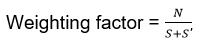
Calculation of weighting factors:
N = number of vehicles in the register (in a stratum)
S = number of questionnaires used in analysis
S’= number of vehicles for which no activity was recorded, but vehicles could be considered as active (holiday, no work, etc.), scrapped, final or temporally out of operation, not performing transport activity anymore.
Optional variables covered:
A1. Vehicle-related variables:
possibility of using vehicles for combined transport (YES)
vehicle operator’s NACE Rev. 2 at class level (four-digit level) (YES)
vehicle empty kilometres (YES)
A2. Journey-related variables:
axle configuration according to the nomenclature defined in the Regulation on road transport statistics (YES)
place of loading, if any, of the road transport vehicle on another means of transport (NO)
place of unloading, if any, of the road transport vehicle from another means of transport (NO)
degree of loading: situation ‘fully loaded’ (procedure 2) or ‘not fully loaded’ (procedure 1) of the goods road transport vehicle during the journey in question, in terms of maximum volume of space used during the journey (procedure 0 = by convention for unladen journeys) (YES)
A3. Goods-related variables:
type of freight (Cargo types) as defined in the Regulation (YES)
Additional variables collected compared to the legal requirements:
Environmental impact-related variables : none
Main figures
2019
Total number of relevant goods vehicles in the country
3 896
Number of vehicles selected for initial sample and questionnaires dispatched to vehicle owners
528
Number of cases where no vehicle activity was recorded during the sampled period but the vehicle could be considered as part of the active stock
21
Number of cases classified as non-respondents
41
Number of cases where sample register information was wrong and response could not be used
9
Number of questionnaires used in analysis
478
18.4. Data validation
As soon as the interviewer collect data, the questionnaire is submitted to the Statistical Office for further processing. Statistical checking data in order to remove all possible mistakes.
The data pass through a range of processes before the final compilation (estimates, etc.) are produced: coding, keying, editing, imputing, etc. The data are compared with the data from the previous period. We check large deviations by contacting the reporting unit.
18.5. Data compilation
Applications for processing data is prepared by Department of Information and Communication Technology, according to the requirements of a statistician in the field of transport.
The database contains detailed information of all vehicles and journeys which was the subject of surveys from 2019. Statisticians enter data in the application.
After the data entry into an application, data control is done and finally the assessment of materials is performed. Only vehicles which performed the carriage in the respective week shall be weighted. Calculate weights associated with the base and obtained the assessment material.
The data in output tables are grouped according to the type of transportation to:
- hire or reward road freight transport;
- own account road freight transport.
Then the data is grouped according to the place of loading and unloading of goods on:
- national transport (goods loaded/unloaded in the Montenegro)
- international transport - goods loaded in the Montenegro
- international transport - goods unloaded in the Montenegro
-cross-trade transport
The results of road freight transport are presented quantitatively at an aggregated level.
18.6. Adjustment
Road freight data are not seasonally adjusted.
n/a
Road freight data collection consists of three datasets with quarterly periodicity: 1. Vehicle related variables dataset for a sample of road good motor vehicles contain, among others, indication about the type and age of the vehicle, the economic activity of the owner of the vehicle, the total kilometres loaded or empty. 2. Journey related variables dataset which contain, among other indications about weight of goods, regions of loading and unloading, distance driven, and tonne-kilometres performed during a journey 3. Goods related variables dataset which contain among others the type of goods transported and their weight and distance travelled, regions of loading and unloading.
A goods road motor vehicle is any single road transport vehicle (lorry), or combination of road vehicles, namely road train (lorry with trailer) or articulated vehicle (road tractor with semi-trailer), designed to carry goods Cross-trade is international road transport between two different countries performed by a road motor vehicle registered in a third country. National transport is Road transport between two places (a place of loading and a place of unloading) located in the same country by a vehicle registered in that country. International transport is Road transport between two places (a place of loading and a place of unloading) in two different countries and cabotage by road. It may involve transit through one or more additional country or countries. Cross trade is International road transport between two different countries performed by a road motor vehicle registered in a third country. Transit is any loaded or empty road motor vehicle, which enters and leaves a country at different points by whatever means of transport, provided the total journey within the country is by road and that there is no loading or unloading in the country. Goods carried by road are any goods moved by goods vehicle Place of loading/unloading of a goods road vehicle on another mode of transport
Place of loading (of the goods road transport vehicle on another mode of transport): The place of loading is the first place where the goods road motor vehicle was loaded on to another mode of transport (usually a ship or a rail wagon).
Place of unloading (of the goods road transport vehicle from another mode of transport): The place of unloading is the last place where the goods road motor vehicle was unloaded from another mode of transport (usually a ship or a rail wagon).
The reporting unit for road freight transport statistics is the goods road transport vehicle or the local unit (a site of a company, as identified in the national business register).
As the total number of statistical units (most commonly vehicles) is very large, sample surveys are carried out to collect information.
The data provided are goods vehicles registered in the declaring country uniquely.
The road data are collected on a quarterly basis and are reported to Eurostat five months after the end of the reference period.
The survey of road freight transport is done on the basis of a stratified sample. Data is obtained by a reporting method so they are subjected to the usual types of errors associated with sampling errors, as well as coverage errors, measurement errors, processing errors and non-response.
Data are collected in tonnes, tonne-kilometres, vehicle-kilometres and in number of journeys (journey data) or in number of basic transport operations (BTO (goods related data)).
Applications for processing data is prepared by Department of Information and Communication Technology, according to the requirements of a statistician in the field of transport.
The database contains detailed information of all vehicles and journeys which was the subject of surveys from 2019. Statisticians enter data in the application.
After the data entry into an application, data control is done and finally the assessment of materials is performed. Only vehicles which performed the carriage in the respective week shall be weighted. Calculate weights associated with the base and obtained the assessment material.
The data in output tables are grouped according to the type of transportation to:
- hire or reward road freight transport;
- own account road freight transport.
Then the data is grouped according to the place of loading and unloading of goods on:
- national transport (goods loaded/unloaded in the Montenegro)
- international transport - goods loaded in the Montenegro
- international transport - goods unloaded in the Montenegro
-cross-trade transport
The results of road freight transport are presented quantitatively at an aggregated level.
Sampling register used for the survey
Name of register:
Database of registered road motor vehicles
Name of organisation who maintains the register:
Ministry of Interior
Frequency of update:
Quarterly
Frequency of access to draw the samples:
Once a year
Arrangements for accessing the register:
Agreement between the Statistical Office of Montenegro – MONSTAT and the Ministry of the Interior for providing statistical information for survey road freight traffic. After receiving the data on registered vehicles, creates a database with necessary data.
Information obtained from the register:
Registration number, date of registration, name and address of owner of vehicle, mark of vehicle, type of vehicle and model vehicle, maximum permissible weight, weight of empty vehicle, number of axles, fuel type, year of production.
Procedure for reminders:
Interviewers visit the reporting unit before the reference week and delivered to them a flyer with a brief description of survey inform them that they are in a survey sample. Seven days after the end of reference week, the interviewer visits reporting unit for collection data’s.
Data are published quarterly according to the Statistical Data Release Calendar (45 days after the end of the reference period).
Data are normally updated once per quarter.
If new annual data (all four quarters of a calendar year) have become available, the annual datasets are also updated together with the quarterly datasets.
Methodology of road freight transport survey in line with Eurostat's recommendations (Regulation (EC) No 1172/98, No 70/2012) from which it follows the conclusion that the data of this survey geographically comparable, ie. comparable with the data of the European Union.
When we talk about the weather comparability, the data are comparable from 2016, because since this year data products using the same methodology.