


1.1. Contact organisation
National Statistics Office, Malta
1.2. Contact organisation unit
Labour Market and Information Statistics Unit
1.3. Contact name
Confidential because of GDPR
1.4. Contact person function
Confidential because of GDPR
1.5. Contact mail address
National Statistics Office
Lascaris
Valletta
VLT 2000
1.6. Contact email address
Confidential because of GDPR
1.7. Contact phone number
Confidential because of GDPR
1.8. Contact fax number
Confidential because of GDPR
2.1. Metadata last certified
16 April 2026
2.2. Metadata last posted
14 April 2026
2.3. Metadata last update
14 April 2026
3.1. Data description
The EU survey on the use of ICT in households and by individuals is an annual survey conducted since 2002. In Malta, it has been conducted since 2005.
In 2025, the survey collected data on the access to information and communication technologies (ICT), on the use of the internet, e-government, e-commerce, use of electronic identificiation,e-skills and privacy and protection of personal data.
3.1.1. Survey name in national and English languages
National language: ICT in households and by individuals
English: EU survey on the use of ICT in households and by individuals
Questionnaire(s) in national language(s) and the translation in English are available in the Annexes below.
Annexes:
ICT Questionnaire_HH_2025 survey
3.2. Classification system
The following common concepts and definitions apply under the Integrated European Social Statistics (IESS):
- the International Standard Classification of Education (ISCED) 2011 published in the following breakdowns: low (ISCED levels 0-2: no formal education, primary education or lower secondary education), medium (ISCED levels 3-4: upper secondary or post-secondary non-tertiary education) and high (ISCED levels 5-6: tertiary programmes which normally need a successful completion of ISCED 3 or 4, or second-stage tertiary education leading to an advanced research qualification);
- the International Standard Classification for Occupation ISCO-08 at the 2-digit level;
- the Classification of Economic Activities (NACE Rev.2-2008), at section level;
- the Common classification of territorial units for statistics (NUTS 1) – finer granularity of NUTS 2 is provided on optional basis by some Member States;
- the SCL – Geographical code list;
- information about household income is provided at lower level of detail.
Additional classifications used in the national questionnaire: None.
3.3. Coverage - sector
The ICT survey in households and by individuals covers those households having at least one member in the age group 16 to 74 years old. Individuals aged 75 to 89 are covered by some countries on voluntary basis.
Internet access of households refers to the percentage of households that have an internet access, so that anyone in the household could use the internet.
3.3.1. Differences in scope at national level
No difference in coverage sector.
3.4. Statistical concepts and definitions
The survey is collecting data of internet users, individuals who have used the internet in the three months prior to the survey.
This annual survey is used to benchmark ICT-driven developments, both by following developments for core variables over time and by looking in greater depth at other aspects at a specific point in time. While the survey initially concentrated on access and connectivity issues, its scope has subsequently been extended to cover a variety of subjects (for example, the use of internet, e-government, e-commerce, use of electronic identificiation,e-skills, privacy and protection of personal data and socio-economic analysis (such as regional diversity, gender specificity, differences in age, education and the employment situation). The scope of the survey with respect to different technologies is also adapted to cover new product groups and means of delivering communication technologies to end-users.
Deviations from standard ICT concepts: None
3.5. Statistical unit
Households and Individuals
3.6. Statistical population
In the ICT usage survey, the target population for the different statistical units is:
- individuals: all individuals aged 16 to 74; optionally 75-to 89.
- households: all (private) households with at least one member aged 16 to 74; optionally with at least one member aged 75 to 89, but no member aged 16 to 74.
Target population composed of households and/or individuals:
- Number of households with at least one member aged 16-74: 212,448
- Number of individuals aged 16-74: 446,552
- Number of households with at least one member aged 75 to 89, but no member aged 16 to 74: Not applicable
- Number of individuals aged 75-89: Not applicable
3.6.1. Non-compulsory age groups
Non-compulsory age groups also included in the target population:
| No | Yes | Age scope | |
|---|---|---|---|
| Individuals younger than 16? | x | ||
| Individuals aged 75-89? | x | ||
| Individuals older than 89? | x |
3.6.2. Population not covered by the data collection
| Non-target population (the difference between the total population and the target population) |
Households | Individuals |
|---|---|---|
| Approximate number of units outside the mandatory scope of the survey (for example individuals younger than 16 or older than 74; households with all members over 74 years old). | Not available. | Not available. |
| Approximate number of units outside the age scope 16 to 89, if the optional age scope 75 to 89 is included. |
Not available. | Not available. |
| Estimate of the resulting percentage of under-coverage (non-covered population compared to the total country), if applicable | Not available. | Not available. |
3.7. Reference area
The collected data refers to the entire geographic location of Malta
3.8. Coverage - Time
Year 2025
3.9. Base period
Not applicable
Percentages of ‘Households’ and Percentages of ‘Individuals’
For most questions the reference period is the last three months before the interview. Questions in the modules on e-government and use of electronic identification refer to the 'last year' before the interview.
Deviation from this statement: None
5.1. Survey period
09 April till 30 June 2025
6.1. Institutional Mandate - legal acts and other agreements
The legal basis for the 2025 EU survey on the use of ICT in households and by individuals is the Regulation (EU) 2019/1700 of the European Parliament and of the Council of 10 October 2019 establishing a common framework for European statistics relating to persons and households, based on data at individual level collected from samples (OJ L 261 I, 14 October 2019, p. 1), as implemented by the Commission Implementing Regulation (EU) 2024/2182 of 2 September 2024 specifying the technical items of the data set, establishing the technical formats for transmission of information and specifying the detailed arrangements and content of the quality reports on the organisation of a sample survey in the use of information and communication technologies domain for reference year 2025 in accordance with Regulation (EU) 2019/1700 of the European Parliament and of the Council (OJ L - 2024/2182, 3 September 2024) and Commission Delegated Regulation (EU) 2024/2515 of 9 July 2024 supplementing Regulation (EU) 2019/1700 of the European Parliament and of the Council by specifying the number and titles of the variables for the use of information and communication technologies statistics domain for the reference year 2025 (OJ L, 2024/2515, 26 September 2024).
Complementary national legislation constituting the legal basis for the survey on the use of ICT in households and by individuals:
The NSO is empowered by the Malta Statistics Authority Act – Chapter 422 of the laws of Malta, to collect data for official statistics. As a result, selected individuals, households and entities have a legal obligation to respond and provide the information requested by the NSO. This creates a legal obligation and therefore is covered by article 6 of the General Data Protection Regulations.
Additionally, the GDPR allows exceptions to the rights of the data subject to object, be forgotten, access to the data subject, rectification and erasure, and restriction of processing, in the case of data collected for statistical purposes. This allows NSO to collect data and process it with the purpose of fulfilling its obligation in producing statistics.
6.2. Institutional Mandate - data sharing
7.1. Confidentiality - policy
NSO Malta | Commitment on Confidence - NSO Malta
7.2. Confidentiality - data treatment
8.1. Release calendar
The NSO Malta | Calendars - NSO Malta is publicly available on the National Statistical Office Malta (NSO) Website.
8.2. Release calendar access
The NSO Malta | Calendars - NSO Malta is publicly available on the NSO Website.
8.3. Release policy - user access
News Releases are published on the NSO website at 11am as per the NSO Malta | Calendars - NSO Malta.
Annual
10.1. Dissemination format - News release
The NSO publishes an annual news release from the findings of the ICT in Households survey
10.2. Dissemination format - Publications
Not applicable
10.3. Dissemination format - online database
there is data on ICT HH on NSO Statistical Database.
10.3.1. Data tables - consultations
Not Applicable
10.4. Dissemination format - microdata access
Anonymised Micro Data can be accessed by researchers. Each request is handled individually, and only the required variables are provided in an anonymised format: NSO Access to Microdata
10.5. Dissemination format - other
Not applicable
10.5.1. Metadata - consultations
Not applicable
10.6. Documentation on methodology
NSO Malta | ICT Usage by Individuals and Households - NSO Malta
News Release Methodological Notes - NSO Malta | ICT Usage by Households: 2025 - NSO Malta
10.6.1. Metadata completeness - rate
100 per cent complete
10.7. Quality management - documentation
An internal document 'Generic Statistical Business Process Model (GSBPM)' is available for the ICT in Households survey, highlighting all procedures involved in the project.
This document is available for internal purposes only.
11.1. Quality assurance
All key variables are checked with their respective timeseries in order to assure consistency over time.
11.2. Quality management - assessment
All key variables are collected and the rate of imputations is low. Data is compared with previous years in order to check reliability over time.
Data was collected during the established time window as indicated in Eurostat's methodological manual.
All data was transmitted to Eurostat in a timely manner.
12.1. Relevance - User Needs
The main users of the data derived from the ICT in Households survey are:
- International organizations (such as UNESCO, OECD and EU)
- Public Entities (such as ministries, authorities)
- Private entities (research organizations, unions, businesses)
- Individuals
ICT in Households statistics are mainly used for Policy making, market research, dissertations and business making.
12.2. Relevance - User Satisfaction
A user satisfaction survey was carried out by the NSO to measure the degree with which obligations towards its users are met. The survey was last held in 2014, and results for the total statistical output for the Education and Information Society Statistics Unit, not specifically for ICT statistics, were as follows:
News Releases:
- Quality – 62.9 % high/good
- Timeliness – 77 % timely
- Usefulness – 80.3 % useful
Requested data:
- Quality – 54.8 % high/good
- Frequency – 5.4 % regular
- Timeliness –73.1 % timely
A dedicated news release outlines main results from this survey, and can be accessed through: NSO User Satisfaction Survey
12.3. Completeness
All required variables are collected and transmitted the Eurostat in the format required.
12.3.1. Data completeness - rate
100 per cent completeness
13.1. Accuracy - overall
The sample is derived using the stratified random sample approach. This is done in order to minimise the risk of having a bias towards any particular subgroup.
Other errors which might occur during the data collection stage are:
- Data entry errors, as the interviewer might tick one answer instead of the other;
- Respondent might not understand the question correctly, thus his/her answer might not reflect the real picture.
13.2. Sampling error
The sampling error reflects the fact that only a particular sample was surveyed rather than the entire population. It is estimated by the standard error and can be expressed by the square root of the estimate of the sampling variance. The estimation of the sampling variance should ideally take into account the sampling design (e.g. the stratification).
Sampling error – estimation method
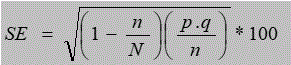
SE = Standard Error
n = Sample Size
N = Population Size
p = Proportion of successes
q = Probability of failure
13.2.1. Sampling error - indicators
Precision estimates for the question "Individuals having ordered goods or services for private use over the internet in the last 12 months" (individuals who ticked 'Within the last 3 months' or 'Between 3 months and a year ago' in in the question “When did you last buy or order goods or services for private use over the internet?”):
Number of respondents (absolute value for ‘Yes’ answers): 1,197
Estimated proportion (in %): 68.4%
Standard error (in percentage points): 1.1%
Details of the breakdowns are available in document INFOSOC_HHNSI_A_2025_MT in the Annexes below.
13.3. Non-sampling error
See more details on non-sampling error below.
13.3.1. Coverage error
The sample for the ICT HH survey is derived from the NSO's in-house population register.
The sample is extracted about 30 days before the collection starts.
The sample is selected according to the following criteria: Age, Sex, Nationality (Maltese or non) and Locality of Residence. The sample size is sufficiently large to obtain reliable responses for the selected subgroups.
The main cases where the population frame may vary from the target population is when an individual may have his 75th birthday before the interview takes place (making him outside of the scope of the survey) or if an individual has recently relocated to an institutional household.
13.3.1.1. Over-coverage - rate
Only units which fall within the scope of the survey are interviewed.
13.3.1.2. Common units - proportion
Not requested in the ICT survey.
13.3.2. Measurement error
Measurement errors:
- Data entry errors, as the interviewer might tick one answer instead of the other
- Respondent might not understand the question correctly, thus his answer might not reflect the real picture.
Questionnaire design and testing:
- The questionnaire is extensively checked to be certain that it mirrors Eurostat's model questionnaire. All question routings are checked to make sure that they apply correctly under various scenarios.
Interviewer training:
- Interviewers are trained on how to contact the survey with the household. During the briefing sessions the questionnaire and terminology are extensively discussed in order to make sure that the interviewer is able to assist the household in compiling the survey.
Proxy interview rates:
- All possible efforts are made to ensure that the survey is conducted directly with the target respondent. However, under special circumstances (difficulty in communication or medical reasons) proxy surveys are allowed. Less than 1% of the interviews are done via proxy.
13.3.3. Non response error
Information about non-respondents:
Given that that survey is conducted via personal interviews, a very low number of missing values for each variable are obtained. There are usually less than 3 cases for key variables and less than 10 cases for other questions.
This low number of missing responses has a very low effect on the non response error.
13.3.3.1. Unit non-response - rate
The unit non-response rate is the ratio of the number of in-scope non-respondents (= number of rejected interviews) to the number of eligible elements selected from the sampling frame.
Unit non-response rate for
- Households with at least one member aged 16 to 74 : 21.9%
- Households with at least one member aged 75 to 89, but no member aged 16 to 74: Not applicable
- Individuals (aged 16-74): 21.9%
- Individuals (aged 75-89): Not applicable
13.3.3.1.1. Details of unit non-response rate
| Number of households with at least one member aged 16-74 | Number of households with at least one member aged 75-89, but no member aged 16-74 | Number of individuals aged 16-74 |
Number of individuals aged 75-89 | Number of individuals (< 16) |
Number of individuals (> 89) |
|
|---|---|---|---|---|---|---|
| Gross sample [A] The number of households/individuals initially selected from the sampling frame (if not applicable, indicate why below the table) |
2,210 | Not available. | 2,210 | Not available. | Not available. | Not available. |
| Ineligible: out-of-scope [B] For example, when a selected household is not in the target population because all members are over 75 years old or when no dwelling exists at the selected address, or a selected individual has died between the reference data of the sampling frame at the moment of the interview. |
0 | Not available. | 0 | Not available. | Not available. | Not available. |
| Number of eligible elements [C] Gross sample size corrected of the ineligible cases |
2,210 | Not available. | 2,210 | Not available. | Not available. | Not available. |
| Net sample size or final sample [D] The net sample size (or final sample) corresponds to the number of households/individuals that can be used in the final database. |
1,725 | Not available. | 1,725 | Not available. | Not available. | Not available. |
| Unit response rate [E] = [D] / [C] The unit response rate is the ratio of the number of in-scope respondents (= the number of achieved interviews or the net sample size) to the number of eligible elements selected from the sampling frame. |
78.1% | Not available. | 78.1% | Not available. | Not available. | Not available. |
Comments, if any: None
13.3.3.1.2. Unit non-response – methods, minimization and substitution
- Methods used for dealing with unit non-response:
The interviewing process adopted the following steps:
-
- In the first instance, selected individuals were notified by post and invited to cooperate in the study. Respondents were informed that participation was mandatory by law (Malta Statistics Act). They were also assured that the data provided was going to remain confidential.
- Interviewers were briefed to carry out telephone interviews.
- Methods used for minimizing unit non-response: Office staff intervened in particularly difficult cases, when faced with extremely non cooperative respondents
- Substitution permitted: No
- Substitution rate (in %): 0%
13.3.3.2. Item non-response - rate
Items with low response rates (observed rates in %): None
13.3.4. Processing error
Data trends are usually checked for all the variables collected. Trends are checked also at age and sex level. This ensures that data is comparable over time.
Imputations are kept to a minimum and mainly used for missing or erroneous data.
The imputation rate is less than 1% per variable.
13.3.5. Model assumption error
Not applicable
14.1. Timeliness
Date of data dissemination at national level:
Data was transmitted to Eurostat by 5 October 2025.
Data was disseminated nationally in the first quarter of 2026.
14.1.1. Time lag - first result
Restricted from publication
14.1.2. Time lag - final result
Restricted from publication
14.2. Punctuality
Data was transmitted on time to Eurostat.
14.2.1. Punctuality - delivery and publication
Data was submitted and validated before Eurostat deadline
15.1. Comparability - geographical
There is no problem of comparability across the country’s regions.
15.1.1. Asymmetry for mirror flow statistics - coefficient
Not relevant
15.2. Comparability - over time
Possible limitations in the use of data for comparisons over time:
In the last couple of years, the NSO shifted from face-to-face interviews to CATI interviews. This change did not seem to affect the quality or reliability of the data collected.
15.2.1. Length of comparable time series
The length of comparable time series depends on the module and variable considered within each of the modules of the survey.
15.3. Coherence - cross domain
Not applicable
15.3.1. Coherence - sub annual and annual statistics
Not applicable
15.3.2. Coherence - National Accounts
Not applicable
15.4. Coherence - internal
All statistics are coherent within the dataset.
15.4.1. Survey questionnaire – mandatory questions
MANDATORY questions in the Eurostat model questionnaire 2025:
Table 15.4.1. of document INFOSOC_HHNSI_A_2025_MT in the Annexes lists the questions for which the coverage of subjects and characteristics reflected in the national questionnaire differs from Annex 2 of the Commission Delegated Regulation (EU) 2024/2515 of 9 July 2024.
15.4.2. Survey questionnaire – optional questions
Adoption of OPTIONAL questions and items in the Eurostat model questionnaire 2025:
Table 15.4.2. of document INFOSOC_HHNSI_A_2025_MT in the Annexes lists the optional questions from the annual Eurostat model questionnaire 2025 included in the national questionnaire and their coverage for age groups beyond the standard scope.
15.4.3. Survey questionnaire – additional questions at national level
Additional questions introduced in the national questionnaire in 2025: None.
15.4.4. Survey questionnaire – deviations
Effects of deviations from the routing used in the Eurostat model questionnaire: No deviation from Eurostat model questionnaire
Restricted from publication
17.1. Data revision - policy
No data revision policy is available. Data from the ICT HH survey is not normally subject to revisions.
17.2. Data revision - practice
ICT HH Data has been only revised when the NSO received an update from the population register. In such cases only the Individual weights and the household weights have been revised.
17.2.1. Data revision - average size
Not relevant
18.1. Source data
The source of the raw data is described with more details in the paragraphs below.
18.1.1. Sampling frame
An in house population register is used to extract the relevant sample. This register is updated with all deaths and births. Deaths updated up to December 2024.
Age calculated as at 31st May 2025.
The ICT HH survey takes the form of a Stand alone survey, which is mandatory by law.
18.1.2. Sampling design
A stratification random sample is used to obtain the sample for the ICT HH survey. The sample is stratified by District (6), Gender, Maltese Citizenship (yes, no), Age group (16-24, 25-34, 35-44, 45-54, 55-64, 65-74).
Only households with at least one individual between the age of 16 and 74 are selected for the sample. Only one individual is selected from each household.
18.1.3. Net effective sample size
Restricted from publication
18.2. Frequency of data collection
Annual
18.3. Data collection
- Methods used to gather data: CATI.
- Short description of the survey method: In the past (Pre-COVID) the ICT Survey was collected via face to face interviews, however for the past 4 years the NSO shifted to telephone interviews.
- Variables completed from an external source: None.
18.4. Data validation
Data is checked and it is ensured that all data follow the questionnaire routing.
Data is validated according to Eurostat's standards.
18.5. Data compilation
Data is imputed using the Hot Deck imputation technique. This is done only for missing or erroneous data. Imputation rate is usually less than 1%.
Given the small amount of imputed figures, the impact of imputation is minimal. However the distribution of results is checked both before and after imputation, to ensure no distortion of the data.
All the required data is collected from the ICT HH survey, therefore there is no need to amalgamate data from different sources.
18.5.1. Imputation - rate
For the target indicator "Individuals having ordered goods or services for private use over the internet in the last 12 months" (individuals who ticked 'Within the last 3 months' or 'Between 3 months and a year ago' in the question “When did you last buy or order goods or services for private use over the internet?”:
Imputation rate (% of observations): less than 1%
Imputation rate (share of estimate): less than 1%
18.5.2. Use of imputation methods
Methods used to impute item non-response: Hot Deck imputation
18.5.3. Grossing-up procedures
Grossing up procedures have been applied to:
Both Households and Individuals are weighted separately, each with their respective weights.
Description of the weighting procedures:
Survey data is weighted to correct for any biases present in the final sample of participating units which arise from variations in response rates observed in different sub-groups. Weighting the data ensures that estimates from the survey represent the target population in terms of the distribution of individuals and private households.
As from reference year 2023, ICT Households data are being weighted using an updated set of benchmarks. These
include:
- Six age-group categories by sex (16-24; 25-34; 35-44; 45-54; 55-64; 65-74)
- The number of Maltese residents and foreign residents
- The distribution of persons by district
18.6. Adjustment
Not relevant
18.6.1. Seasonal adjustment
Not relevant
The EU survey on the use of ICT in households and by individuals is an annual survey conducted since 2002. In Malta, it has been conducted since 2005.
In 2025, the survey collected data on the access to information and communication technologies (ICT), on the use of the internet, e-government, e-commerce, use of electronic identificiation,e-skills and privacy and protection of personal data.
14 April 2026
The survey is collecting data of internet users, individuals who have used the internet in the three months prior to the survey.
This annual survey is used to benchmark ICT-driven developments, both by following developments for core variables over time and by looking in greater depth at other aspects at a specific point in time. While the survey initially concentrated on access and connectivity issues, its scope has subsequently been extended to cover a variety of subjects (for example, the use of internet, e-government, e-commerce, use of electronic identificiation,e-skills, privacy and protection of personal data and socio-economic analysis (such as regional diversity, gender specificity, differences in age, education and the employment situation). The scope of the survey with respect to different technologies is also adapted to cover new product groups and means of delivering communication technologies to end-users.
Deviations from standard ICT concepts: None
Households and Individuals
In the ICT usage survey, the target population for the different statistical units is:
- individuals: all individuals aged 16 to 74; optionally 75-to 89.
- households: all (private) households with at least one member aged 16 to 74; optionally with at least one member aged 75 to 89, but no member aged 16 to 74.
Target population composed of households and/or individuals:
- Number of households with at least one member aged 16-74: 212,448
- Number of individuals aged 16-74: 446,552
- Number of households with at least one member aged 75 to 89, but no member aged 16 to 74: Not applicable
- Number of individuals aged 75-89: Not applicable
The collected data refers to the entire geographic location of Malta
For most questions the reference period is the last three months before the interview. Questions in the modules on e-government and use of electronic identification refer to the 'last year' before the interview.
Deviation from this statement: None
The sample is derived using the stratified random sample approach. This is done in order to minimise the risk of having a bias towards any particular subgroup.
Other errors which might occur during the data collection stage are:
- Data entry errors, as the interviewer might tick one answer instead of the other;
- Respondent might not understand the question correctly, thus his/her answer might not reflect the real picture.
Percentages of ‘Households’ and Percentages of ‘Individuals’
Data is imputed using the Hot Deck imputation technique. This is done only for missing or erroneous data. Imputation rate is usually less than 1%.
Given the small amount of imputed figures, the impact of imputation is minimal. However the distribution of results is checked both before and after imputation, to ensure no distortion of the data.
All the required data is collected from the ICT HH survey, therefore there is no need to amalgamate data from different sources.
The source of the raw data is described with more details in the paragraphs below.
Annual
Date of data dissemination at national level:
Data was transmitted to Eurostat by 5 October 2025.
Data was disseminated nationally in the first quarter of 2026.
There is no problem of comparability across the country’s regions.
Possible limitations in the use of data for comparisons over time:
In the last couple of years, the NSO shifted from face-to-face interviews to CATI interviews. This change did not seem to affect the quality or reliability of the data collected.
