EU enlargement and environmental policy
The enlargement process is an opportunity for candidates and potential candidates for EU membership to align with the EU’s environmental acquis – the collection of all EU environmental rules. The prospective of membership offers a framework for development and provides concrete targets to be achieved. By their date of accession, candidate countries must be able to effectively apply all EU legislation and policy.
During the pre-accession period, the European Commission works with the candidate countries and potential candidates to assist them in adapting their environmental legislation and upgrading their implementation and enforcement capacities.
Annual progress reports show the efforts made per country to align with EU rules in all areas. Chapter 27 of each report focuses on the environment.
Neighbourhood countries
The EU and its neighbours share some common environmental challenges, including pollution or biodiversity loss, which have transboundary effects. The EU works in partnership with neighbouring countries to address bilateral, regional and global environmental challenges. This is paramount to creating lasting, sustainable change that benefits all.
The European Neighbourhood Policy (ENP) was created in 2004 to offer the EU's neighbours a privileged relationship with a mutual commitment to common values.
It comprises the Eastern Partnership (Ukraine, Belarus, Republic of Moldova, Georgia, Armenia and Azerbaijan) and the Southern Neighbourhood (Algeria, Egypt, Israel, Jordan, Lebanon, Libya, Morocco, Palestine, Syria and Tunisia). Both include a clear environment priority given our shared environmental challenges.
The EU is also a Party to the Barcelona Convention to protect the marine and coastal environment in the Mediterranean.
Initiatives such as the EU4Environment – Green Economy in Eastern Partner Countries, the EU4 EMBLAS and the European Union Water Initiative Plus highlight the EU’s involvement and commitment in creating sustainable change across all territories shared with its neighbours. Moreover, projects such as the Water and Environment Support, which runs until April 2023, focus on environmental issues in the Mediterranean neighborhood.
Industrialised countries and emerging economies
Europe’s partnerships with countries overseas further strengthen the commitment to jointly tackle global environmental challenges that threaten the future of our planet. The EU has forged strategic partnerships with the following countries: Canada, Japan, South Korea, USA, Brazil, China, India, Mexico, Russia and South Africa. For more specific information on actions/agreements, see:
- 1994 Cooperation Agreement between the EC and the Republic of India
- EU-India Strategic Partnership: A Roadmap to 2025
- Joint Statement - 15th EU-India Summit, 15 July 2020
- India-EU Water Partnership (IEWP)
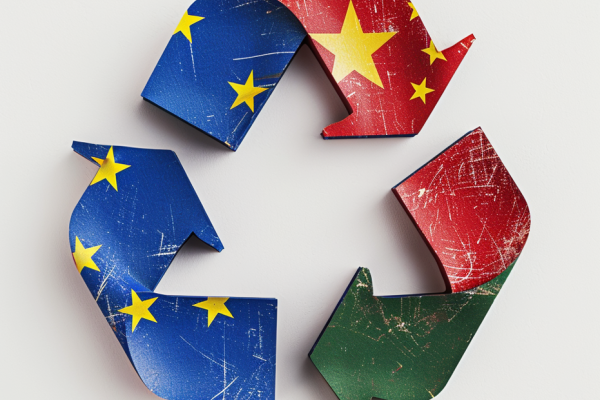
- EU-India joint declaration establishing a new partnership on resource efficiency and circular economy
Relations between the European Union (EU) and Russia have been strained since the 2014 illegal annexation of Crimea and the city of Sevastopol by Russia and its destabilising actions in eastern Ukraine. After Russia began its invasion of Ukraine on 24 February, 2022, the remaining political, cultural and scientific cooperation was suspended.
The European Union and the USA are two of the most active players on the global stage and the transatlantic economy is the largest and wealthiest market in the world. Taken together, the economies of both territories account for more than 40% of world GDP and more than 40% of global trade in goods and services. The United States of America is an important and long-standing partner of the European Union on many global and regional environmental and sustainable development issues and in many international environmental forums and agreements.
There is frequent working and expert-level contact between Directorate-General for the Environment of the European Commission and US counterparts: in particular with the State Department and the Environmental Protection Agency (EPA). Whilst there is no formal EU-US High Level Dialogue on environment policy, there are regular exchanges of information and experience on issues such as circular economy, deforestation, wildlife trafficking, chemicals management, air quality and marine litter as well as in the context of multilateral environmental fora and G7/G20.
More information: North America - Canada and the United States | EEAS (europa.eu)
The Arctic, an area of unique beauty and rich resources, has close ties with Europe: three EU Member States – Denmark (Greenland), Finland and Sweden – have territories there, and two Arctic states – Iceland and Norway – are members of the European Economic Area.
In recent years, the Arctic has been facing intensifying pressure from pollution, climate change and unsustainable development, demanding that actions be taken towards its preservation. The EU is committed to working with the Arctic states, local communities and other stakeholders to address the environmental challenges. In October 2021, the Commission and the High Representative published a Joint Communication on a stronger EU engagement for a peaceful, sustainable and prosperous Arctic.
As input to the last update of the EU Arctic Strategy in June 2021 the Commission released the final report of a study (financed under the Partnership Instrument) giving an overview of EU actions in the Arctic and their impact.
Relevant links:
- Northern Dimension Policy: Joint Statement by the EU, Iceland and Norway on suspending activities with Russia and Belarus
- Barents Euro-Arctic cooperation
- Council of the Baltic Sea States
- EEAS Arctic Policy
- Overview of EU actions in the Arctic and their impact - Summary
The African continent is particularly vulnerable to climate change and environmental degradation. Food security, sustainable water supply and extreme weather phenomena (floods, drought desertification) are major issues that require an African-EU joint effort.
The Joint Africa-EU Strategy (JAES) was adopted in 2007 in Lisbon, and it is the overall political framework defining continent-to-continent relations. Relations with Sub-Saharan African countries are defined under the legal framework of the Partnership Agreement with the African, Caribbean and Pacific States (ACP), the so-called Cotonou Agreement.
The Asia-Europe Meeting (ASEM) is an informal process of dialogue and cooperation between Asia and Europe launched in 1996. Since 2016, European and Asian Heads of State and Government celebrate March 1 as the ASEM Day to emphasise the importance of multilateralism for shared sustainable growth and the friendship between Europe and Asia.
Furthermore, the launch by the EU of the Switch Programme aims to respond to the need for cleaner and more energy-efficient industry in Asia. The programme targets SMEs and promotes the use of environmentally friendly technologies and practices. Its efforts also contribute significantly to poverty alleviation.
The basis for cooperation between the EU and Central Asia is the EU-Central Asia Strategy. This strategy sets out a number of priorities for action on the environment and focuses on water supply and management as well as the promotion of cross-border river basin management. Other priorities include combatting climate change, tackling desertification and safeguarding biodiversity.