Reference metadata describe statistical concepts and methodologies used for the collection and generation of data. They provide information on data quality and, since they are strongly content-oriented, assist users in interpreting the data. Reference metadata, unlike structural metadata, can be decoupled from the data.
[RO1] National Institute of Statistics (NIS) (Romania)
1.2. Contact organisation unit
Transport, Post and Telecommunication Statistics Unit - Structural Business Statistics Directorate - Economic Statistics Directorate General
1.3. Contact name
Confidential because of GDPR
1.4. Contact person function
Confidential because of GDPR
1.5. Contact mail address
16 Libertatii Blvd., Bucharest - 5, Romania
1.6. Contact email address
Confidential because of GDPR
1.7. Contact phone number
Confidential because of GDPR
1.8. Contact fax number
Confidential because of GDPR
2.1. Metadata last certified
21 July 2026
2.2. Metadata last posted
21 July 2026
2.3. Metadata last update
21 July 2026
3.1. Data description
Road freight data collection consists of three datasets with quarterly periodicity:
Vehicle related variables dataset for a sample of road good motor vehicles contain, among others, indication about the type and age of the vehicle, the economic activity of the owner of the vehicle, the total kilometres loaded or empty.
Journey related variables dataset which contain, among other indications about weight of goods, regions of loading and unloading, distance driven, and tonne-kilometres performed during a journey
Goods related variables dataset which contain among others the type of goods transported and their weight and distance travelled, regions of loading and unloading.
3.2. Classification system
Statistics on carriage of goods by road apply the following statistical classifications:
The type of goods transported by road was collected, until reference year 2007 (included), according to the 24 groups of goods following the "Standard Goods Classification for Transport Statistics/Revised (NST/R )". Since 2008 reference year, the classification used is NST 2007, in accordance with COMMISSION REGULATION (EC) No 1304/2007 of 7 November 2007 amending Council Directive 95/64/EC, Council Regulation (EC) No 1172/98, Regulations (EC) No 91/2003 and (EC) No 1365/2006 of the European Parliament and of the Council with respect to the establishment of NST 2007 as the unique classification for transported goods in certain transport modes.
The optional variable type of cargo follows the Classification of Cargo Types of UNECE (United Nations, Economic Commission for Europe - codes for types of cargo, packages and packaging materials, Recommendation 21 adopted by the Working Party on Facilitation of International Trade Procedures, Geneva, March 1986).
3.3. Coverage - sector
The statistics refer to the carriage of goods by road by means of goods road transport vehicles which are registered in Romania with a load capacity of 3.5 tonnes or more and vehicle age up to 25 years.
A goods road motor vehicle is any single road transport vehicle (lorry), or combination of road vehicles, namely road train (lorry with trailer) or articulated vehicle (road tractor with semi-trailer), designed to carry goods
National transport is road transport between two places (a place of loading and a place of unloading) located in the same country by a vehicle registered in that country. International transport is road transport between two places (a place of loading and a place of unloading) in two different countries and cabotage by road. It may involve transit through one or more additional country or countries. Cross-trade is international road transport between two different countries performed by a road motor vehicle registered in a third country.
Cabotage is road transport between two places (a place of loading and a place of unloading) in the same country performed by a road motor vehicle not registered in that country.
Transit is any loaded or empty road motor vehicle, which enters and leaves a country at different points by whatever means of transport, provided the total journey within the country is by road and that there is no loading or unloading in the country. Goods carried by road are any goods moved by goods vehicle. Place of loading/unloading of a goods road vehicle on another mode of transport
Place of loading (of the goods road transport vehicle on another mode of transport): The place of loading is the first place where the goods road motor vehicle was loaded on to another mode of transport (usually a ship or a rail wagon).
Place of unloading (of the goods road transport vehicle from another mode of transport): The place of unloading is the last place where the goods road motor vehicle was unloaded from another mode of transport (usually a ship or a rail wagon).
3.5. Statistical unit
The statistical unit for road freight transport statistics is the goods road transport vehicle authorised to perform this activity.
3.6. Statistical population
The total number of goods road motor vehicles authorised to perform freight transport by road.
3.7. Reference area
Data produced refer to national, international (cabotage and cross-trade included) transport of goods by road, performed by vehicles registered in Romania.
3.8. Coverage - Time
The first data provided for the first quarter in 2006.
3.9. Base period
Not applicable.
Data are collected in tonnes, tonne-kilometres, vehicle-kilometres and in number of journeys (journey data) or in number of basic transport operations (BTO (goods related data)).
The road data are collected on a quarterly basis and are reported to Eurostat five months after the end of the reference period.
6.1. Institutional Mandate - legal acts and other agreements
National level:
Law 226/2009 on the organisation and functioning of official statistics in Romania updated with subsequent amendments; Legal basis.
Order of the President of the National Institute of Statistics of Romania setting the methodology for the production of goods road transport statistics.
Eurostat submits annually semi-aggregated data (data exchange tables, see Commission Regulation (EU) No 202/2010 amending the Commission Regulation (EC) No 6/2003) back to the reporting countries so that they can compile the total road freight transport on their national territories, including the operations by national hauliers and also those of all other reporting countries.
These data exchange tables include more detailed breakdowns than the publicly available tables. They also include, for each value, the information on the number of observations that the estimates are based on. In this way, the reporting countries can estimate the reliability of results that they aggregate from the data exchange tables.
7.1. Confidentiality - policy
National level:
Law 226/2009 on the organisation and functioning of official statistics in Romania updated with subsequent amendments: Legal basisl.
European level:
Regulation (EC) No 223/2009 on European statistics (recital 24 and Article 20(4)) of 11 March 2009 (OJ L 87, p. 164), stipulates the need to establish common principles and guidelines ensuring the confidentiality of data used for the production of European statistics and the access to those confidential data with due account for technical developments and the requirements of users in a democratic society.
7.2. Confidentiality - data treatment
Only aggregated data are disseminated in NIS publications and in on-line databases.
8.1. Release calendar
Data is disseminated in quarterly publications on NIS website, as .pdf and .xls format, at ninety days after the end of the reference quarter and annual data is disseminated in TEMPO online NIS database at five months after the end of the reference year.
The statistical data is accesible to all users at the same time.
Data is transmitted to Eurostat 5 months after the end of the reference period and is disseminated in quarterly and yearly NIS publications. Annual data is disseminated in TEMPO online database.
10.1. Dissemination format - News release
Not applicable
10.2. Dissemination format - Publications
'Transport of passengers and goods, by mode of transport' - NIS quarterly publication on NIS website as .pdf and .xls format
Documentation on quality management is available on the NIS website: Quality reports.
11.1. Quality assurance
The quality of the data is ensured by following the indications specified in the Code of Practice for European Statistics.
The statistical error (percentage standard error) of the micro-data transmitted to Eurostat is not greater than 5%.
11.2. Quality management - assessment
The statistical process is monitored for relevance, accuracy, actuality, punctuality, consistency and comparability. The assessment of the quality of the aggregated data is based on the comparisons of the survey performed by NIS with the recommended methodological approach, i.e. the coverage of the survey, the quality of the register, the sampling and the response rates, as well as simplifying assumptions. The precision calculationsare in accordance with Commission Regulation (EC) 642/2004.
12.1. Relevance - User Needs
The statistics produced are in accordance with the legislation in force and the methodology recommended by Eurostat. At national level, statistical data is used by Romanian public authorities, i.e. Ministries, Agencies, researchers, other users.
This publication presents how the statistical data produced and the methodological information of the NIS meet to the information needs of different categories of users. It includes a presentation of the main results of the statistical survey on "Satisfaction of statistical data users", respectively the profile of users of statistical data produced by the NIS, trust in the NIS and the statistical data produced by the NIS, the quality assessment of the data produced by the NIS.
12.3. Completeness
The statistics produced are in compliance with the legislation in force and Eurostat's Road freight transport methodology.
13.1. Accuracy - overall
In order to compile road goods transport statistics a sample survey is carried out. The overall sampling error is within the standard percentage error, i.e. 5%.
The nonresponse treatment is performed for each stratum and the partial responses are not accepted. The nonresponse treatment is performed during the logical control.
14.1. Timeliness
Data are compiled and submitted to Eurostat within 5 months after the end of the reference period. Data are published at ninety days after the end of the reference quarter.
14.2. Punctuality
Road freight data are transmitted to Eurostat within 5 months after the end of the reference period, as specified in the Regulation (EU) 70//2012, without delays.
15.1. Comparability - geographical
The definitions used for the production of road freight data are those presented in the legislation and in Eurostat's Road freight transport methodology.
The gross weight of goods and all packaging, but excluding the tare-weight of any container, swap-body and pallets containing goods is reported.
Multi-stop journeys are recorded by consecutive stops - "vertical stages".
Swap-bodies are reported as "large freight containers".
15.2. Comparability - over time
Since 2006 reference year data is reported in accordance with the legislation.
Since 2008 reference year data have been reported in accordance with the unique classification for transported goods NST 2007 - Commission Regulation (EC) No 1304/2007.
15.3. Coherence - cross domain
Road freight transport statistics is produced based on a sample survey carried out quarterly by NIS.
15.4. Coherence - internal
Not applicable
Information on costs is available in the National Annual Statistical Programme.
The revision policy does not apply to the case for the road transport of freight.
18.1. Source data
A sample survey carried out by NIS is used for road freight data collection. Data on vehicles, journeys and goods transported are provided by the transport operators for the vehicles selected in the sample online through NIS e-Survey Online Portal or on paper to Territorial Statistical Offices.
Sampling register used in the survey
Name of register: Vehicle Register
Name of organisation who maintains the register: Romanian Road Authority
Frequency of update: Quarterly
Frequency of access to draw the samples: Once a quarter
Arrangements for accessing the register: The sampling frame is based on the information on authorised vehicles received quarterly from Romanian Road Authority. The scrapped vehicles reported by owners and the vehicles older than 25 years are not included in the sampling frame.
Information obtained from the register: Number of registration, type of vehicle (category of vehicle and subcategory of vehicle), year of manufacturing, maximum permissible weight, load capacity, number of axles of vehicle (single vehicle), name and address of the vehicle's owner. From NIS statistical registers is obtained the information on main activity of the owner of the vehicle (NACE Rev.2). The information is updated by the transport operator while filling in the questionnaire.
Used in stratification : Type of transport (derived from NACE Rev. 2), load capacity.
Procedure for reminders: Reminders are transmitted by email and than the respondents are contacted by phone. The response rate is adequate.
18.2. Frequency of data collection
The survey is carried out throughout the entire year and all 13 weeks of each quarter are covered. The vehicle (the statistical unit) is selected in the sample once a year for one week. Annual data are summed up from the quarterly data.
18.3. Data collection
Sampling methodology
Statistical unit: Tractive vehicle
Types of units excluded: Vehicles with load capacity less than 3.5 tonnes, military vehicles, vehicles belongig to central or local public administrations (specialized), agricultural vehicles and vehicles older than 25 years.
Time unit: 1 week
Time units of the quarter included in the survey: All (13 weeks)
Stratification: The sample is stratified according to the following variables:
Statistical regions (8 classes):
North-East
South-East
South - Muntenia
South-West Oltenia
West
North-West
Centre
Bucharest-Ilfov
Type of transport:
hire or reward
own account
Load capacity (4 classes):
3 500 - 7 500 kg
7 501 - 12 000kg
12 001 - 17 000 kg
more than 17 000 kg
Recording of weight of goods: Gross weight of goods is collected, i.e. containers swap bodies and pallets are excluded.
Recording of journey data sent to Eurostat:
Single stop: For journeys with more than one commodity, only one record is created.
Journeys with the same distance, same goods, same quantity, same place of loading and unloading are recorded on a single row in the questionnaire, mentioning the number of identical journeys, but in A2 are recorded all journeys.
Multi stop: Multi-stop journeys are recorded by vertical stages.
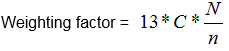
Calculations of weighting factors
N = total number of vehicles in a stratum
n = number of vehicles selected for the sample form the respective stratum
where:
nh1 = number of vehicles with activity from stratum h
nh2 = number of vehicle without activity from stratum h
nh3 = number of refusal from stratum h
nh4 = number of vehicle with uncertain activity from stratum h
Optional variables covered:
A1. Vehicle-related variables:
possibility of using vehicles for combined transport (YES)
vehicle operator’s NACE Rev. 2 at class level (four-digit level) (YES)
vehicle empty kilometres (NO)
A2. Journey-related variables:
axle configuration according to the nomenclature defined in the Regulation on road transport statistics (YES)
place of loading, if any, of the road transport vehicle on another means of transport (NO)
place of unloading, if any, of the road transport vehicle from another means of transport (NO)
degree of loading: situation ‘fully loaded’ (procedure 2) or ‘not fully loaded’ (procedure 1) of the goods road transport vehicle during the journey in question, in terms of maximum volume of space used during the journey (procedure 0 = by convention for unladen journeys) (YES), see the mention from Contries Specific Notes.
A3. Goods-related variables:
type of freight (Cargo types) as defined in the Regulation (YES)
Additional variables collected compared to the legal requirements:
Environmental impact-related variables: Quantity of fuel (low quality of data).
18.4. Data validation
National level : The first level of checks and validation are performed at Territorial Statistical Offices level and the second/final level of checks and validation are performed by NIS, according to the provisions in Order of the President of the National Institute of Statistics of Romania setting the methodology for the production of goods road transport statistics.
From Eurostat : Since 1999, micro-data from the reporting countries have to be submitted according to Commission Regulation 2163/2001. The data are then checked and validated by EUROSTAT (verification of many different codes used (NUTS 3, numeric or alphabetic variables) correctness of linked questionnaires in the different dataset, etc…). Detected errors are then reported back to the data sender with the request for correction, this is an iterative process until at least 99.5% of all data records are validated and loaded in the database.
18.5. Data compilation
The quarterly micro-data are processed, edited and validated, than extrapolated on the basis of weighting factors in order to obtain quarterly data.
18.6. Adjustment
Road freight data are not seasonally adjusted.
Not applicable.
Road freight data collection consists of three datasets with quarterly periodicity:
Vehicle related variables dataset for a sample of road good motor vehicles contain, among others, indication about the type and age of the vehicle, the economic activity of the owner of the vehicle, the total kilometres loaded or empty.
Journey related variables dataset which contain, among other indications about weight of goods, regions of loading and unloading, distance driven, and tonne-kilometres performed during a journey
Goods related variables dataset which contain among others the type of goods transported and their weight and distance travelled, regions of loading and unloading.
A goods road motor vehicle is any single road transport vehicle (lorry), or combination of road vehicles, namely road train (lorry with trailer) or articulated vehicle (road tractor with semi-trailer), designed to carry goods
National transport is road transport between two places (a place of loading and a place of unloading) located in the same country by a vehicle registered in that country. International transport is road transport between two places (a place of loading and a place of unloading) in two different countries and cabotage by road. It may involve transit through one or more additional country or countries. Cross-trade is international road transport between two different countries performed by a road motor vehicle registered in a third country.
Cabotage is road transport between two places (a place of loading and a place of unloading) in the same country performed by a road motor vehicle not registered in that country.
Transit is any loaded or empty road motor vehicle, which enters and leaves a country at different points by whatever means of transport, provided the total journey within the country is by road and that there is no loading or unloading in the country. Goods carried by road are any goods moved by goods vehicle. Place of loading/unloading of a goods road vehicle on another mode of transport
Place of loading (of the goods road transport vehicle on another mode of transport): The place of loading is the first place where the goods road motor vehicle was loaded on to another mode of transport (usually a ship or a rail wagon).
Place of unloading (of the goods road transport vehicle from another mode of transport): The place of unloading is the last place where the goods road motor vehicle was unloaded from another mode of transport (usually a ship or a rail wagon).
The statistical unit for road freight transport statistics is the goods road transport vehicle authorised to perform this activity.
The total number of goods road motor vehicles authorised to perform freight transport by road.
Data produced refer to national, international (cabotage and cross-trade included) transport of goods by road, performed by vehicles registered in Romania.
The road data are collected on a quarterly basis and are reported to Eurostat five months after the end of the reference period.
In order to compile road goods transport statistics a sample survey is carried out. The overall sampling error is within the standard percentage error, i.e. 5%.
Data are collected in tonnes, tonne-kilometres, vehicle-kilometres and in number of journeys (journey data) or in number of basic transport operations (BTO (goods related data)).
The quarterly micro-data are processed, edited and validated, than extrapolated on the basis of weighting factors in order to obtain quarterly data.
A sample survey carried out by NIS is used for road freight data collection. Data on vehicles, journeys and goods transported are provided by the transport operators for the vehicles selected in the sample online through NIS e-Survey Online Portal or on paper to Territorial Statistical Offices.
Sampling register used in the survey
Name of register: Vehicle Register
Name of organisation who maintains the register: Romanian Road Authority
Frequency of update: Quarterly
Frequency of access to draw the samples: Once a quarter
Arrangements for accessing the register: The sampling frame is based on the information on authorised vehicles received quarterly from Romanian Road Authority. The scrapped vehicles reported by owners and the vehicles older than 25 years are not included in the sampling frame.
Information obtained from the register: Number of registration, type of vehicle (category of vehicle and subcategory of vehicle), year of manufacturing, maximum permissible weight, load capacity, number of axles of vehicle (single vehicle), name and address of the vehicle's owner. From NIS statistical registers is obtained the information on main activity of the owner of the vehicle (NACE Rev.2). The information is updated by the transport operator while filling in the questionnaire.
Used in stratification : Type of transport (derived from NACE Rev. 2), load capacity.
Procedure for reminders: Reminders are transmitted by email and than the respondents are contacted by phone. The response rate is adequate.
Data is transmitted to Eurostat 5 months after the end of the reference period and is disseminated in quarterly and yearly NIS publications. Annual data is disseminated in TEMPO online database.
Data are compiled and submitted to Eurostat within 5 months after the end of the reference period. Data are published at ninety days after the end of the reference quarter.
The definitions used for the production of road freight data are those presented in the legislation and in Eurostat's Road freight transport methodology.
The gross weight of goods and all packaging, but excluding the tare-weight of any container, swap-body and pallets containing goods is reported.
Multi-stop journeys are recorded by consecutive stops - "vertical stages".
Swap-bodies are reported as "large freight containers".
Since 2006 reference year data is reported in accordance with the legislation.
Since 2008 reference year data have been reported in accordance with the unique classification for transported goods NST 2007 - Commission Regulation (EC) No 1304/2007.