
The Waste Framework Directive lays down some basic waste management principles. It requires that waste be managed
- without endangering human health and harming the environment
- without risk to water, air, soil, plants or animals
- without causing a nuisance through noise or odours
- and without adversely affecting the countryside or places of special interest
It explains when waste ceases to be waste and becomes a secondary raw material, and how to distinguish between waste and by-products. The Directive also introduces the "polluter pays principle" and the "extended producer responsibility".
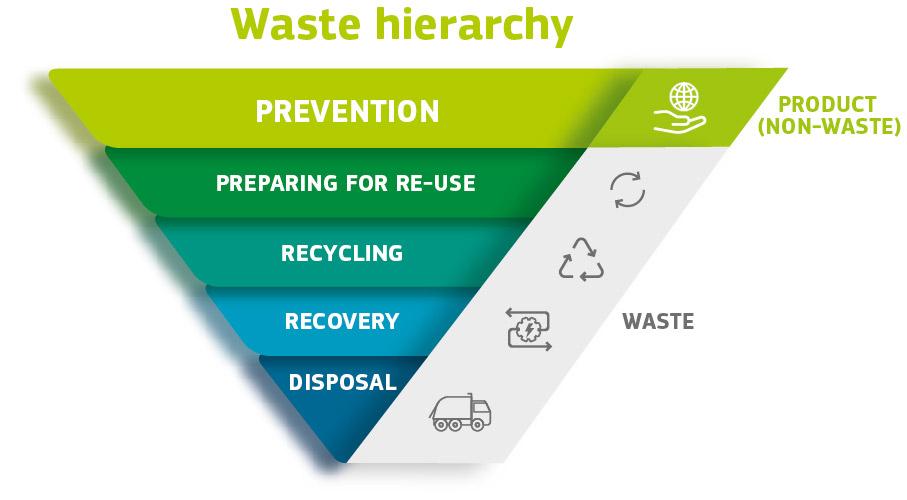
The foundation of EU waste management is the five-step “waste hierarchy”, established in the Waste Framework Directive. It establishes an order of preference for managing and disposing of waste.
2023 Proposal for a targeted revision of the Waste Framework Directive
Targets
To comply with the objectives of this Directive, EU countries shall take the necessary measures to achieve the following targets
- by 2020, the preparing for re-use and the recycling of waste materials (such as paper, metal, plastic and glass) from households shall be increased to a minimum of overall 50 % by weight
- by 2020, the preparing for re-use, recycling and other material recovery, including backfilling operations using waste to substitute other materials, of non-hazardous construction and demolition waste shall be increased to a minimum of 70 % by weight
- by 2025, the preparing for re-use and the recycling of municipal waste shall be increased to a minimum of 55 %, 60% and 65% by weight by 2025, 2030 and 2035 respectively
The rules and calculation methods for verifying compliance with these targets can be found in Commission Decision 2011/753/EU. Additional rules for the calculation, verification and reporting of data on waste in accordance with the amended Waste Framework Directive can be found in Commission Decision (EU) 2019/1004.
The Commission provides guidance on municipal waste data collection, which can be found here.
Hazardous waste
Hazardous wastes pose a greater risk to the environment and human health than non-hazardous waste and therefore require a stricter control regime.
The Waste Framework Directive provides additional labelling, record keeping, monitoring and control obligations from the "cradle to the grave", in other words from the waste production to the final disposal or recovery. It also bans the mixing of hazardous waste with other categories of hazardous waste, and with non-hazardous waste.
The classification into hazardous and non-hazardous waste is based on the system for the classification and labelling of dangerous substances and preparations. This ensures that similar principles are applied over the whole life cycle of materials.
For more information on the classification of all types of waste (including hazardous), see the European List of Waste.
Read the guidelines on the separate collection of household hazardous waste.
By-products
The Waste Framework Directive defines by-products as a substance or object, resulting from a production process, the primary aim of which is not the production of that item. By-products can come from a wide range of business sectors, and can have very different environmental impacts. It is important to classify by-products correctly to avoid environmental damage or unnecessary costs for business.
End-of-waste criteria
End-of-waste criteria specify when certain waste ceases to be waste and becomes a product, or a secondary raw material.
According to Article 6 (1) and (2) of the Waste Framework Directive, certain specified waste ceases to be waste when it has undergone a recovery operation (including recycling) and complies with specific criteria, in particular when
- the substance or object is commonly used for specific purposes
- there is an existing market or demand for the substance or object
- the use is lawful (substance or object fulfils the technical requirements for the specific purposes and meets the existing legislation and standards applicable to products)
- the use will not lead to overall adverse environmental or human health impacts
This criteria for specific materials is set by the Commission through the “comitology” procedure. A mandate to set end-of-waste criteria was introduced to provide a high level of environmental protection and an environmental and economic benefit. They aim to further encourage recycling in the EU by creating legal certainty and a level playing field as well as removing unnecessary administrative burden.
How are the end-of-waste criteria being developed?
A methodology to develop the criteria has been published by the Joint Research Centre.
The Commission is preparing a set of end-of-waste criteria for priority waste streams. These criteria have been laid down for
- iron, steel and aluminium scrap (see Council Regulation (EU) N° 333/2011)
- glass cullet (see Commission Regulation (EU) N° 1179/2012)
- copper scrap (see Commission Regulation (EU) N° 715/2013)
Implementation
Find out more about how the EU helps member countries to implement the Waste Framework Directive. Read about implementation reports, the European List of Waste, guidance documents and Waste Prevention Programmes.
2023 Amendment to the Waste Framework Directive
Following a thorough analysis including stakeholder consultations, the Commission has proposed a targeted amendment of the Waste Framework Directive, with a focus on textiles waste. The proposal aims to bring about a more circular and sustainable management of textile waste, in line with the vision of the EU Strategy for Sustainable and Circular Textiles.
Under EU rules on waste, Member States are required to set up separate collection of textiles by 1 January 2025. For this to happen, separate collection, sorting, re-use and recycling capacities within the EU have to be strengthened. This requires significant investments to build infrastructure, and to develop new technological solutions.
In particular, the Commission is proposing to introduce mandatory and harmonised Extended Producer Responsibility (EPR) schemes for textiles in all EU Member States. EPR schemes require producers to take responsibility for the entire lifecycle of their products, in particular at the end of the product’s life. Under the proposal, the level of the financial contributions of the producers will be based on the circularity and environmental performance of textile products (referred to as "eco-modulation").
The proposal will foster research and development in innovative technologies that promote circularity in the textile sector. It also supports social enterprises involved in textile collection, sorting, reuse, and recycling, and will ultimately incentivise producers to design more circular products.
To reduce illegal waste shipments to non-EU countries, often disguised as intended for reuse, the Commission's proposal further clarifies the definitions of waste and reusable textiles. This will complement the proposed Regulation on waste shipments, which ensures that textile waste is only exported when there are guarantees that the waste is managed in an environmentally sound manner.